Tuesday, September 12, 2006
Which country is where?
"Shop Early and enjoy the holidays"
Uh. They're missing their target with that tagline, at least with me. I buy very little for Christmas anyway, and when during the year I buy it strangely has no effect on my ability to enjoy the season. When it gets here. (Sigh.)
Kimberly Dozier update
A CBS colleague's happy blog post about her surprise visit today to the CBS News Washington bureau is here. She's been through a number of surgeries and lots of rehab, and she has more rehab and surgery ahead, but she's looking pretty good and is itching to get back to work.
Addition: August 3, 2006 story from CBS/AP: CBS' Kimberly Dozier Leaves Hospital
More 9/11 anniversary links...
I found the day a bit too complex and personal to write about this year, for whatever reasons. That's not to say I might not revisit it later. But yesterday I needed space and solitude, and time to think. I'm still feeling a bit that way. I'm not quite ready to declare a hiatus, but...
Sunday, September 10, 2006
Pirates in a new guise?
Burgess is the author of

Seize the Trident: The Race for the Superliner Supremacy and How it Altered the Great War
Stars and stripes and ivy, two peeks from 9/11
In the aftermath of the attacks of September 11, a Yale University student asked one of her instructors, "Would it be OK now for us to be patriotic?" The professor, John Lewis Gaddis, widely regarded as the dean of American Cold War historians, replied: "Yes, I think it would."
Then there's how John McWhorter opened a commentary not too long ago (The New York Sun, August 3, 2006):
In a way, I don’t live in America. My world is the minority one of NPR and kalamata olives. This week, however, I’m writing from a cruise ship, and America this is. This is the America of USA Today, sausage links and “Rumor Has It.”
These are also the people who Blue Americans are given to thinking of as “scary” hordes, ever on the brink of returning America to the heartless Social Darwinism of the Gilded Age.
The idea is that because of this, we enlightened folk are to craft our public statements so as to hold off this eternal threat. When I put an American flag sticker on my windshield after September 11, a friend of mine of this type actually ripped it off, an action she meant as something between a joke and a protest. In her eyes, there were so many people “out there” who might take the sticker as a call for ignorant jingoism that it was irresponsible for a college professor to have the sticker on his car. About every fourth letter in my mailbag is from someone who says that they agree with my often right-of-center comments on race, but “worry” that people “out there” might misinterpret me as suggesting a return to Jim Crow, or leaving ghettos to fester unattended.
New college program brings thousands of Saudis to U.S.
MANHATTAN, Kan. -- Thousands of students from Saudi Arabia are enrolling on college campuses across the United States this semester under a new educational exchange program brokered by President Bush and Saudi King Abdullah.
The program will quintuple the number of Saudi students and scholars in the United States by the academic year's end. And big, public universities from Florida to Oregon are in a fierce competition for their tuition dollars.
The kingdom's royal family -- which is paying full scholarships for most of the 15,000 students -- says the program will help stem unrest at home by schooling the country's brightest in the American tradition. The State Department sees the exchange as a way to build ties with future Saudi leaders and young scholars at a time of unsteady relations with the Muslim world...
As always, I suggest you read the full article.
I guess I'm in a mood today, but my first thought when I read the above passage was "Oh, are there public universities in the country still teaching 'the American tradition'?"
Cattiness aside, I do hope we're being careful about which schools get these students. The last thing we need is yet more Arabs landing in places infamous for decrying Western Civilization. No?
In short, I suspect this could be a very good thing, or a very bad thing, depending primarily on the experience of the Saudis once they get here, both in the classroom and in the broader community.
Update: Captain Ed looks at pros and cons.
Rocky Balboa statue (Sylvester Stallone version) has its own comeback
Saturday, September 09, 2006
Kiev officials want to teach country's heritage, ethics
hat tip: Photios
From Iraq, a request for a more united effort
Sept. 11 as seen from Germany
Author note: Meet Lauraine Snelling
Her latest book, due out later this month, is

The Brushstroke Legacy
For what it's worth, I don't generally read much in the "Christian fiction" genre, so I'm not overly familiar with her work. A few years back I read three or four books of hers to get a feel for what I was selling, and those particular books reminded more than a little of the couple/three books by Janette Oke that I'd read, also to get a feel for what I what I was selling. It was a small sampling from each author, you understand, just enough to form a hunch that fans of one might like the books of the other.
Cindy Swanson did a review of Snelling's book Saturday Morning last year, in which she said, "..Lauraine Snelling is best known as a writer of historical Christian fiction, but she hits one out of the park with her latest contemporary fiction offering..."
FaithfulReader.com did an interview with Snelling in June 2004, which you can find here. I have to admit, some of the authors she has in her favorite authors list took me a bit by surprise. (It is, I would like to add, a very eclectic list, which I like to see in an author's favorite authors list.)
There was once a small boy who banged a drum all day...
So far I'm having no luck on that front at all.
But I did, in the process, stumble across this wonderful little story about various ways of dealing with a boy with a drum.
Saudi religious police outlaw cat or dog sales in part of the country
Friday, September 08, 2006
Southern Baptists and 9/11
Challenge of 9/11 strengthened Southern Baptist Disaster Relief
New York, 5 years after 9/11: Baptist ministry continues
As a N.Y. teen, he found faith beyond a ‘horrible tragedy’
Daughter on 9/11 jet ‘wouldn’t want us to give up on God’
‘Fear to Faith’ workshops ease minorities’ post-9/11 trauma
WORLDVIEW: Sept. 11, five years on
Book note: Twenty and Ten, by Claire Huchet Bishop
She doesn't mention it, but this is the book that inspired Miracle at Moreaux, starring Loretta Swit.
When kindness has left people...
Oregon high court rules for Scouts
The case can be read here.PORTLAND — The Oregon Supreme Court today rejected the discrimination claim of an atheist whose son was required to attend a Boy Scout recruiting session in a Portland public school.
The Scout oath requires members "to do my duty to God and my country" but simply providing information to pupils in public schools isn't discrimination under Oregon Law, the court said.
Reversing a lower court, the justices denied the claim of Nancy Powell, whose son, Remington, was in elementary school when the dispute began in 1996.
The justices said the recruiting process on school grounds treats all students the same.
"It is in the later enrollment in the organization that the Boy Scouts differentiate among those who do not profess a belief in the deity and those who do," the court said. "That enrollment, however, is not done by the school district, nor is it done in any public elementary school activity."
Dissenting, Justice Rives Kistler said the Scouts' offer "appeared to be open to all the elementary school children without limitation," but that wasn't the case.
"That offer, both in fact and in operation, divided the elementary school children into two groups: those whose religious views agreed with the Scouts' views and those whose views did not," he wrote.
hat tip: The Alliance Alert
More on Rives Kistler here.
Science study showing brain-damaged woman's imagination in good working order stuns some
I've seen misreporting of Terri Schiavo's condition in today's avalanche of articles, and I've seen shrill defensive maneuvers by doctors who have advised families to pull the plug, and I'm noticing offensive maneuvers by those in the euthanasia camp, but at least this study and the hue and cry in the press should spread a little doubt where it needs to be re-established in my opinion.
Why this study's results surprise so many people, I don't know. Way back in the 1970s, when I worked briefly in a doctor's office and also when I got some first aid training, we were trained that it was always safest to assume that people who are unconscious can hear and understand more than you might think. When did we lose that experience-based view of things?
Addition: Amy Welborn succinctly covers related moral issues.
Today in History: September 8
How very odd to look out the window and...
Luckily for me, I heard a strange racket just before that, and caught sight of a young man who works for our landlord setting up a ladder. And luckily the landlord had told me a few weeks ago that sometime before winter he was going to have the chimney taken down so the roof could finally be fixed properly. (We've had all sorts of leaks.)
Now, if I could just get the cats convinced that the pounding and shaking and thuds are not signaling the end of the world we'll be in great shape... ;)
Whoever's on the roof (I think there might be two of them? I'm certainly not stepping outside in a rain of bricks to chance a peek), is making very fast work of it. The bricks, by the way, are shattering to dust, for the most part, when they hit the blue tarp laid out on the ground to collect them. They are, in other words, badly weathered bricks, and it's certainly time for them to come down off our roof. The chimney no longer exists in the living quarters anyway. I presume it got taken out in some 'modernization' move long since. Just a guess. Why they didn't take out all the chimney at once and patch the roof back then I don't know. I guess to leave the upper chimney in place was easier? And maybe cheaper?
I'm looking forward to being rid of the leaks. I am also, ahem, circling the kitchen and playing with color combinations in my head, now that I'm beginning to think it might be worth my while to go ahead and paint in there. (There's no sense painting a ceiling that leaks, is there?)
Wednesday, September 06, 2006
Moms for Modesty banding together, speaking out
hat tip: Shannon
Works-for-Me Wednesday: Easier can opener
So, we tried the No-Hands One Touch Can Opener, and, to my surprise (the ads made it look cheap, I thought) it works very well. And it's very forgiving of clumsiness. I see Sharper Image has something very similar. A side bonus: it looks perfectly ridiculous as it works, which is good for grins. (I know, I know, I am too easily amused.)
I'm not familiar with the Disabled Hands website I've linked to above for product info, but it looks like a good site for all sorts of ideas and tips and products for people with diminished hand function. A bonus: They ask for reader tips and recommendations, so it's apparently something of a community as well as product flogger. I'll be checking it out, at any rate.
More Works-For-Me-Wednesday tips can be found at Rocks In My Dryer.
Tuesday, September 05, 2006
In case you're interested in life in Kenya
My wonderful wife is Heather. Our fun-loving kids are Jay (93), Ben (96) and Rachel (01). We serve with Caleb Project and are based in Nairobi, Kenya, lent to Wycliffe Bible Translators. Nairobi is the largest city in east Africa.
He's been blogging just over a year at My Part of Nairobi.
I thought this post, on a tailoring school equipped with foot-treadle machines, with hand-drawn patterns posted on the wall, was interesting. As he says, "It's amazing what can be done when resources are limited."
Book note: The Man Who Fed the World, by Leon Hesser
Who won the Nobel Peace Prize in 1970? You may be forgiven for not remembering, given some of the prize's dubious recipients over the years (e.g., Yasser Arafat). Well, then: Who has saved perhaps more lives than anyone else in history? The answer to both questions is, of course, Norman Borlaug.
Who? Norman Borlaug, 92, is the father of the "Green Revolution," the dramatic improvement in agricultural productivity that swept the globe in the 1960s. He is now the subject of an admiring biography by Leon Hesser, a former State Department official who first met Mr. Borlaug 40 years ago in Pakistan, where they worked together to boost that country's grain production. "The Man Who Fed the World" describes, in a workmanlike way, how a poor Iowa farm boy trained in forestry and plant pathology came to be one of humanity's greatest benefactors...

Man Who Fed the World
One of my college research assignments was to study the downsides and failures of "The Green Revolution." For instance, as I remember it, early efforts sometimes put one variety of a single crop from horizon to horizon and sometimes beyond, which led to some pretty spectacular crop failures. Plus, the heavy reliance on chemical fertilizers caused more than a few problems. Having said that, "The Green Revolution" definitely had its merits, among them the development of drought-resistant, disease-resistant, sturdier varieties - or even more nutritious ones. Just the push to develop wheat that didn't "lodge" (get knocked to the ground by wind, etc.) made a huge difference in crop yields. Pro and con, there's no doubt in my mind that Dr. Borlaug and his associates changed the world of agriculture, and also the course of world history.
High school teacher says he's willing to use a conservative book...
Yawn, cough, sniffle
Saturday, September 02, 2006
Friday, September 01, 2006
We get results
Dave Baxter writes that his mother, Joanne Bailey Baxter of Lorain, Ohio, wrote the original back in 1991. His comment and a copy of his mother's poem are here.
In case you haven't made her acquaintance yet...
...or the anonymous lady behind A Circle of Quiet?
...or Katherine? (She's moved to Britain from France, by the way. So now we get a whole new set of "did you know they did that this way over here?" posts.)
Wednesday, August 30, 2006
Yesterday, we got lucky...
I'd reached the point I was wearing a wet bandana over my nose while at home (possibly overkill, but, boy, did it feel good to breath moist, clean air for a change) and was mulling where to head if matters got worse. The smoke had made it into the house. There didn't seem to be anywhere to get away from it. (I tried to think of buildings around here that might be really well sealed, with good air filtration systems, that might be open to the public, but decided I don't know of any. By all means, educate me if you know of one.) People stopping by the Bookstation (our gas station cum bookstore) were telling about taking detours because of road closures caused by fires, or of waiting for pilot cars to take them through fire areas. It didn't sound like there were smoke-free areas anywhere within easy driving distance, even if you could get through. And then the wind shifted.
Today, so far, we have a cool, clear breeze. There are clouds that look like the sort to drop a bit of rain. There's no rain so far, but it feels like rain. Now, I'd planned to mow the lawn today if it wasn't too smoky, and rain would quash that idea. That's OK. The mowing can wait. I'd love to have some rain, especially if some of it wandered over one forest fire or another around here.
Tuesday, August 29, 2006
Smoke gets in your eyes...
Some of the neighboring communities have light dustings of ash, and flakes of it coming down. Not pleasant. We're just enough farther away we haven't had that. Yet, anyway.
And, yes, my husband has lung problems. And, yes, we have the house closed up and the A/C on. So far so good on that front.
Shake Table Complex Wildland Fire InciWeb webpage
Sharp's Ridge Wildland Fire InciWeb webpage
InciWeb Oregon Incidents webpage
NIFC National Fire News
Book note: Dreams of the Heart: The Autobiography of President Violeta Barrios de Chamorro of Nicaragua

Dreams of the Heart
I haven't had a chance to read this, but it got traded in at our bookstore the other day and it looks interesting. From the publisher (courtesy Barnes & Noble):
When Violeta Chamorro defeated Daniel Ortega in 1990 to become president of Nicaragua, despite a knee injury that put her on crutches for the entire campaign, most observers were shocked. Ortega's party, the Sandinistas, controlled the country, except for the Catholic Church and Mrs. Chamorro's newspaper, La Prensa, which, virtually alone, predicted the outcome accurately. After the election, many doubted that the Sandinistas would permit Mrs. Chamorro to take office, but she did, thanks in no small part to her own canny political instincts in reaching out to the Sandinistas rather than retaliating against them for causing a decade of oppression and poverty. After six years in office she has brought her country back from ruin, ending a civil war and revitalizing an economy that had become the second worst in the Western Hemisphere. Perhaps most remarkable of all, Mrs. Chamorro had never held office before, and from childhood had had no other aspiration than to raise a family. Although written by a sitting president, this is a memoir like no other - intensely personal and deeply moving. President Chamorro explains that her lack of political experience left her to govern by the model she knew best, raising a family. Her own children were politically divided, like her country, and she tried to keep communication open among them. She did the same for what she calls her family of Nicaragua, reconciling left and right whenever possible, trying to put past political turmoil behind her. Devoted to the memory of her martyred husband, committed to her religious faith and her faith in democracy, Violeta Chamorro has ruled from the heart and led her country from disaster to recovery.
The book was published in 1996, and is currently out of print. As of post time, there were quite a few used copies available, plus, of course, your library might be able to help you if you'd like to check it out.
Related reading: Background notes from U.S. State Department for the Republic of Nicaragua.
Book note: The Omnivore's Dilemma, by Michael Pollan

The Omnivore's Dilemma: A Natural History of Four Meals
So, a friend lent me a copy of this book and asked me to read it. I looked at the jacket copy and the blurbs, and tried to decline. The jacket copy, blurbs, and other promotional writing make it look like the book is aimed at people who worship global warming and/or hang out in far-left blogland but think of themself as intellectual. I figure the book is not going to be worth my time. But the friend insists. So I read it.
I think the folks in charge of marketing this book are missing the boat, driving off conservatives like that. Not that I think it's entirely a conservative-friendly book. But that's the thing. It's not a liberal-friendly book, either, not by a long stretch. By the time you've read the whole book, there's been something to cause umbrage to practically everybody out there. OK, maybe umbrage is the wrong word, but it's close. This book isn't what I thought it would be; it's not a screed and it's not written to fit some template. It's part history book, part science book, part journalism, part amateur philosophizing, part 'what-I-did-on-my-summer-vacation'-type adventures, part cookery book, written by a journalist who reads deeply and widely, is willing to
In a nutshell, author Michael Pollan looks around at food, wonders exactly where it comes from before it gets to his table, and tries to find out. Of course, if you're like me, you'd just as soon not think too minutely about how beef and chicken and breakfast cereal, etc., get to your table, but, well, it's not a bad thing for grown-ups to face up to now and then, is it? Especially if there are some things about the system that might be changed for the better? Pollan takes on all comers, I must say. (PETA included.) If he doesn't understand something, he's willing to get close enough to try to understand it. (Example. He's never shot a gun, but decides to find out what it's like to go hunting, so devotes months to the project. What he finds out surprises him. And me, for that matter.)
Fair warning: There are some bits I wish had been bowdlerized, but they are few and far between. I wouldn't hand this to the kids and it doesn't quite pass my "Grandma" test - if my grandmother were still alive, I wouldn't hand her this, mostly because of a few body-part references.
The author and I have our differences, here and there. For instance, he says that he can't see why humans would have abandoned the relatively healthy hunter-gatherer lifestyle for agriculture unless they'd killed off what they'd been hunting/gathering. I disagree. While I'm sure some bands did overhunt or overharvest, and while I'll grant that farming launched some public health issues right from the beginning (epidemics from crowding together and accumulated waste, new diseases incubated in domestic animals), I can think of lots of reasons people who were hunter-gatherers might settle down in one place instead. People tend to be territorial, for one thing; even hunters protect their hunting grounds. That somebody figured that a home base might be more easily defended than a whole region seems a possibility. That somebody got tired of carrying Grandpa around on his back might have been a factor here or there, now and then. Plus, people like to build things. (Including forts, I think.) Also, some people just naturally like to have stockpiles. For that matter, I suspect many a farm was started by a fellow who got tired of hearing, "Must we move already? I just got the camp set up the way I like it." ;)
But I quibble. It's an interesting, if sometimes stomach-churning, book, and I think it addresses some issues that probably ought to be addressed. Our food supply is a vital interest. If we're not smart about it, we court disaster. It's also, at times, an unexpectedly funny book, written by a middle-aged guy out to explore both the world and his inner self. And there are some sometimes-priceless descriptions of different subcultures in today's America. A unique offering. I can't recommend it without reservations, but I can recommend it.
A footnote: Pollan will carefully build up a case sometimes so he can then illustrate why it doesn't hold together as well as its advocates like to think it does. If you jump to conclusions, you're likely to find yourself mistaken. I found that whenever I was getting ready to gnash my teeth, the cure usually was to simply keep reading.
When reporters are 'converted' at gunpoint
Thank goodness they got free. But, of course, now they're marked men. Having been 'converted' at gunpoint, they are under the threat of death if any jihadist gets it into his head that they're not being good enough Muslims. File that bit of info under "Why We Must Fight."
If you've been wondering about the widely-reported comments they made at their first news conference about how they hope their kidnapping doesn't scare off any other journalists because the Palestinian people are such nice, misunderstood folks, I would like to make a couple of points. First, I'm sure there are Palestinians and then there are Palestinians. I've lived places in the United States, for Pete's sake, where bullies gained power and the citizenry hadn't a clue how to get itself free for a while. This is not to excuse what the Palestinians have done over the last decades, but to admit that there are likely some nice people trapped alongside and under the bullies. Second, excuse me, but that press conference was made while they were still under Palestinian control. As in armed guards and terrorists standing beside them while they spoke, in Gaza, at a Palestinian Authority sponsored media event. I think we may safely excuse them for saying whatever they needed to to get out of the situation alive. Yes?
Why the rest of the media played along the way it did is another question, but from here on out I will take anything either man says about the Middle East or Islam with a handful of salt, because, after all, they are under threat of death if any crazy jihadist gets it into his head that they aren't being good enough Muslims by his own lights.
Saturday, August 26, 2006
County fair, part two
I finally got around to getting my American Legion fundraiser hamburger this evening. No county fair is complete without one, in my book. :)
Tonight, the rodeo announcers were courting trouble. As I finished up a little yardwork (if you missed my previous post, I can listen to the rodeo announcers at home because the volume is very high at the fairgrounds), I heard a bad joke about Canada and curling, which was bad enough - but then one of the announcers tried making fun of a local guy for having a first name that is given to ladies as well as men. Local-man-with-girl's-name being a very well known fellow with a lot of friends, many of them cowboys, I suspect this was not altogether a wise thing to do. There were two announcers in the booth, trying to outjoke one another, and the second guy must have caught the vibes from the audience and/or contestants because he did a quick and obvious change of subject. Heh. It was getting dark and I came in about then, so I don't know what happened from there on out. Sorry. (I know. I know. I'm just too easily entertained.)
Aside: I'm having computer/Internet problems again, plus I'm working on an offline project that involves a lot of typing. If blogging is light or nonexistent for a while, assume I'm either temporarily offline, or am trying to avoid bodily damage from too much typing all at once.
County fair
If I go outside to the street, I can look down it and see the fairgrounds. Our street, in fact, leads to the main entrance. So, you understand, not all of town is as busy as outside my front door. But, still.
Not everything about the fair is good. The yahoos in charge of the PA system for the rodeo grounds and grandstand apparently assume people are deaf - and then proceed to do their best to make them that way. Even from where we live, the noise has sometimes been astonishing. The lemonade part of that equation, however, is that I need never actually buy a concert ticket. I can just sit at home and listen, just fine. I wouldn't dare sit any closer anyway. Yikes. My husband talked to a fair board member about it last night, and she told him that it wasn't as loud in the grandstands as three blocks away because the air is different this year and is channeling sounds differently. Uh, huh. I'd give her a physics textbook if I thought it would do any good. But then, again, she's been on duty daily, on scene; I think she's approaching exhaustion or burnout or something. (Or maybe all the noise has scrambled her brain?)
Last night, we had drunks wandering past at all hours. That doesn't happen much anymore, not since we got the new police chief. But, knock wood, all I heard last night were people who were loud, but not fighting. Many of these folks, I'm guessing, are individuals who don't get together with certain friends except once a year, at fairtime, and aren't remotely smart about handling the excitement. (Don't laugh. There are people I don't seem to run into except once a year, at the fair. When you live in a very rural area, big events can cause that sort of thing. I, however, don't do the bar scene or other such nonsense. It makes a difference, I think, if you teach yourself to have fun without intoxicants, yes?)
And then there are the crooks who come to town to take advantage of all the chaos, chief among them some of the folks who work for the carnival that comes to town and sets up at the fairgrounds for the duration. We catch carnies shoplifting every year. We catch them trying to scam clerks by all manner of cons. While I am sure there are honest carnival workers somewhere in the world, and possibly even at this carnival, what we get are the guys who like to steal people blind if they can get away with it. I have grown to seriously distrust carnies, I'm afraid.
But on the whole the fair is a good thing, I think. It promotes healthy competition - well, mostly healthy competition. You don't want to get between some of the old ladies around here and the blue ribbon she thinks is hers! Trust me on this.
Now, add to this the fact that some hunting season or another is just opening - and therefore the county is thick with hunters coming in from out of the area - and we are talking busy days just now.
Speaking of which... Gotta run.
County fair, part two
Book note: A Smart Girl's Guide to Starting Middle School (American Girl Library Series)

Smart Girl's Guide to Starting Middle School: Everything You Need to Know about Juggling More Homework, More Teachers, and More Friends!
The Saturday Review of Books...
Thursday, August 24, 2006
Pluto demoted
...The decision by the IAU, the official arbiter of heavenly objects, restricts membership in the elite cosmic club to the eight classical planets: Mercury, Venus, Earth, Mars, Jupiter, Saturn, Uranus and Neptune.
Pluto and objects like it will be known as "dwarf planets," which raised some thorny questions about semantics: If a raincoat is still a coat, and a cell phone is still a phone, why isn't a dwarf planet still a planet?
NASA said Pluto's downgrade would not affect its $700 million New Horizons spacecraft mission, which this year began a 9 1/2-year journey to the oddball object to unearth more of its secrets.
But mission head Alan Stern said he was "embarrassed" by Pluto's undoing and predicted that Thursday's vote would not end the debate. Although 2,500 astronomers from 75 nations attended the conference, only about 300 showed up to vote.
"It's a sloppy definition. It's bad science," he said. "It ain't over."
Under the new rules, two of the three objects that came tantalizingly close to planethood will join Pluto as dwarfs: the asteroid Ceres, which was a planet in the 1800s before it got demoted, and 2003 UB313, an icy object slightly larger than Pluto whose discoverer, Michael Brown of the California Institute of Technology, has nicknamed "Xena." The third object, Pluto's largest moon, Charon, isn't in line for any special designation...
Read the whole article
Some observations for Men of God
Even if you're not interested in why he proposes priests should be readily identifiable as such, read the piece for the story of the actor on location in France, who wandered off the set for a walk in the countryside, dressed as a priest. That the actor is one of my favorites has nothing to do with why I'm suggesting this... Well, not much, anyway. :)
Wednesday, August 23, 2006
Boy Scouts rescue 18-month-old from river
OMAHA, Neb. A troop of Boy Scouts on a camping trip to earn merit badges ended up saving an 18-month-old girl's life.
About five members of the Omaha St. Cecilia's Troop 100 were swimming in the Platte River at Two Rivers State Recreation Area on Saturday.
Eleven-year-old Christian Nanson spotted the girl floating face-down in the water and yelled to nine-year-old John Fitzgerald to help. The boys grabbed the girl out of the water while other Scouts found a cell phone to call for help and directed rescuers.
Douglas County Sheriff's Deputy David Brock said the girl was treated for hypothermia and released from the hospital today. She had been with her family before she slipped away from her mother, chasing after some dogs.
hat tip: seattlepi.com/Associated Press, via OpinionJournal
Nice save
This mom has a lot of experience with kids, and she came up with a snappy comeback. She looked at the other kids and asked them point blank whether, if their mother had done what she'd just done in front of a group of kids, they thought they'd be embarrassed?
Well, yeah.
End of teasing.
Unexpected lesson taught.
This lady says she has no idea what made her try that. She says that after you're a mother for a while stuff like that just pops out of your mouth now and then.
The Common Room's Guide to The Quick Interview
Before you question The Headmaster's program, may I suggest that you think back to which jobs you liked going to and which you didn't, and then ponder how much of what made a job a joy or an ordeal depended upon the good/bad attitudes of the other people who worked there? I've learned to appreciate bosses who don't try to yoke me with slackers/jokers/malcontents. How about you?
To read, or not to read; that is the question...
Barbaro update
Remember, Gentlemen, there is a lady present
In a small room at Michigan State Prison hangs the picture of an attractive woman with an overhead banner bearing this message: "Remember, Gentlemen, there is a lady present." The picture is of Dorothy Carnegie, and the room is where Dale Carnegie classes are held for inmates of the prison. Prison classrooms are the only places Carnegie classes are held where iron bars on the windows and guards at the door make it impossible for fear-stricken students to take to their heels.
Of all the special classes given by Dale Carnegie & Associates and their sponsors, none have been more successful and more eagerly received than those given to prisoners. In 1960 some fifteen hundred inmates of thirty-one penal institutions in the United States and Canada completed work in forty-eight classes. More than seven thousand prisoners have participated since the prison program was initiated in Hawaii in 1950 by J. Edwin Whitlow, the Carnegie sponsor there...
From Talking Your Way to Success - the story of the Dale Carnegie Course, William Longgood, Association Press, New York, 1962. The copyright is held by the National Board of Young Men's Christian Associations. This is a third printing, from 1973.
Now, if I just knew if any of the fourteen people who signed the ffep of this book are famous...
Addition: I just realized I used an abbreviation that isn't commonly known outside my field. Oops. Sorry. ffep means front free-endpaper (or first free-endpaper). It's that first, usually blank, page you see when you lift the cover.
Don't let this make you go and do something crazy, but...
...Well underneath the cracking Devin body was Ferrari chassis #0202 belonging to a 1952 Ferrari 340 America with a Vignale Spider body. It’s one of the most valuable Ferraris in existence.
Once fully restored, which [Tom] Shaughnessy plans to do himself, the Ferrari could bring nearly $2.8-million...
So, if some long-lost relative shows up at your doorstep asking to snoop around your garage or barn, you know, just for old times' sake... ;)
About THOMAS
Tuesday, August 22, 2006
Not the "Party of Death" but of an impoverished view of life
Although I have tried mightily, I cannot find much merit in the idea that there is a “party of death” at work in American politics. It seems to me that this formulation states the problem wrongly...
I have to agree. Read the rest to see why. He's got some wonderful observations, I think.
hat tip: Open Book
Monday, August 21, 2006
The valor of men on the street
I could give you other examples, albeit less dramatic, of men coming to my rescue even though they didn't know me from Adam. They just swooped in, made sure everything was all right, and then went happily on their way, usually shrugging off my thanks with some lowkey variation of "Ah, shucks, t'weren't nothin' ma'am." Anonymously. Just to help. Just to protect. Just because they were stronger or braver than me or were afraid I was in over my head. And I'm grateful to every one of them. Hooray for Western Civilization, I say; what other society turns out such selfless, valorous men?
Sometimes, of course, when men risk their lives they lose them. My heart goes out to the families of the woman and men who died in this incident. I hope they can understand how much it means to the rest of us - well, me anyway - that there are families that produce such people. I, for one, know I am in their debt. (Via Bookworm.)
Saturday, August 19, 2006
Making your own macro lens mount
jquinby's project isn't quite that time-consuming (he claims it took about 20 seconds), but he's now taking macro shots with his digital camera, using stuff he had on hand. I can think of some folks around here who would have fun doing the same thing. (Hide the telescope! Scavengers ahoy! :)
Trees, trees, trees (and more)
Friday, August 18, 2006
Have you ever seen a pink spider?
Addition: More on crab spiders here and here.
"Petitioning for Life"
hat tip: Mere Comments
Wednesday, August 16, 2006
Salute to a cradle, well used
Tuesday, August 15, 2006
Barbaro update
More from Penn Veterinary Medicine's website, including archived articles.
Breyer is making a Barbaro model horse, first ship date October 1. Ten dollars from each sale goes to support the New Bolton Center, where Barbaro has been treated. Cost is $45 each plus $8 shipping and handling. (And you folks in New Jersey get to add sales tax.) It's out of my price range, but hey, maybe you want one and can afford it, right? (Did you have a Breyer horse as a kid? I did. Palomino. I made my own tack for it. Great fun.)
Previous post: Barbaro not doing well (July 13, 2006)
When an educational system tends to look down its nose...
hat tip: Orrin Judd
We have uncooperative wasps
But there you have it. We have an apple tree. This tree had a phenomenal number of blooms this year, nearly all of which seemed to get pollinated, which meant we had way too many apples for the tree to support, so we have had apples raining onto the ground all summer as the tree self-culls. Over the weekend I mowed, without removing any fallen apples. Most of the apples were too small and emerged unscathed, but some apples got an edge sliced off by the mower blades. Enter the wasps. They've been having a heyday with whole apples, but cut apples are something else entirely, apparently. Such battles they've had over specific apples! I'm talking leg-to-leg, knockdown, dragout, somersaulting, lunging, very serious battles. There are, mind you, plenty of apples. If the wasps scattered, each could have an apple to himself. But no. Two or three wasps get their little minds (such as they are) set on a specific apple, and the battles go on and on. When finally the losers fly off, the victor divides his time between sucking on the apple (sometimes a slightly fermented apple, ahem), and racing around the perimeter of his apple, like a Doberman on guard dog duty. Head up. Menace in every move. Making it clear he has no intention, none, of allowing access to anyone or anything.
On a semi-comic sidenote, we also have very small ants that like the fallen apples. For reasons I haven't quite figured out, a tiny ant can rout a wasp, even a wasp that has successfully banished brother wasps. It can do it without a fight, usually. It just runs toward the wasp, and the wasp flies frantically away.
In case I haven't mentioned it lately, I love having a semi-wild backyard. There's always something new to notice.
Book note: Work Over Welfare: The Inside Story of the 1996 Welfare Reform Law by Ron Haskins

Work over Welfare: The Inside Story of the 1996 Welfare Reform Law
Clicking on the book cover will take you to Barnes & Noble.
Rocks stars and Christianity
For another intersection of rock and religion, did you know that the weird and ghoulish Alice Cooper is helping establish a large, impressive Christian-run youth center in Phoenix? (Via Kim Priestap)
Let's just say I have mixed feelings about the second story, and leave it at that for now, shall we?
Sadness in perspective
Amanda has an excerpt that's worth a read, I think, whether or not you're interested in the book. She also mentions (and links to) the Loyola Classics Series, edited by Amy Welborn. This is not your college lit professor's classics series. ;)

Edge of Sadness
My thanks to Loyola Press for bringing a bunch of better books back into print.
Monday, August 14, 2006
Hemingway's cats targeted by feds
In case it isn't clear, I think the USDA has some explaining to do. I don't know about you, but I can think of better uses of taxpayer money than sending a couple of agents down to videotape cats from a hotel room that oversees the Hemingway property. (And that's just for starters.)
hat tip: Lisa Cianci
More history and politics resources
Book note: Surviving Hitler: Corruption and Compromise in the Third Reich by Adam Lebor and Roger Boyes
Book note: The Flying Inn by G.K. Chesterton
For a book nearly a hundred years old, it sure sounds timely, I must say.

Flying Inn
hat tip: Phil Wade at Brandywine Books
Discussing things mechanical
I stumbled on this blog after going to Mark Tapscott's blogger profile from Tapscott's Copy Desk, one of my semi-regular reads. I had no idea there were so many bloggers devoted to vehicles. This could be an interesting neighborhood to stroll through, yes?
Sunday, August 13, 2006
Terror plot updates and commentary
Saturday, August 12, 2006
Fairbanks turns problem into benefit, rewrites textbooks at same time
(I warned you not to read this over dinner, didn't I? ;)
World-class bagpipe band calls British Columbia home
The article includes a bit of Canadian history, with a focus on explorer Simon Fraser (1776-1862).
Mike Douglas has died
The Saturday Review of Books...
Friday, August 11, 2006
Alton Brown and "Food for Thought"
And, I must say, I appreciate that he likes to travel the byways of America. That's something we like to do, too. And I like his philosophy about hospitality.
He's also an author:

I'm Just Here for the Food: Food + Heat = Cooking

I'm Just Here for More Food

Alton Brown's Gear for Your Kitchen
Thursday, August 10, 2006
Feeling creative, concise, and competitive?
You do remember to look at the night sky sometimes, don't you?
Book note: Debunking 9/11 Myths, by Popular Mechanics

Debunking 9/11 Myths: Why Conspiracy Theories Can't Stand Up to the Facts
Wednesday, August 09, 2006
American Trivia
Answer.
Hint: the total area inside the 'city limits' is 4,811.5 square miles, the land area is 2,874 square miles, but the population is less than 10,000. So, yes, to say it's the largest city strikes me as a bit of a stretch. (But let them have their fun, I say, as long as it doesn't tie in with some con game.)
More from the Census Bureau.
More from About.com, where Matt Rosenberg explains why this place "is a perfect example of an "overbounded" city...".
And now for something totally different
And, yes, yes, I know. Some of the motel owners around here have wives who wear saris. And those are nice. But those are everyday saris. Not quite the same thing.
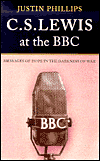
Book note: C.S. Lewis in a Time of War, by Justin Phillips
C.S. Lewis in a Time of War does have quite a bit about C.S. Lewis, particularly his broadcasting career, and it does keep coming back to him, but this is also - if not primarily - a history of the BBC, with an emphasis on its religious broadcasting. Which is not a bad thing. There is, for instance, an entire chapter on Dorothy Sayers and her battle to have The Man Born to Be King broadcast as she thought it ought to be broadcast. Sayers, in fact, shows up several places. There is quite a bit on how the founders of the BBC saw it largely as a medium to spread civilizing influences, particularly the Christian gospel. There is quite a bit on how the BBC coped with World War II, the hits it took, the moves it made to not only help insure its own survival but also to enhance national security. (Did you know, for instance, that it was decided to keep the news announcers few in number and have them state their names on air, so that the public would come to recognize each voice, so that enemy impostors - if any should manage to get on the air - would be instantly noticeable?) There is also some good, general recounting of life outside broadcasting during World War II. But the book by no means confines itself to the World War II years, either.
The author, Justin Phillips, was a journalist with the BBC for many years. He was also an elder at his church. According to the jacket copy, he'd completed the manuscript for this book when he died in 2000, but his daughter Laura Treneer oversaw the final editing and brought the book to publication.
Phillips makes a convincing argument that working with his editors at the BBC - learning to write for a radio audience with the help of good producers - turned C.S. Lewis into a better writer overall, and that the collaboration that went into the radio broadcasts strongly influenced Mere Christianity, and for the better. Certainly, that Lewis had ardent advocates of ecumenical Christianity at his back, trying to use his broadcasts to reinvent religious broadcasting, had to have made a difference.
At any rate, this book comes across as a labor of love, but not a puff piece. Phillips freely acknowledges that the BBC has made some serious missteps along the way, including in its relationships with both Lewis and Sayers. In that regard, this book also ranges into the "how to be a better manager" field, for anyone willing to take to heart the lessons of a bad example or two. (For example: Don't turn a prissy and territorial schoolmarm type assistant loose to correspond with anyone like Dorothy Sayers. You'll be hard pressed to pick up the pieces after the dust settles.)
Many books come across as something that someone else might have written had they only put their mind to it, but this one, I think, could not have been pulled off without Phillips, with his background, enthusiasm, and attention to detail. The chapters are well end-noted, for anyone wanting to dig deeper. For sources, he relied on not only written material, but archived audio, and interviews he conducted himself. It's a nice contribution overall to Lewis studies, but also gives a look at World War II from a fresh angle. On top of that, Phillips weaves in a bit of Christian apologetics of his own, building on what Lewis said in Mere Christianity and the broadcasts that preceded it.
On top of everything else, it shows how the BBC put itself on war footing for World War II, keeping national interests uppermost while fighting whatever looked like government encroachment upon its turf.
All in all, a nice behind-the-scenes look.

C. S. Lewis in a Time of War: The World War II Broadcasts That Riveted a Nation and Became the Classic Mere Christianity
One question, though. Does anyone know if that book is the same as the following? Or does it cover much the same ground in a different fashion? The former was published by HarperSanFrancisco earlier this year, and my copy says it's a first edition. I don't see any notice that it was previously published elsewhere. But the following, published a few years ago by Zondervan, certainly sounds like the same book?
C. S. Lewis at the BBC: Messages of Hope in the Darkness of War
Clicking on a book cover will take you to Barnes & Noble.
A reader writes...
...A friend just told me about a doctor in her town who had advised many women to abort their Down's children (including her, and her child ended up not having it) and then he had a grandchild with Down's. He wrote a public apology to all the women he'd counselled to have abortions!
Tuesday, August 08, 2006
Butterfly Central (for an afternoon)
It was especially nice because yesterday I came down with something, and was dragging when I set the sprinkler in place. It's amazing how much a little unexpected beauty and grace can bring into a person's day.
This morning we had a doozy of a thunderstorm, and then a lot of rain. And a power outage. The clouds also played at turning into mini-twisters, which wasn't particularly fun to watch. The weather has settled down some, but it's still a good day for non-electronic endeavors, at a guess. (She writes as the power dips and comes back, dips and comes back... Yikes.)
I am feeling some better today (she says with a yawn), but I think I'll spend most of my spare time dozing instead of blogging, thanks (she says with another yawn). Place nice until I come back, OK?
Saturday, August 05, 2006
Book note: Mama's Bank Account by Kathryn Forbes
"No Tears for Fidel, Please"
hat tip: Carol Platt Liebau
Update: Bill Steigerwald of the Pittsburgh Tribune-Review also has a look at "What Fidel's Cuba really is like."
The President's summer reading list, and books on polio
One of the books on the President's list, by the way, is one I have on my want-to-see list: Polio: An American Story, by David M. Oshinsky. (By the way, the paperback edition is due to be released the end of this month, and can be pre-ordered now.) Clicking on the book cover will take you to Barnes & Noble.

Polio: An American Story
While looking for that book to link to, I chanced across this one. Have you read it? It sounds good in the write-ups. It's aimed at ages 12 and up. The author is Peg Kehret.
Small Steps: The Year I Got Polio
In China...
Friday, August 04, 2006
Back when I was a kid...
YouTube: how it started, where it's at, where it might be headed
Book market watch: Handicrafts for the Handicapped, c. 1916
I've just done a cursory search, and find a few copies of a 1928 edition also for sale, for not quite as much money, but still quite, quite nice, thanks.
This is not to mention that it sounds like an interesting and possibly useful book.
Thursday, August 03, 2006
Killing boys to "prevent" autism, and attacking women for having disabled children
Can't argue with him there.
He provides links at the bottom of his commentary for further reading - like Confessions of a "Genetic Outlaw" by Elizabeth R. Schiltz, a mother who has been openly called irresponsible by people who resent that she knew she was going to have a child with Down Syndrome, but didn't have an abortion. She is kinder to the folks arrayed against her and her family than I'd be. I'd suggest you read her article whether or not you read Colson's. (It was published, believe it or not, at BusinessWeek, in the Technology section. Hey, I'm not arguing. Sometimes it's the folks who are all caught up in the excitement of technological breakthroughs who need most to stop and think about the implications of what they're doing, after all.)
New and old ways of looking at the world through the lens of economics

Knowledge and the Wealth of Nations: A Story of Economic Discovery
Nick Schulz, editor of TCS Daily, has an article at OpinionJournal regarding the above book and what it is about.
If you like reading about history and/or economics, you might want to take a peek into one of the many editions of the following book, now in its seventh edition. I've only seen the earliest editions, but they were more interesting and readable than I had expected in a textbook, or with something with the title "The Worldly Philosophers."
No, let me revise that. I have just taken the time to take down a copy of the third edition and read in it a while. This reminded me. This is not a book to "peek into" if that means you will read just parts of chapters. This author sometimes sets some things up to take down - piece by piece if necessary - later in the chapter. If you don't take chapters as a whole, you will be miseducating yourself, very likely.

The Worldly Philosophers: The Lives, Times And Ideas Of The Great Economic Thinkers
I didn't know about the book The Worldly Philosophers until I saw it listed as suggested reading to go along with the well-done course Legacies of Great Economists by Professor Timothy Taylor, available through The Teaching Company. I know "Legacies of Great Economists" sounds like it might be a specialist course, but it isn't. It provides a fair amount of general history, and explains some of the evolution of ideas that have been used and misused by policy makers through the ages.
For the fine print, I am an affiliate of Barnes & Noble, so if you click through on a book cover and buy something on that trip I get a few pennies as a commission. But I have no affiliation with The Teaching Company. I just found that particular course more informative than I'd expected.
Book note: Sheiks & Adders by Michael Innes
Along the way, though, I had come to avoid most of what he wrote as an older man. Some of his later books seem a bit bitter. So, I'm pleased to note that the latest book of his to cross my path, Sheiks & Adders, c. 1982, a book written when he was quite old, isn't bitter at all, but comes across as written by an old man who has decided to be indulgent toward the younger generations. It harks back to his early days, brimming with highly unlikely circumstances and strange characters getting embroiled in ridiculous (but dangerous) situations. If you don't go into it expecting a great mystery novel (it is, in fact, very vague on the mystery side of things, the mystery apparently being an excuse to get our hero out of the house and amongst strange happenings and in contact with people who need a dose of his wisdom), but merely want a light diversion with a bit of social commentary, it'll do. The opening is worrisome in that it makes it appear the book will be thick with the finer points of the history of language, but I assure you that doesn't happen. And, a plus: the Boy Scouts are allowed to make a few appearances and are even allowed to help our hero Sir John Appleby.
The book is still in print.

Sheiks and Adders
In fact, now that I take a look, I see that many of his books (he was prolific, no question) are back in print, thanks to House of Stratus. If you aren't familiar with his work, may I suggest you start with one of his earliest books?

The Secret Vanguard

Hamlet, Revenge!
...Oh, sure. Just my luck. One of my favorites, Lament for a Maker, seems to be, at present, out of print again. (Or maybe it is just temporarily out of stock at Barnes & Noble?) I'm not the only one who likes this one. I've seen it held up as one of the best-written mystery novels of all time. I'm not sure I'd go that far, but if you only read one book by this author, this would likely be a good one to pick.
Lament for a Maker: A Sir John Appleby Mystery
P.S. J.I.M. Stewart wrote a memoir, Myself and Michael Innes, but I can't say I'd recommend it, if for no other reason than I liked the author less after I read it. He comes across better in his fiction, I'd say.
Note to self...
Anyway, that's where I was much of yesterday. Fighting software battles. And staying offline until we had our ducks back in a row. Uffda.