Thursday, February 23, 2006
Harvard, Take Two
No, really.
Ruth R. Wisse, the Martin Peretz Professor of Yiddish Literature and professor of comparative literature at Harvard, has an interesting commentary in today's OpinionJournal. The title is Coup d'Ecole. The subhead is "Harvard professors oust Larry Summers. Now they must face their students."
Her description of this generation of students might surprise you, as might her ideas about which way things might be trending at Harvard. (She even expects the return of ROTC, for instance.)
Earlier somewhat-related post: A totally academic exercise
More on George Washington's refusal to be king, in name or otherwise
The article is packed with information on some of the difficulties the founders faced in setting up a brand new type of government, on Washington himself, and on how later Presidents were swayed by his example.
The Brussels Journal
“I believe in being free, acquiring knowledge, and telling the truth.”
The above quote from the legendary American journalist H.L. Mencken (1880-1956) sums it up pretty much. The Brussels Journal is a project set up by European journalists and writers to restore three values that are so lacking in the so-called “consensus-culture” of contemporary Europe: Freedom, the quest for Knowledge, and the Truth.
We defend freedom and, though we do not pretend to know the ultimate truth, we strive to acquire as much knowledge as possible by presenting facts and views that are hard to find in the “consensus-media” of Europe.
We are not an organisation; we are a coalition of individuals. Our contributors do not necessarily share every view represented in the articles of this website, but we know they all write with an earnest desire for the truth. What binds us is our defence of liberty and the conviction that the state exists to serve man and never the other way round.
Hat tip: johng
A totally academic exercise
Please understand that Knippenberg himself has no say in the selection either (and additionally feels that "Harvard as a whole is probably ungovernable"). He just didn't like that another website had asked for suggestions and there wasn't a conservative on their list, so he's just trying to open things up a little.
He gets the ball rolling with some suggestions of his own. For instance, Zell Miller. The reason he gives for this candidate?
Zell Miller knows a good bit about living in an institution with people who can’t stand him.
For another example:
Bill Kristol is a Harvard man; unfortunately, his experience in the White House probably doesn’t adequately prepare him for the Machiavellian nastiness of faculty politics.
I'm not sure I'll play, but I know a couple of you who are pretty good at this variety of zinger. Have fun. Please play nice, but have fun.
Update: James D. Miller is campaigning for the post over at TCS (aka Tech Central Station). See Hey, Harvard, Hire Me!
Theodore Roosevelt Trapped Last Tomcat for Navy
ABOARD USS THEODORE ROOSEVELT (NNS) -- A chapter in naval aviation history drew to a close Feb. 8 aboard USS Theodore Roosevelt (CVN 71) with the last recovery of an F-14 Tomcat from a combat mission.
Piloted by Capt. William G. Sizemore II, commander, Carrier Air Wing (CVW) 8, Fighter Squadron (VF) 213’s aircraft 204 was trapped at 12:35 a.m. and marked one of the final stages of the Navy’s transition from the F-14 to F/A-18 E/F Super Hornet.
“It’s the end of an era and it just kind of worked out that I was the last trap,” said Sizemore. “This is one of the best airplanes ever built, and it’s sad to see it go away. It’s just a beautiful airplane. It’s powerful, it has presence, and it just looks like the ultimate fighter.”
Lt. Bill Frank, a VF-31 pilot, also took part in the last mission, and is credited with being the last pilot to ever drop a bomb from an F-14 Tomcat.
“We were called on to drop, and that’s what we did,” said Frank. “It’s special and it’s something I can say I did, but what’s more important is the work of the Sailors who made it possible. They have worked so hard during this cruise to make every Tomcat operational.”
The decision to incorporate the Super Hornet and decommission the F-14 is mainly due to high amount of maintenance required to keep the Tomcats operational. On average, an F-14 requires nearly 50 maintenance hours for every flight hour, while the Super Hornet requires five to 10 maintenance hours for every flight hour.
[...snip...]
The F-14 entered operational service with Navy fighter squadrons VF-1 Wolfpack and VF-2 Bounty Hunters aboard USS Enterprise (CVN 65) in September 1974. The Tomcat’s purpose was to serve as a fighter interceptor, and it eventually replaced the F-4 Phantom II Fighter, which was phased out in 1986...
There's more.
Hat tip: Tomcat Says Goodbye to Combat at Scott's Conservative News & Commentary
More news about the USS Theodore Roosevelt (CVN 71) is available here.
Wednesday, February 22, 2006
Why India fell for the code of Wodehouse - Books - Times Online
...The apartment has a lingering odour of lunchtime curry. It’s a dashed rummy place to be talking about Bertie Wooster. I have come to explore the curious Indian obsession with P. G. Wodehouse.
Nearly 60 years after the nation’s British rulers packed their bags and legged it home, his books are on sale in most bookshops, sometimes nestling nervously between Jeanette Winterson and Virginia Woolf.
Wodehouse never wrote about India, but sells better on the subcontinent than in Britain, with pirated copies in common circulation. He is one of the most heavily requested authors at the British Library in Delhi and there are clubs and internet chatrooms devoted to him.
[...snip...]
...Thomas Abraham, is now president of Penguin Books India, the country’s largest Wodehouse publisher. “We’ve all grown up with Wodehouse,” he says. “It’s a phenomenon here. When one of his books goes out of print, everyone goes ballistic. My publishing counterparts in the UK are very amused.”
In a country where most books in English sell fewer than 1,000 copies and 5,000 constitutes a bestseller, the corduroy-suited Abraham estimates that his company sells up to 70,000 Wodehouses a year: part of a thriving “retro-market” that ranges from Agatha Christie to Modesty Blaise.
Most Wodehouses are bought by middle-class Indians whose public school-like “English-Medium” education arguably equips them to appreciate the author’s verbal virtuosity and literary allusions better than many Brits.
“Wodehouse’s appeal is a pure sense of linguistic delight,” says Abraham, who has read “about 82” of his 85 books. “In the 1980s there was a debate about whether he was ‘literary’ or not, but the fact is that the books are a great read, laughaloud funny.
“It’s a whole world of clean, wholesome, escapist fun and parents here like to hand it down to their children...
Read the whole McClarence article here.
And, yes, it did not escape me that this article says that another popular author over there is Agatha Christie. (That should give some elites over here the vapors, don't you think?)
European news round-up
EU ministers clash on media libel and defamation rules
Netherlands blasts Solana on alleged cartoon apologies
EU hopes for Turkey to build bridges in cartoon conflict
EU passes controversial data retention law
EU on brink of shoe war
New Europe keener to learn German than French
Reports on Mladic capture spark confusion
Iceland cool on EU membership
Exultet: My kind of guy
Words on the tip of my tongue...
1.What is the name of a pole that sticks out on the front of a barn (often/sometimes/always? with a winch attached) and is used for loading hay into the loft? Hay winch doesn't sound quite right. Or does it? I know this is likely to be the sort of thing prone to regionalism, but that's OK; I'd be happy to hear what you call it in your neck of the woods. What do you call it?
2. What do you call the hairstyle that Cindy Swanson and her sisters call a cricket? I used to wear my hair like this a lot, but my memory isn't dredging up what we called it. One of Cindy's illustrations shows a young ballerina; does the dancing world have a special name for this hairstyle? What do you call it?
Nice comeback...
...For a long time there was an attitude that novels of mystery and suspense were unvalued stepchildren in the literary world. Only fifteen years ago, on a national television program, I was asked if I ever hoped to write a "good" book someday, one that wasn't in the suspense genre? I replied that I had no idea about my own work, but a few mystery/suspense stories were hanging in there. For example, Oepidus Rex, Hamlet and MacBeth.
Fortunately, that kind of question isn't asked too often anymore...
Weapons Cache Databank
So you want to discuss movies and theology at the same time?
Meanwhile, over at The Book Den, Denny Hartford has Cracking the Cinematic Da Vinci Code.
Tuesday, February 21, 2006
States Curbing Right to Seize Private Homes - New York Times
Not everyone wants limits, of course. Broder writes:
The National League of Cities, which supports the use of eminent domain as what it calls a necessary tool of urban development, has identified the issue as the most crucial facing local governments this year. The league has called upon mayors and other local officials to lobby Congress and state legislators to try to stop the avalanche of bills to limit the power of government to take private property for presumed public good.
But, then again:
Seldom has a Supreme Court decision sparked such an immediate legislative reaction, and one that scrambles the usual partisan lines. Condemnation of the ruling came from black lawmakers representing distressed urban districts, from suburbanites and from Western property-rights absolutists who rarely see eye to eye on anything. Lawmakers from Maine to California have introduced dozens of bills in reaction to the ruling, most of them saying that government should never seize private homes or businesses solely to benefit a private developer.
The Supreme Court seemed to invite such a response in its narrowly written ruling in the case, Kelo v. City of New London. Justice John Paul Stevens, writing for the majority, expressed sympathy for the displaced homeowners and said that the "necessity and wisdom" of the use of eminent domain were issues of legitimate debate. And, he added, "We emphasize that nothing in our opinion precludes any state from placing further restrictions on its exercise of the takings power."
Full article.
Oregon high court upholds property rights law, Washingtonians encouraged
Some of our neighbors to the north are also poised to take on overreaching government regulation: Washington next in property rights wars.
The battle continues, but citizens wrested some of their own land back from heavy-handed regulators today. Well, as it happens, we did our bit in 2004 when we passed Ballot Measure 37 (2004). It's taken until now for the high court to toss out a bid to block the measure -- and declare it constitutional. (Ruling here.)
Addition: Via How Appealing, here's an article by Laura Oppenheimer of the Oregonian, while Peter Wong of the Statesman Journal has "Reaction to Measure 37 Mixed", and here's an Associated Press article by Brad Cain.
Why Growth Is Good - Books & Culture
Elzinga is calling it "an important book on an important subject" and is predicting it will be widely read. I'm relatively sure the "widely read" part is relatively speaking. On the other hand, if, by any chance, it starts becoming an influential book, don't say I didn't give you a heads up ;-).
To go to Barnes & Noble for more information and reviews (or to order, of course), click the book cover.

Moral Consequences of Economic Growth
Monday, February 20, 2006
Semicolon: Louis L'Amour's Bookshelves
Sherry says she'll be doing several posts about Louis L'Amour's memoir Education of a Wandering Man over the next few days, having found it "eminently quotable".
Chicken Spaghetti: 2nd Carnival of Children's Literature Announcement. NEW DATE.
Wittingshire: Our Children's Favorite Books
As for her note on the Hank the Cowdog series...
Erickson, Hank the Cowdog series. These are very clever, with lots of fun word play and tangled idioms--sometimes when we read these aloud Jonathan and I are choking with laughter, and the kids have no clue why.
... I would add that it's been my experience in our bookstore that kids might enjoy these books, sometimes very much, but it's generally the parents who insist they must have every one in the series ;-). So Amanda and Jonathan are in good company, believe me. The audiobook versions have also been popular around here. For whatever reason, the Hank the Cowdog books aren't especially my cup of tea -- but there's no getting around the fact that people who like them tend to have Great Fun with them.
P.S. My husband does the book ordering these days, so I just went and asked him whether we were still getting much call for Hank the Cowdog books. His reply was essentially, "Oh, yes! Both locals and tourists." He added that one local family recently stocked up on the audiobooks for a several week long trip to Louisiana and back. I bet that was some wild trip :-).
P.P.S. Yes, dear regular reader, you read that right. My husband, who gave us all such a scare not that long ago, is well enough he's overseeing book orders again, not to mention other day-to-day business matters. We have to dodge yards and yards of tubing from his oxygen concentrator, but that's nothing. He's still not up to where he'd like to be but, on the other hand, compared to what most of the medical professionals told us to expect he's doing rather well, thanks. (Knock wood.)
P.P.P.S. Amanda's kids are between seven and eleven years old. If you have any book recommendations for that age range, drop a note in comments here, please.
Kids in the House - Office of the Clerk, U.S. House of Representatives
Happy Washington's Birthday, Take Two
As it says at Kids in the House: Inspect-A-Law: Federal Holidays:
By law, Congress has established 11 permanent Federal holidays. Each Federal holiday emphasizes a particular aspect of the American heritage that molded the United States as a people and a nation. Although these patriotic celebrations are frequently referred to as "national holidays," legally they are only applicable to Federal employees and the District of Columbia. Neither Congress nor the President has asserted the authority to declare a "national holiday" that would be binding on the 50 states. Each state individually decides what its legal holidays will be. This is an example of federalism in action.
And here in Oregon the Blue Book put out by the Secretary of State, under Legal Holidays and Days of Special Observance, has today as President's Day.
Rats. I am usually a big fan of federalism.
And, for that matter, I wouldn't want the federal government taking over anything more than it has already, thanks. I like that states have some leeway to go their own directions. I like that states are in a position to compete for citizens as well as businesses. (I don't mind telling you that I like the idea that there are states to which I can move if it gets too crazy or ugly or expensive around here.)
So, Happy Washington's Birthday! to federal employees, the good folks of the District of Columbia, and all you living in states that haven't gone mushy and postmodern about it.
Happy Washington's Birthday!
I've been a fool. A sucker! I've fallen for a propaganda campaign. I have my ideas about who is behind the push to lump all the Presidents together and not look at any one of them too closely, but at the moment I don't care to spend my time thinking about them.
As Matthew Spalding points out It’s Still George Washington’s Birthday (Not President’s Day).
No, really. See 2006 Federal Holidays.
Happy Washington's Birthday!
Update: See Happy Washington's Birthday, Take Two for a clarification/correction.
Saturday, February 18, 2006
Children with extra challenges, and the parents who love them
And then, two babies later (first our Rose, then bouncing Beanie), I gave birth to a little boy, and he wasn’t healthy. He was, to put it bluntly, rather a mess. Thus began the next chapter of the lesson that started during the long months of Jane’s illness. Being entrusted with the care of a child who is not physically perfect can be yes, painful and scary, but also one of the sweetest, most rewarding experiences a person can have. Do you know how much they teach us, these small, brave, persevering persons? I hadn’t begun to grasp the meaning of that whole "Count it all joy" business in the book of James until I met these children. Now I get it, or at least I get a glimpse of it. There is immeasurable joy not just in the overcoming of trial, but even—I know it sounds implausible, but it’s true—in the trial itself.
Patience, cheerfulness, courage, determination, persistence—these virtues which require such effort in me are a matter of course for this boy of mine. And so it was for his oldest sister, when she was in the thick of her ordeal. If we learn by example, then I have surely learned a great deal from my children.
Headmistress keeps running into people who look at her brain-damaged daughter and say, "I wouldn't want to live like that." As she explains in Why We Fight, "That is irrelevant to any discussion of the ethical treatment of human beings who already do live 'like that.' " She also talks about the joy of having a child "who has so little, but loves so much."
Mark and Amanda Correa had their firstborn a couple of weeks ago, more or less, and next thing they knew Nathaniel was flown off for specialized care and drastic heart surgery. Mark had set up a blog to record the ups and downs of impending fatherhood and the baby's first year, but he had no idea he'd be up against this. But he's been nothing but amazed at how Nathaniel has held on and rallied. I love this bit, from Surgery success!:
Nathaniel is out of the operating room. He's heavily sedated right now in order to keep his heart from having to do much work. He's got tubes into his chest cavity, tubes directly into his heart, tubes into his lungs, etc. As much work as possible is being done for him.
All things considered, he looks fantastic. I've never been happier to see a drooling, knocked out baby in my life.
The Correas are in a different boat than Melissa and Headmistress, because there's a good chance that now that he's had heart surgery, Nathaniel will be healthy and indistinguishable from the average kid who doesn't make such a dramatic entrance. But his parents show the same joy and devotion as the others, and the same acceptance of the difficulties along with the perks. (On the other hand, Mark is afraid they're going to drop from exhaustion, especially his wife, before they get the hang of taking care of Nathaniel without the help of hospital staff. A little encouragement from you experienced parents might be nice...)
And then there's Barbara Curtis, who blogs at Mommy Life, who says in her sidebar "I'm a mother of 12 who lived to write about it!" Several of her children, biological and adopted, have Down Syndrome, and she writes wonderfully about the experience of being their Mom. She's got those posts filed here. From this one:
In this society, for a parent without one to see something positive in a child with Down syndrome requires a paradigm shift, I know. But if my counterculture years taught me anything, it was to question prevailing attitudes. I’d really never liked the dread surrounding Down syndrome, clouding the horizon for still-waiting-for-test-results expectant parents.
On the Internet in recent years I’ve “met” a few who’ve received the dreaded news, then logged onto Down syndrome newsgroups, trying to pick up the pieces. Often they describe pressure from geneticists and doctors to terminate the pregnancy and “try again.” These professionals are quick to point out the burdens of having a child with Trisomy 21 – possible medical problems, heavier emotional demands, a child who is “less than.”
But then on the Internet, or face-to-face in their own home towns, they meet the real professionals – parents involved with Down syndrome on a daily basis, in much better position to comment on the so-called “quality of life” issues. Always there is an outpouring of loving response, personal variations on Emily Kingsley’s theme in her famous essay, “Welcome to Holland”: So you planned to go to Italy and landed in unexpected territory. At first you’re disappointed. Then you notice the windmills and the tulips – beauty you never expected to find. You discover it’s not a bad place after all.
Hooray for the Internet. When so many in the medical community seem intent on culling babies that don't meet their own quality control guidelines, how nice it is that there's somewhere anyone can go to meet parents who have learned that perfection isn't a prerequisite for joy.
The Scrutineer is not amused by (yet another) London Stock Exchange takeover bid
The latest glare of disapproval, Australian chutzpah would be admirable if it were not so risible, opens with:
IT'S amazing that Macquarie Bank, would-be acquirer of the London Stock Exchange, wants to play out this sad little takeover farce to the very end.
...goes on midway through to say:
It is like offering someone a buoy when they are actually water-skiing with a smile.
...and ends with (emphasis mine):
But, even if the amount had remained at roughly half this level, shareholders should reject a bid short on logic, strapped for cash, creating a hostage to fortune because of its highly leveraged nature, and now not even very entertaining.
To be honest, I haven't been following the London-Stock-Exchange-up-for-grabs story (which seems to me to have been going on forever). The last time I heard, months and months ago I think it was, I seem to remember that some German outfit had thought it was poised to take it over.
(Pause while your hostess searches. Ah, here we go, and that information came from another Martin Flanagan Scrutineer volley, back in May. According to Flanagan, a failed bid for the London Stock Exchange by the head of the Frankfurt stock exchange -- who had made his first moves toward getting some control of London markets back in 1998 -- left another European player, a "Paris-to-Brussels bourse in prime position to try and circumvent the regulators.")
I'm having trouble getting comfortable with just the idea of allowing foreign control of a stock exchange. I'm not sure it falls under the same potential danger listing as foreign management of a nation's ports, but I have to admit it doesn't strike me at first glance as a necessarily good idea. But what do I know? (Not much on this particular subject, believe me. I'm just saying what my gut says.)
If anybody knows more about the whole swirl going on around the London Stock Exchange right now, feel free to weigh in. A little reassurance would be nice, but I'd settle for a more informed understanding regardless of the direction.
Friday, February 17, 2006
City Journal Winter 2006 | New Philanthropists Talk Left, Act Right by Howard Husock
Twopenn'orth
I haven't found that particular phrase in it. But now I do know that there's an equivalent phrase. I quote:
* add/put in one's twopenn'orth informal to have one's say; to make one's contribution to a discussion, etc. [contraction of twopenny worth]
Hmmm. So did the Brits get their saying from us, or did we get our saying from them, I wonder?
Time flies: Or, Welcome to Year Two
I've tried to write a substantial, reflective post in honor of making it to the one year mark, but so far most of my attempts have sounded like the very worst sort of Academy Award acceptance speech, and the others didn't strike me as better.
So I'll content myself, for now, with this post, with saying Thank You to my readers. Thank you for your links, your comments, your help when I needed it.
And thank you Google, for opening up a whole new world for me, and giving us little guys a chance to put our two cents in.
Thursday, February 16, 2006
Fighting cybercons
As scams go, this one is particularly clunky. The English stinks. The proposal stinks worse. I'm an Anglophile of sorts, so I take this affront against the UK semi-personally. And even if I weren't fond of England I like to think I know the indecency of using terrorist attacks for fun and profit.
Luckily for us -- and I hope unluckily for the underhanded, shameless criminal who cooked up this scheme -- we know where to report stuff like this.
Cafe Hayek: Flat or Rising or Both
These posts will look at inaccurate or misleading charts, graphs or pictures.
For instance, Russell Roberts points out that the chart with a Washington Post first page story on energy conservation efforts in Japan claims to show that "Japan's oil consumption has remained steady since 1975, while U.S. consumption has risen steadily." The problem is that the figures show that Japanese oil consumption rose 21 percent between 1975 and 2004, while U.S. consumption rose 26 percent. (Hardly flat versus steady rising.)
History snippets with your seeds
At any rate, I'm having fun reading in the Seed Savers 2006 Catalog, which features the old-timey flowers I favor, and an astonishing array of vegetables (not to mention books and gifts).
Sometimes, you get a bit of lore with your sales pitch. For instance, in the write-up for Nigra Hollyhock:
Alcea rosea Grown by Thomas Jefferson at Monticello, but mentioned even earlier by John Parkinson in 1629, who described this single hollyhock as being "of a darke red like blackblood." Appears black on overcast days, but will have a hint of red in the bright sun. Plant next to a white fence for a spectacular contrast. Self-seeding biennial, 5-6' tall.
Or, for Outhouse Hollyhock:
Alcea rosea This classic variety has graced outbuildings on Iowa farmsteads for over a century. A favorite at Heritage Farm. Single blooms of white, light pink, pinkish-red, magenta and burgundy. Years ago, refined ladies just looked for the hollyhocks and didn't have to ask where the outhouse was. Blooms the second year in the North of first year in more moderate, long-seasoned climates. Self-seeding biennial, 6-9' tall....
German court shoots down shoot-down law
Strangely enough, in this report from Deutsche Welle it's the court's finding that the law didn't protect human dignity enough that seems to have emphasis. I'd have stressed the lives of the civilians on the planes above their dignity. But what do I know?
The article says the law prompted heated debate over whether the government ever has the right to kill citizens to save the lives of other citizens. Well, yes, you don't want the government treating innocent civilian lives like weights and measures if you can help it. I do see that.
The pilots' union also fought the law, on the grounds that people not on the plane couldn't know what the situation was on that plane, and therefore people on the ground might make a tragic mistake. I rarely agree with unions, but I concede they probably have a point here.
That I have a relative who is an airline pilot might possibly have a wee bit of influence on my thinking, but, hey, now that passengers and crew of airlines know that they can and should fight back, and now that there are changes making it harder for bad guys to actually gain control of a plane -- or retain control once they've grabbed it -- shouldn't we take that into consideration? And, yes, I know that now that commercial flights are better protected, the next attack might more likely be made with a private plane instead of an airliner. That's trickier, certainly, because a private pilot hasn't the same resources for fighting back. And it is perhaps more likely that no innocents might be on the plane at all; that it might be flown by a thief instead of a hijacker...
All in all, I'm not sure we ought to take the option off the table entirely. If you've got a stolen plane with one person aboard where it ought not be, and you can shoot it down over a field instead of a city, it might make sense. For that matter, if there's more than one person aboard, but they seem to be together...
Yikes, I hate the idea. But we have the example of field crashes versus building crashes, and we know which we see as better.
Plus, if terrorists know their chance of actually making it to their target is close to nil, I like to think they'd be inclined to explore other options.
I also have to hope that private pilots these days understand that there's a huge risk to flying planes where other people tell you to, so are taking precautions on the ground to prevent personally becoming an easy target for hijackers. (After all, it's rare in history where society has been so civilized that a person could get away with not being wary, and ready to fight for his life at the drop of a hat. We might have become spoiled, but I'm sure it's not bred out of us entirely already.)
Then again, I don't want to fall into that old 'the ends justify the means' thinking.
Sigh.
I guess this falls more or less under "gee, I'm glad the final decision isn't up to me." I'm not feeling up to the task. It feels like 'darned if you do, and darned if you don't' to me.
Certainly, I have mixed feelings about the court's ruling. However they meant it, I'm afraid it will reinforce the idea that seems to be in some minds that 'the West' rests too much on formality, and is ripe for destruction.
I'd rather that people who hate everybody but themselves realized, without much doubt, that fighting the civilized world is way more trouble than it's worth and they're just throwing resources away if they try.
Wednesday, February 15, 2006
Self-serving plug...
Mere Comments: Opening the Mind
...and wishing to get off the phone, because it was suppertime, of course: "You have a man who advocates infanticide occupying an endowed chair of bioethics -- and you invited him to assume that chair precisely because of those opinions."
The reply, not at all defensive, was priceless. With a smug lilt in the voice, and the deep ineducability that comes from being told, for years, that you are better and smarter than silly people who think, for example, that killing your month-old child is a reversion to barbarism, "Princeton likes to encourage the airing of all opinions."
I answered immediately that that simply was not true. If I were a young untenured professor at Princeton, and I spoke as frankly as I do in class at Providence College, they would boot me out the door -- though more probably the Bible-believing Roman Catholic doesn't get in the door in the first place. Back in the days when I attended (when Princeton did not have Touchstone's own redoubtable Robert George), diversity of opinion was merely forty shades of red. With that, the conversation was over.
But when I thought about it later I saw that I hadn't given the best answer. Princetonians do not have open minds about embezzlement, wife-beating, child abuse, or treason (well, not about the first three, anyway), nor should they. If you have an open mind about cruelty, that is a sign of your moral corruption. That Peter Singer has an open mind about killing your "defective" child after a few weeks' trial run -- after you've decided that, alas, the yoke of care is heavier than you had supposed, so that you just have no choice but to let little Tim go, probably with a lot of nice flowers and a word of consolation from a minister of the First United Church of Moloch, may he bless us every one -- says little about infanticide and a lot about Singer, and about Princeton.
Yet even that is not the best answer. The purpose of an open mind, says Chesterton, is to shut it on something true...
[...snip...]
...It is in the quest for knowledge as it is in matters of love: just as no one can wholly love another who keeps an escape hatch open, who considers it possible that not-loving might be a better option, so the relativist or the indifferentist keeps all doors open by neglecting to enter any of them. He prides himself on a radical opennness which is really refusal and timidity...
Full post.
BreakPoint | Fountain of Life

Radical Gratitude: Discovering Joy Through Everyday Thankfulness
Note: This isn't the only book in print right now with the title Radical Gratitude, so if you're ordering a copy from somewhere (through the link here would be nice, of course, but we're still friends if you buy elsewhere), be sure to make sure you have the one you want. For that matter, since titles are generally not protected by copyright, it's always a good idea to doublecheck that you have the right author, on any order, because some titles get used many times over, both accidentally and on purpose.
Wired 14.02: The Teardown Artists
(Closed circuit for Matthew. This might be fun for your engineering club. My understanding it that you guys probably call it reverse engineering...)
hat tip: Totem to Temple
Father Jonathan sends both Intelligent Design and Neo-Darwinism "down the hall"
A money passage or two, necessarily long for context:
But they missed the point, and this guy in a collar who you’re reading is the proof of their folly. How’s that? Because regardless of Judge John Jones’ inadequate rationale as expressed in his judicial decision, I actually agree with him that ID should not be taught as modern science.
Before you throw the Good Book at me, let’s agree on what we mean by modern science and what we mean by intelligent design. Unlike thinkers of ages past, who intertwined gracefully some elements of philosophy with the natural sciences, today we prefer — for reasons of method — to separate one from the other. In these categories, the competence of modern science accepts only what we can observe and measure (empirical evidence). Questions like, “What’s the essence of it?” and “What’s it for?” are sent down the hall to the philosophy department. And that’s fair.
Intelligent design theory asks just that type of “down the hall” question. Its proponents claim that a good scientist can’t look at the complexity of the human eye without asking himself, “How did that happen?,” and responding with the answer, “I don’t know, but I do know that it didn’t just happen; there must be intelligence behind that design.” The affirmation is quite logical, but the evidence would be philosophical, not empirical, and for that reason it belongs down the hall.
You would think this reasonable principle would be valid for everyone. Not so. Judge Jones wrote that ID was “a religious alternative masquerading as a scientific theory.” An alternative to what? Ask your children or grandchildren what they are taught in their public school about the origin of human beings. They may say “evolution,” but it’s more than that. They are being taught a very unscientific theory called Neo-Darwinism, the belief that there is NO purpose or intelligence behind life forms, that it’s all random. Where’s the empirical evidence for that? As a matter of fact, it’s impossible to prove, either scientifically or otherwise. It too should go down the hall.
"Father, are you saying that evolution is not true?" Nope. I’m saying that mainstream, atheistic, Neo-Darwinism is bad science because it isn’t science. No reasonable person denies that life forms can evolve, but it’s quite different to say that through purely random natural selection one species evolves into another to the point of reaching human intelligence.
[...snip...]
I don’t want to end without clarifying that I do believe in intelligent design when it’s taught in the right place and in the right way. In fact, teaching it to our children as a philosophical (not just religious) theory is a sign of common sense and open-mindedness. Isn’t the whole of reality a little bigger than science? The problem is that in most public schools the “philosophy department down the hall” doesn’t really exist.
Given the state of things, maybe that’s all right. After all, who do you want to teach your kids about something as important as their origin and purpose? That’s your job. Thanks for allowing me to help.
Did I help? Let me know.
For his full post and e-mail address go here.
Tuesday, February 14, 2006
Bald eagle comeback recognized
I lift my cup of tea, and make a toast, "Well done!." I love watching eagles, all types, but baldies especially. I'm glad they're doing so well.
On a side note, I have a wee bit of trouble with the way threatened and endangered species are counted. Since wildlife has a tendency to elude wildlife watchers, you can only get an estimate. Indeed, the government only lists its figures as estimates. But surely I'm not the only one who found the 1963 "estimate" of 417 pairs in the lower 48 states suspiciously low (especially since it seemed like there were quite a few folks with a huge stake in getting the public to think that the birds were doomed without drastic government action, including raids on property rights). And surely I'm not the only one who reads this in the Weiss article...
Today the number of breeding pairs is estimated at 7,066, with the birds thriving in 49 states including Alaska, the one state in which they were never listed as threatened. (Bald eagles are not indigenous to Hawaii.)
...and finds an "estimate" of 7,066 worth a shake of the head.
And does anybody really think that there is any way whatsoever to even guess with any hope of accuracy how many bald eagles there were in this part of the world "[w]hen the first Europeans arrived in North America"? Really? One hundred thousand breeding pairs, you say? I suppose the natives, all tribes everywhere, sent bird tally teams out, and put the numbers down in logbooks? Don't get me wrong, I feel people are free to guess all they want to. I just hate for policy to be built on their guesses, which are built on necessarily shaky foundations, that's all.
Well, no matter. At least enough authorized modern birdwatchers have found enough birds to reassure the folks who prefer to fear the worst, and, finally, maybe, just maybe, the eagles will be moved off the threatened list. There will still be safeguards in place, mind you. As Weiss reports, they're still covered under the Migratory Bird Treaty Act and the Bald and Golden Eagle Protection Act, for instance, not to mention more general laws, and to appease environmental groups the feds are working on clearing up their defintions of what constitutes "disturbing" eagles.
As strictly anecdotal evidence, some winters we see more bald eagles than others, but the local trend has been upward. Around here it's not all that unusual to see more than twenty of them on one drive between here and the next town over. I don't know if our population gets included in that surprisingly precise estimate of 7,066 breeding pairs (for that matter, not all of ours appear to be paired off yet), but I'm sure we're doing our bit in preserving the species. I haven't wanted to mention that before this, for fear of bringing headaches and government inspectors down on the heads of people who have been quietly providing good habitat.
I hope I'm not jumping the gun too much mentioning it now. It would be just my luck that this rash of articles today (several news sites have articles on this) is an underhanded attempt to flush out folks like me. (Stage setting: melodrama. Characters: gleamy-eyed men in black capes and with handlebar mustaches which they twirl for dramatic effect. Heh -- the government bureaucrat says -- another spot that people have been harboring unknown birds! Hand me that book of regulations and let us be off!)
And, yes, I'm joking. Kind of.
New -- The Carnival of Blue Stars
...wives, husbands, mothers, fathers, aunts, uncles, cousins, neighbors, friends of our service men and women. If you care about our Soldiers, you are qualified to submit an entry to the Carnival of Blue Stars.
The first one was Sunday, February 12.
Monday, February 13, 2006
Here in the Bonny Glen presents the First Carnival of Children's Literature
Saturday, February 11, 2006
Notes in the Key of Life: Reading Mary Stewart

Airs above the Ground
Open letter to NBC Sports
It was bad enough that certain members of the United States squad of Olympic athletes chose to behave like jerks during the parade of nations in the opening ceremonies. Did you really need to encourage them by keeping your cameras on them, not to mention rewarding them with air time?
Just asking.
With disappointment,
Kathryn Judson
Friday, February 10, 2006
Market Watch: Historical romances by Mary Ann Gibbs
Then I ran across a copy of The Moon in a Bucket by Mary Ann Gibbs, a Victorian romance published by Beagle. Beagle books are somewhat more likely than Harlequin to go up in price over the years (from relative scarcity, among other things) -- but between the time I started checking prices at various sites and then headed back to the main site I use to determine pricing, a $14 copy of this title had sold at that first site. That was the least expensive copy going. This is above the usual price range for this type of book, even from Beagle. And somebody bought the book, so the prices apparently aren't just wishful thinking on the part of the sellers.
This, mind you, is a 182-page genre romance novel, in mass market paperback.
The back cover copy includes this (ellipsis in original):
To love Vincent meant exchanging her luxurious world for a life which horrified her family and her suitor, Roger Herrington. Could she do it -- and would they let her...?
Deborah is all of eighteen. Vincent is an actor. Oh, my. But, anyway, you get the picture of what sort of book this is. And, spoiler alert!, never fear, for dear, self-sacrificing Roger comes through gallantly in the end and the noble-in-his-own-way actor rides away over the horizon, proud of himself for not dragging the dear child down to his level. (I know that because I just cheated and peeked at the last pages). Hooray, it doesn't appear to be an 'idiotic girl tosses her life away for a ruffian who will make a lousy husband if he even bothers to stick around' book, in other words. (I'm rather tired of those, aren't you?)
So I go looking for more books by Mary Ann Gibbs, and find that some are plentiful and inexpensive -- but some of her historical romances are running ten to twenty bucks and up for starting prices. Hello.
And, no, I don't want to think how many of these I've sold in the last few years for a buck or a buck and a half or two bucks each.
(You have to learn to laugh at yourself in the used book business. And you get a lot of practice at it, believe me.)
Elephants in Academia: How do I love having John Bolton as President of the Security Council?
Detective story send-up disguised as a children's book
This is a send-up of classic detective fiction, front to finish. Poe, Conan Doyle, Christie, etc. -- nobody gets a pass, as far as I can see. Conventions are skewered, stereotypes are trotted out for a giggle.
So, I've read a fair number of mystery stories, and I watched Upstairs, Downstairs on television. I understand what this book is poking fun at, or at least some of what this book is poking fun at. (I concede I might have missed an inside joke or two.) But I have to wonder what a kid would think of the book? There's plenty of room to read it with a great deal of drama, so I think it could be a fun read-aloud book. And there is a puzzle -- a crime -- to be solved, told in such a way that even a moderately young child stands a chance of seeing the ending coming. But I can't shake the idea that this book might be more fun for the grown-up detective fiction fan doing the reading than for the child hearing it. (Boy: Why are you laughing, Mommy? Mother: You'll understand after you read about five Sherlock Holmes books, my son, and two or three with Hercule Poirot...)
At any rate, I don't know what I expected, but what I found was a fairly cute send-up of detective fiction. For what it's worth.
My copy has a 1987 copyright. I see that the edition for sale new at Barnes & Noble has a 1992 publication date. The cover looks the same, so I'm guessing it's just a later press run.

Piggins
Thursday, February 09, 2006
What's wrong with these pictures? :: ProLifeBlogs
Having said that, if I ran a newspaper and someone brought these ads in and wanted to run them, I'm almost certain I'd have taken the money and I'd have run them. And since I have a blog, which I am free to run my way (at least under current conditions), I am happily linking to the rejected ads, for free, just to help the would-be advertisers get their views out. (So there ;-).
A Thumbs Up for Curious George the Movie
GM's Corner -- Newest member of the team
His introduction is here. (I wouldn't skip this. Where else can you find someone who describes himself, among other things, as a "...minarchist small L libertarian with Objectivist tendencies. I believe strongly in small government, individual merit and self-reliance. I am a laissez-faire capitalist and an atheist. I am not, however, a militant atheist...")
And yes, that is not a profile that you might expect for someone writing at GM's Corner, but Woody (G.M.'s longtime co-contributor) says "...G.M. and I recognized Liberty Dog's talent and ideas several months ago and think that you might appreciate the offering of a similar, but sometimes different, viewpoint--which remains always courteous..."
Liberty Dog's first post is Liberals Tolerate Liberals--and, That's About All.
It's shaping up into a very interesting group running that blog.
Fight on, G.M.! Your buddies are good but it will be nice to have you back in the game.
Wednesday, February 08, 2006
Two updates on Haleigh Poutre's case
So is some of the background that is now coming out. Her mother, Allison Avrett, is now saying that... Well, read for yourself: Biological mother seeks role in deciding care of brain-injured girl - Boston.com, by Mark Pratt, Associated Press Writer, February 8, 2006. Read the whole thing.
For more background, see Mass. Asked to Take Girl Off Life Support, by Adam Gorlick, Associated Press Writer, February 7, 2006.
My thanks, by the way, to AP for its coverage of this case. My thanks, too, to The Boston Globe and The Republican of Springfield for going after documents and digging on this.
BreakPoint | Park Rangers and Pilgrims
In 1989, the builders of a tea garden in a San Francisco park inadvertently left a parking barrier behind. Four years of complaints yielded zero efforts to remove the eyesore. Then—and I’m not making this up—a group of New Agers began to venerate the barrier as “a manifestation of the Hindi god, Shiva.”
Quicker than you can say “wall of separation,” park rangers hastened to remove the now-sacred eyesore. While the barrier’s worshippers eventually got to keep the object of their veneration, officials insisted that their worship be in private.
It’s hard to imagine a better example of the tortured relationship between religion and public life. Fortunately, however, there’s a new book that offers a possible way out of the mess we have created...
Full commentary (Contains "further reading and information" links.)
For more information on the book from Barnes & Noble, click on the book cover below.

Right to Be Wrong: Ending the Culture War Over Religion in America
Author spotlight: Melissa Wiley
Melissa Wiley, hostess of the blog Here in the Bonny Glen, has written some of them. Her author page is here. Her books include (among others):

Across the Puddingstone Dam (Little House Series: The Charlotte Years)

The Little House in the Highlands: (Little House Series: The Martha Years)

Little House by Boston Bay

Beyond the Heather Hills: The Martha Years (The Little House Series)

Down to the Bonny Glen
Tuesday, February 07, 2006
Zagreb coming and going
In addition to the priceless narrative by the incomparable Archie (can you tell I'm a fan?), and the sometimes wild plot twists (which I won't mention, so as to not spoil your fun if you read the book), what struck me about this book is that the author painted such a clear picture of Europe in trouble, and put in his two cents' worth about useful idiots running around doing stupid things and thinking they were making history. It lies underneath the plot, but it's there all the same, functioning, I think, as both a call for sanity in insane times and a warning or reminder that ruthless people bent on their own goals exist and must be dealt with.

Over My Dead Body
Rex Stout, for that matter, was a crusader against Nazis both in fiction and in real life, and he got in a few salvos in this book, again without burying the story in messages.
But here's the funny part. This book features a couple of characters who have come to America from Zagreb, Yugoslavia. Part of the story hinges on Nero Wolfe having been there in his younger days.
So, last night, after work was done and just before going to bed I finally finished watching
I don't know about you, but this is not a city that comes to my mind very often, if ever. And there it was, starting my day and ending it, too. These days, I might mention, it has become Zagreb, Croatia.
Fiddler on the Roof, I might add, is one of those movies that makes clear how much I've changed over the years. I'm sure when I watched it when I was young that I picked up on different things, cheered where I don't cheer now, liked different characters and for different reasons. And, doggone it, how did the daughters get younger with the passage of time? I look at them now and think how incredibly young they look. I'm sure that when I was more or less their age, they looked all grown up. (Sigh.)
Here in the Bonny Glen's Carnival of Children's Literature
At any rate, I'm looking forward to reading the entries in the first Carnival of Children's Literature, coming February 13, hosted by Here in the Bonny Glen. The deadline for entries is 6 p.m. on Saturday, Feb. 11.
hat tip: Semicolon
Monday, February 06, 2006
We're discussing not-too-dry history books...
I hate a history that is merely dates, places, battles, and names. I want to know about the people who made things happen, the people who stand in the shadows...
Just off the top of my head (and glancing at my bookshelves), in no particular order, I'm going to suggest a look at Brunelleschi's Dome by Ross King, Shrinking the Cat by Sue Hubbell (history as well as science), Names Through the Ages by Teresa Norman (which has history as well as names, and is great geek fun, in my geeky opinion), Power With Grace by Ishbel Ross (a biography of Mrs. Woodrow Wilson), Hard Bargain by Robert Shogan (FDR and Churchill), John Adams by David McCullough, The Path Between the Seas by David McCullough, (OK, practically anything by David McCullough), Washington Goes to War by David Brinkley, Spies of the Revolution by Katherine and John Bakeless, and New Land, New Lives: Scandinavian Immigrants to the Pacific Northwest by Janet E. Rasmussen (oral histories).
Another regional book with a narrower focus, which is sometimes dry facts and sometimes full of hilarious or odd happenings, is Cornerstone: The formative years of St. Vincent -- Oregon's first hospital by Ellis Lucia. It also has some great old photos, if you like that sort of thing.
For a really geeky entry, there's One Good Turn: A Natural History of the Screwdriver and the Screw, by Witold Rybczynski. Hey, don't laugh. This is about a tool that changed civilization, and its history encompasses more than you might think.
In the same vein, there's The Evolution of Useful Things by Henry Petroski and The Pencil: A History of Design and Circumstance, by the same author. I've long since sold my copies of those, but I seem to remember them as interesting reads.
This list is, admittedly, all over the board as far as subject matter, depth, and style. I hope Krista finds something she likes in it.
But I'm sure she'd like to have your recommendations, too. So would I, for that matter.
Anybody?
Friday, February 03, 2006
They also serve who build and grade
The hand raising kerfuffle (and kids weigh in)
And, no, I don't think that going to a no-hands-up policy in and of itself is necessarily a bad thing. I think that a teacher scanning the room and picking on the student he wants to pick on can work very well. For that matter, that's what I remember my teachers doing anyway, if they weren't content with whoever was vying the most strenously for attention. That old 'you never know when you'll be called on' idea has some merit, of course.
But to ban hand raising as if teachers can't bypass handraisers at their discretion strikes me as a bit odd.
And to do it for the reasons cited in the above-linked article -- most nobably, to contend that hand raising leads to feelings of victimization, for pity's sakes -- doesn't strike me as indicative of a healthy school environment, let's put it that way.
I feel for public school teachers these days. Really, I do. Troublemakers in the student body have too much protection, unions fight for the right of incompetent teachers and administrators to set the standards, too many parents have yielded their responsibilities to whoever will pick up the slack, the pop culture can't be helping young folks too much, etc.
But, honestly. Stuff like this makes it very hard to feel sorry for the teachers involved. Really it does.
If you're wondering what kids think, the CBBC has invited students to discuss Should you put your hands up in class?. The comments are all over the board, as you might imagine, but quite a few of these youngsters show some pluck and common sense. (A number of them, of course, appear to feel put upon by whatever option they're under. Are we surprised?)
One common topic seems to keep popping up, however. It seems like a lot of these kids think that the alternative to hand raising is to have students shouting out the answers. It sounds like that's what they're used to?
Update: More on this over at Either End of the Curve
The Bird's Nest: Women Sue Wal-Mart Over Contraception
*Deep breath*
*Unclench jaw*
*End of rant* (For now, at least.)
As you might have guessed, this is one of the things that gets under my skin. So I am delighted to find someone who maintains a better outlook than I sometimes slide into on this issue.
From Sharon at the bird's nest, in a post on those women who are suing Wal-Mart in Massachusetts:
Then this comes along. Is it not just another attack on Wal-Mart? Ok, these women were inconvenienced because a baby-killer prescription is not offered at their store. It states right there in the article- "CVS, the state's largest pharmacy chain, stocks the pill at all of its drugstores." Could they not have just gone to CVS?
Yes, they could have. Instead, they have to draw attention to another store for not being liberal enough. It's getting a bit ridiculous.
What she said.
It's getting a bit ridiculous.
Welcome, Nathaniel Hector Correa
Best of luck, you three.
Thursday, February 02, 2006
Joust The Facts: Ahh, New Hampshire
So, hey! Hooray for New Hampshire, which is trying to cut down on voter fraud.
Giacomo has info (and commentary).
Another Western Union end-of-the-telegram story
Wednesday, February 01, 2006
Yesterday's news : Friday, May 29, 1896: Schoolchildren move a house
How many children does it take to move an old, decrepit house six miles? The answer, Minneapolitans learned back in 1896, was about 10,000.
Two years earlier, a Minneapolis Journal reporter had tracked down the oldest wood-frame house west of the Mississippi and proposed to have the city’s schoolchildren team up to move the structure from its temporary address, 324 16th Av. S., to Minnehaha Park, where the Stevens House would be preserved for future generations to enjoy.
The newspaper solicited donations, added its own money and bought the house, then organized the move with the support of the Park Board, the school board, the mayor and the streetcar company. On May 28, 1896, about 10,000 first- through 12th-grade students got a day off from school to handle the big job. In seven relay teams, they latched onto ropes and helped 10 horses pull the house down Minnehaha Avenue to a spot outside the park.
You can imagine the mayhem...
After a bit more introduction, the very long article from 1896 is republished, with one snip (certain dignitaries apparently waxed eloquently on and on, and on and on, according to the information in the snip). There are illustrations, including a photo of the house being moved.
Western Union Telegrams A Thing of the Past
Effective January 27, 2006, Western Union will discontinue all Telegram and Commercial Messaging services. We regret any inconvenience this may cause you, and we thank you for your loyal patronage.
The telegraph changed the world. Just being able to send news of ceasefires or surrenders made a huge difference, of course (doesn't it just break your heart how many soldiers got killed in the old days when wars were over but their officers didn't know it yet?) -- but there were also a lot of civilian uses. Construction of railroads, calls for help, warnings of fires, floods, you name it. The telegram was useful, and it changed the way the world worked. It also changed the pace of life, for better and for worse.
And then there were the dreams. For a while after international telegraph service was set up, some folks thought that world peace was at hand, because, after all (they argued) if you can just communicate there won't be any misunderstandings, and if there aren't any misunderstandings there won't be any fighting. (And you thought hippie-think was new, eh?) Some newspapers bought into this delusion and ran with it. (And you thought that the odd and sometimes-dangerous phenomenon of journalists being utopians was new, too, eh?)
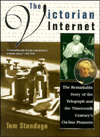
The following book covers history directly and indirectly related to the telegraph. I found author Tom Standage's insistence on drawing parallel after parallel with the Internet sometimes a wee bit grating, but otherwise found it a good read, and very interesting; enjoyable as well as informative.

The Victorian Internet: The Remarkable Story of the Telegraph and the Nineteenth Century's On-line Pioneers
Tuesday, January 31, 2006
Good adventure book about the Danes in World War II
It revolves around a Norwegian boy and his Danish cousins, who get involved in the Danish underground. It's aimed at older kids or young adults, but I found it intriguing enough to read as an adult. Whether that was from the writing or the subject matter I can't remember (this was years ago that I read this book) -- but I did put it into my personal library to reread instead of putting it out on the store shelves, for whatever that's worth.
And, tah dah, since I just today found my copy in a box (we're still in the middle of a move), I can even share the front-flap jacket copy with you:
The back flap on the dust jacket touts another book by Eva-Lis Wuorio called Code: Polonaise, set in Poland in World War II. It also centers around children, in this case orphans who join up with the Polish Underground. I haven't read that one, but I'd like to.In April 1940 Germany attacks Norway and Denmark. The Norwegians fight back fiercely; the Danes submit and their country is immediately occupied by the Nazis. In Norway, Thor Ericksen, though too young to fight in the army, is old enough to drive a truck with wounded soldiers while German bombs fall from the sky. In Denmark, Thor's cousins, Karen Jensen and her younger brother Kristian, at first find life under the Germans much as it was before. But a Danish underground is formed, and Karen and Kristian find ways in which they, too, can serve the Resistance.
Thor joins his relatives in Denmark and, together with Karen and Kristian and many, many other Danes, becomes part of one of the proudest episodes in human history - a daring secret plan to prevent the Germans from deporting Danish Jews to concentration camps.
In this authentic story, Eva-Lis Wuorio conveys the atmosphere of life in Norway and Denmark during World War II. These dangerous years had moments of great poignancy, but they also had moments of joy and lively humor. After reading To Fight in Silence, boys and girls will know that this is a time to remember.
Wuorio was born in Finland but grew up in Canada. In the Author's Note in To Fight in Silence, she says:
I just checked, and Rescue in Denmark doesn't seem to be in print, either. Of course, you might be able to find a copy at your local library, and you can always search for used copies. To search at Barnes & Noble, go here:During World War II, I worked as a reporter on the Toronto Evening Telegram and interviewed literally hundreds of Norwegians who had escaped from their occupied homeland and were training as soldiers, sailors and airmen in Canada. I also talked to dozens of Danish officials who had come to North America to explain their country's predicament to the outside world. My mother kept a scrapbook of everything I wrote and I have found those clippings very useful. While traveling in the Scandinavian countries after the war, I learned to know and love them, and heard many stories of the war years.
When I began to write this book, I asked for help from the Press and Information Section of the Danish Ministry of Foreign Affairs and from the War Museum in Copenhagen. I am grateful for their co-operation... Then my librarian found a book for me, Rescue in Denmark by Harold Flender, published in 1963 by W.H. Allen & Co., London, and Simon and Schuster, New York, and I was able to check my dates and information against this interesting, documented work about the escape of Denmark's Jews from Nazism...
I haven't found very much on Eva-Lis Wuorio on the Internet, but while looking for more on her I ran across an extensive list of books about the Holocaust, for children through young adult, both fiction and nonfiction. It is provided by Northbrook Public Library, Northbrook, Illinois.
USGS - Earthquake information on the web
There are, for instance, animations that move through the last week's earthquake maps, showing, in other words, not only where earthquakes hit, but in what order. You can choose among a variety of settings, from a whole world view to, say, the San Francisco Bay area, or the Los Angeles area, or Yellowstone, among others.
There's a map that registers earthquakes over the last 8 to 30 days, sorted by depth, so you can see where the most activity has been.
There's even a page that attempts to forecast California aftershocks.
And much more.
Just in case you're interested in that sort of stuff.
Joust The Facts: A Really Bad Nike Ad
Update: Giacomo posts the email response he got from Nike, plus his reply, at Nike's Initial Response.
Upcoming book watch - The Case of Terri Schiavo: Ethics at the End of Life
The write-up in this catalog causes me a bit of concern.
Well, judge for yourself. I'm not comfortable with the way the Catholic Church position is being represented (or misrepresented, in my view), among other things. You tell me. Reprinted from the Barnes & Noble website, an identical write-up to what is in the trade catalog:
FROM THE PUBLISHER
After the Nancy Cruzan case was decided by the Supreme Court in 1990, and ultimately resolved by the Courts of the State of Missouri, the decision to withhold or withdraw life-prolonging nutrition and hydration appeared to many to be as noncontroversial as decisions to refuse respirators or dialysis. Even the Catholic Church held that, although there should be a presumption in favor of providing nutrition and hydration, the patient or the patient's surrogate could overrule this presumption, if either believed the treatment was disproportionate or burdensome.
The Schiavo case changed all that. Although the decision to remove Terri Schiavo's nutrition and hydration was made by her husband-her legal surrogate-based on his wife's belief that such treatment was disproportionate, Schiavo's immediate family protested so much that the case took years to resolve. It eventually involved all branches of government at both the state and federal levels.
The ethical dilemmas that such cases pose continue to stir great controversy. This in-depth examination of these dilemmas provides information and documentation from many perspectives. The editors have included a foreword by Dr. Jay Wolfson, Terri Schiavo's court-appointed guardian ad litem, as well as Dr. Wolfson's report to Gov. Jeb Bush on the case and Gov. Bush's reply; public statements by President George Bush and Senators David Weldon, Rick Santorum, Tom DeLay, Bill Frist, and Barney Frank; statements by the pope and other representatives of the Catholic Church on this issue; plus much medical and legal background material on both precedents to the Schiavo case and its aftermath, including the results of the autopsy report.
For anyone wishing an in-depth understanding of these complex ethical issues, issues many of us will have to confront in our own families, this volume is indispensable.
The publisher has announced, in the catalog I have, that there is a national marketing budget for this book, with national media appearances and a national advertising campaign planned. The book is due to come out in late March, but is already available for pre-order.

Case of Terri Schiavo
And, no, I don't know what to make of the cover. I have my theories, but I think I'll hold off broadcasting them until I find out more about the contents of the book, and see what the media campaign is like.
Monday, January 30, 2006
New book buzz: River Rising
Thanks to another post at Brandywine Books, I know that Gina Holmes of Novel Journey did an author interview with Athol Dickson. (Just in case you're a gotta-know-the-author sort of reader.)
Clicking on the book cover will take you to Barnes & Noble for more information and reviews.

River Rising