Tuesday, March 20, 2007

Itchy Coo and "Braw Books for Bairns o Aw Ages"

So, I was trying to find the market price for an oldish used book, and to my surprise found that the title had been reprinted -- by Black & White Publishing, which was a publisher I didn't recognize. So, being the curious type, I googled. And found that it was Scottish. And there, on their website, I found a link for an imprint for children's books in the Scots language. Including some familiar authors in translation. For instance, Roald Dahl.

And then there's Kidnapped, by Robert Louis Stevenson, adapted into a graphic novel in Scots:

'Tak tent o whit I say, mannie – keep awa fae the Hoose o Shaws!'

Wi his mither an faither deid, an wioot a bawbee tae his name, David Balfour sets oot for Embra an the hame o his sleekit auld Uncle Ebenezer. But Ebenezer is no pleased when his young nevoy chaps his door.

Efter narrowly joukin death at the Hoose o Shaws, David is swicked intae gaun aboard the brig Covenant whaur he finds himsel KIDNAPPIT an aboot tae be sellt intae slavery. When the ship gangs doun in gurlie seas, David, alang wi gallus Jacobite rebel Alan Breck, begins the lang an dangerous stravaig back tae Embra through the Hielans o Scotland tae claim his richtfu inheritance.

Published in collaboration with Edinburgh UNESCO City of Literature's One Book – One Edinburgh reading campaign, KIDNAPPIT is the first ever graphic novel in Scots. Alan Grant and Cam Kennedy, renowned for their work writing and illustrating such weel-kent graphic fiction as Batman, Strontium Dog, Judge Dredd and Star Wars, have reworked Stevenson's classic tale of adventure in 18th-century Scotland to produce this brilliant new version. Itchy Coo are proud to be publishing this exciting Scots edition, our 25th title.

Oh, wait. I've heard about the Alan Grant/Cam Kennedy version of Kidnapped - it's also available in modern English, in the UK at least.

Tennessee allows some commercial sales from home kitchens

Via Like Merchant Ships, earlier this year Tennessee changed its rules on commercial preparation of food in home kitchens. The idea is to support a growing cottage industry while protecting the public. There are hoops to jump through and a fee to pay and a certificate to earn, and some food products are still restricted to commercial kitchens, but, on the whole, it sounds like this opens up new options for competent, home based cooks. Actual rules here (pdf).

Harry Potter translation notes

A blogger going by the name of The Teaching Assistant has read the Harry Potter books in both English and Spanish, and is now working through the books in French translation:

A random observation about literature in translation: the Spanish versions of Harry Potter usually go for the letter of the law, leaving most names of characters, places, spells, and magical artifacts intact, unless it is important to change a word or phrase because it was an anagram or something in English and that anagram or something is of immense importance. To give two examples, "the mirror of Erised" becomes "El espejo de Oesed" in Spanish instead of "El espejo de Erised" and the name Tom Marvolo Riddle becomes Tom Sorvolo Ryddle. Soy Lord Voldemort!

The French versions, on the other hand, go for the spirit of the law. To excess. They change nearly everything. That was okay for a while, but now my patience has been exhausted. (That is to say, it wasn't irritating when I knew less French than I do now.) About two of every three character names are changed for no discernible reason (and believe me, I've tried discerning). The above plus the rest of the changes leaves me wanting to hex the translator until he resembles a gelatinous slug. The French translator takes such an intemperate amount of creative license that the only possible explanation is that he has absconded with Rita Skeeter's Quick Quotes Quill. Seriously.

One amusing thing I should mention about the French translation is that Tom Marvolo Riddle becomes Tom Elvis Jedusor. Je suis Voldemort! That's right, the Dark Lord's middle name is Elvis.


Full post here.

Review books for a chance to win free books

Alibris (one of several websites through which my husband and I sell used books) is promoting reader reviews by giving away $100 coupons to ten randomly chosen book reviewers a month. More info here.

Play nice, please. Leading by example is a good thing, yes?

Monday, March 19, 2007

Terminology noted in passing

From the book Healthy at 100 by John Robbins, as a lead-in to a discussion on heart disease:

The human heart doesn't actually look very much like a valentine, but it is nevertheless a wondrous and beautiful muscle. About the size of a large pear, it begins to beat only a few weeks after conception, and then proceeds to pump forth the rhythm of our lives through every moment of our uterine and earthly existence....

OK, I don't talk that way, but referring to someone's uterine existence might have its uses in certain circles, I suspect. Hmmm. I'll have to think about this one...

The passage is on page 71 of the hardback.

Neil Cavuto: making the best of a tough situation

From Neil Cavuto Deals With MS (WebMD the Magazine, March 1, 2007):

When news anchor Neil Cavuto was diagnosed with multiple sclerosis a decade ago -- after surviving stage IV Hodgkin's lymphoma in the late '80s -- he sought second opinions in New York, Atlanta, Minnesota, and London, in his attempt to refute the undeniable.

Ten years later, Cavuto both accepts his MS and defies it. Doctors marvel at his MRI scans because they indicate a man unable to walk or talk. Yet while he sometimes has difficulty doing both, the Fox News anchor is remarkably fit, exercising on a stationary bike and treadmill to stave off muscle atrophy of the legs, a common problem in MS patients. Cavuto, 48, has the secondary progressive form of the disease, meaning it steadily worsens over time.

He has fatigue, headaches, trouble walking, some vision loss, and -- occasionally -- hoarseness. "Having difficulty talking isn't good in my profession, but my wife welcomes it," jokes the anchor, who memorizes scripts for his program, Your World With Neil Cavuto, in case he can't read the teleprompter during taping.

[...snip...]

He volunteers for the National MS Society. And children's issues, such as scholarships for kids whose parents have been immobilized by MS, are close to his heart, since he and his wife, Mary, recently adopted two boys, now ages 4 and 5...


Full article

hat tip: media blog at National Review Online

The first wave of spring

The first wave of solid spring hit about last Thursday, I think it was, and lasted through yesterday. Today doesn't seem to be quite sure which season to join. I'm sitting here wondering how long I can hold out in my cotton skirt with sandals. A more-sensible person would have opted for warmer clothes by now, but... but... I don't want to go back to warmer clothes. I. am. so. ready. for. spring.

It amazes me how quickly life springs in spring. The first day of really spring-like weather we had butterflies. I never saw a caterpillar. Just, boom, here were butterflies. Yesterday I saw a ladybug (aka ladybird beetle), full-grown and bright. We've had swarms of small bugs, names unknown to me, that seem to have come out of nowhere. Violets bloomed all over the yard, all of a morning. I can look out in the morning and again in the evening and see a difference in plants all over the yard. Sometimes, in spring, the saying "just watching the grass grow" isn't altogether a joke. Especially if you watch the shrubs and trees and bulbs and perennials letting loose, sometimes by inches a day.

So, of course, I'm outside as much as possible, "just watching the grass grow" and playing with - changing - garden plans I made in the winter. Gardening in my mind.

I. am. so. ready. for. spring.

Tuesday update: A bit windy, cold and stormy today, off and on. Rain. Then snow. Then...

Did I mention that our seasons around here tend to come in waves, advancing and receding, advancing and receding?

Or that I'm ready for spring? Spring that stays a while? Not that winter doesn't have its charms, but...

Thursday, March 15, 2007

Heppner does St. Paddy's

Hmmm. It's been a few years since I've made it to Heppner, Oregon. But I see that they're now billing the town as The Irish Capital of Oregon. Which means, of course, that they're going all out for St. Patrick's Day. Events kick off tonight with "Emigration to Happiness - 7:30PM, St. Patrick’s Catholic Parish Hall, 560 NW Jones. Get in the Irish Mood with this original play written by Father Condon with original music by Joe Lindsay."

Well, I'll be. Father Thomas Condon's a major historical figure in this part of the world, but I didn't know that play writing was amongst his many accomplishments. (Or at least I assume that the Father Condon to which they refer is the famous minister/scientist for whom the Paleontology Center at the John Day Fossil Beds is named.) More on Condon here, from the Oregon Cultural Heritage Commission.

For that matter, since this is the 25th annual A Wee Bit O’Ireland festival in Heppner, perhaps it has long been The Irish Capital of Oregon, and that fact just hadn't sunk in with me. It's amazing what a person can fail to know about their own general region of the world...

The four day festival features Friends of the Library book sales (to put my own weakness first), music, arts and crafts, lots of events involving eating, motorcross, sheep dog trials, a bowling tournament, something called road bowling, a teen dance, a Saturday into Sunday "WEE HOURS O’THE MORNIN’ BREAKFAST – 10 PM-3 AM" hosted by the Heppner Volunteer Fire Department (not all small towns roll up the sidewalks early, apparently), a Cruz-In (old cars), more. Lots more. It sounds like fun. (She says, tentatively pencilling in next year's event...)

A few years back we made a day trip just to visit the town of Heppner and see what it was like. We enjoyed our visit very much. The people were friendly, and our inexpensive lunch at an unpretentious little eatery was quite good and the locals adopted us for the duration, including us in conversation. It's one of those towns we have on our would-like-to-revisit-someday list, and I could see it going onto a maybe-it-wouldn't-be-a-bad-place-to-live-or-retire-to list. It is off the beaten path, but it's close to larger towns - for that matter, it's not too far from actual cities. Like I said, I haven't been there in a while, but if it's anything like it was back then in spirit, I don't mind giving it a plug as a place to visit or relocate.

hat tip: U.S. Congressman Greg Walden's online newsletter

Wednesday, March 14, 2007

Retro cooking

Via Like Merchant Ships, if you like cookery a la 1940s-60s, you might like to check out Retro-Food.com.

Katrina rebuilding continues

One thing some people don't quite seem to understand about America is that, by and large, when Americans see a need, volunteers from around the country quietly pitch in. Even after the news cameras go home. (Sometimes especially after the news cameras go home.) And without going through the government. Just because.

Rebuild Lakeshore is a website of the Lakeshore Baptist Church of Lakeshore, Mississippi, a community hit with the full force of Hurricane Katrina. The site is full of story after story of not only community members helping one another out, but of total strangers showing up to do hard and often-dirty work of rebuilding. Just check out the teams that showed up just in February.

Is this a great country, or what?

They still need a lot of help down there, in-person and otherwise. Check out the website for more info.

Oh, and don't miss the post on 50 Lessons From Mississippi, written by a young woman named Sarah Ascol after she did a stint of volunteer work in a kitchen set up to feed volunteers. Some of it's insightful. Some of it's laugh out loud funny, too. How can you not love a post that includes such gems as "45) Singing together gets the job done faster - unless you stop to dance" and "30) Soap bubbles in your hair works almost like hairspray" and "22) Nine young adults are really no match for 51 kids full of candy-corn" and "14) Even teenage boys get blue when they miss their Moms"?

hat tip: Cindy Swanson

French Word-A-Day: ketchup, etc.

I've just stumbled onto a blog called French Word-A-Day. The most recent post is on, of all things, ketchup, both as a word and as a food, as it is used in France, including an account of ketchup used as a condiment for fried rice. No, really.

I've just glanced at a few entries, but the blog looks delightful from what I've seen so far. It's far more than just language lessons.

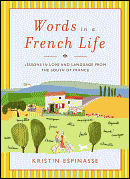
The blog hostess, American expat Kristin Espinasse, is also a book author:

Words in a French Life: Lessons in Love and Language from the South of France

Book note: February House, by Sherill Tippins

February House: The Story of W. H. Auden, Carson McCullers, Jane and Paul Bowles, Benjamin Britten, and Gypsy Rose Lee, Under One Roof In Wartime America


I haven't had a copy of this book in my hands; I stumbled across it while looking online for something else at Barnes & Noble today. Given some of the artists involved in the experiment, I wouldn't want to guess how family friendly the book is or isn't, but... well, I think it falls under the 'sometimes truth is stranger than fiction' category. And besides, as I understand it, some of these people were influential. Besides, the preface and reviews are promising.

From Barnes & Noble (click on book cover above for link), the preface begins:

New York is full of old people, struggling to occupy their allotted space despite the pressures of the younger generations pushing in. Elbowed by joggers, hedged in by cyclists, they make their daily odysseys to the supermarket and then retreat to the safety of their homes. As one of tens of thousands of college graduates moving to New York City in the 1970s, I was as oblivious as the next twenty-two-year-old to this segment of the population. A decade later, as a new mother in Brooklyn Heights, a neighborhood of brownstones facing Wall Street across the East River, I merely noted the number of people with aluminum walkers on the sidewalks as I maneuvered my child's stroller around them. A few years on, however, when I began volunteering to deliver meals to the housebound and got to know many of these people as individuals, I began to regret my past indifference.

Many liked to talk, and I found that I liked to listen. The octogenarian who had covered her walls with her own arresting paintings told me about the silent-film actress who had once lived at the nearby Bossert Hotel and ordered up a milk bath every day. The retired city councilman with the fierce gray eyebrows described the spectacular sunsets, enhanced by post-Depression factory fumes, that he had so enjoyed on his homeward walks over the Brooklyn Bridge. The chain-smoking former navy officer recalled the rich scent of chocolate that used to waft through the streets from a Fulton Street candy factory before World War II. I learned, too, how the Brooklyn Dodgers got their name (Brooklyn residents were once called"trolley-dodgers" because of the many speeding trolley cars on the borough's streets); how a working-class girl could enjoy a free daily swim at the St. George Hotel's swank saltwater pool (all it took was a doctor's note); and what Irish-American children were told when they found an orange in their Christmas stocking ("Thank Mr. Tammany, not Santy Claus").

Most intriguing to me, however, were the references to a house that once stood at 7 Middagh Street (pronounced mid-daw), a short, narrow lane at the neighborhood's northeastern tip overlooking the former dockyards and, beyond, New York Harbor. The house had been rented, one neighbor told me, by a group of well-known young poets, novelists, composers, and artists the year before America entered World War II. Aware that enormous devastation lay ahead and determined to continue contributing to the culture as long as possible, they had created an environment for themselves to support and stimulate, inspire and protect —just a few blocks from where I lived.

When I learned that these residents included the poet W. H. Auden, the novelist Carson McCullers, the composer Benjamin Britten, Paul and Jane Bowles, and, of all people, the burlesque artist Gypsy Rose Lee—all under thirty-five but already near the apex of their careers—my interest was piqued even further. In a pictorial survey of Brooklyn's history, I found a photograph of the house—a small, shabby brick and brownstone structure with elaborate Tudor trim. The man who had signed the lease and organized this experiment in communal living turned out to have been George Davis, a fiction editor at Harper's Bazaar who had single-handedly revolutionized the role played by popular magazines in bringing serious literature and avant-garde ideas to the American masses. Davis was known for his attraction to the eccentric in culture, in entertainment, and in his choice of friends. With his encouragement, nights at the Middagh Street house became a fevered year-long party in which New York's artistic elite (Aaron Copland, George Balanchine, Louis Untermeyer, Janet Flanner, and Louise Dahl-Wolfe, among others) mingled with a flood of émigrés fleeing Nazi-occupied Europe, including the composer Kurt Weill and the singer Lotte Lenya, the artist Salvador Dalí and his wife, Gala, and the entire brilliant family of the Nobel Prize–winning novelist Thomas Mann. Days, however, were dedicated to their work —writing, composing, painting, and otherwise seeking new answers, new approaches to life in a collapsing world.

By the winter of 1940–41, 7 Middagh—called "February House" by the diarist Anaïs Nin because so many of its residents had been born in that month—had developed a reputation as the greatest artistic salon of the decade...

There's quite a bit more to the preface, much of it quite interesting, I thought.

Also from Barnes & Noble is this from The New Yorker:

In 1940, George Davis, an editor recently fired from Harper’s Bazaar, rented a dilapidated house in Brooklyn Heights in which he installed brilliant, volatile artists, who spent the next year working, fighting, and drinking. Carson McCullers sipped sherry while, down the hall, the burlesque star Gypsy Rose Lee typed her mystery novel with three-inch fingernails, and, downstairs, Benjamin Britten and Paul Bowles fought over practice space. W. H. Auden was housemother, collecting rent, assigning chores, and declaring no politics at dinner. Tippins’s book is a cozy, gossipy read, punctuated by solid, if perfunctory, literary criticism. Like all bohemian utopias, February House (so named because of the residents’ February birthdays) was unable to withstand the centrifugal force of its constituent egos. The artists dispersed—to return home, serve in the military, or follow wayward lovers—and the house was demolished to make way for the Brooklyn-Queens Expressway.

Tuesday, March 13, 2007

Book note: WWII picture books for kids

See Karen Edmisten: More WWII Picture Books for some recommendations for history-related books for children.

Kindness Happens blog

Here you go. A Kindness Happens blog. :)

Fires, wars, murders, drugs. Too often, we read in newspapers and see all over the TV and Internet the bad things going on in the world.

But what really makes the world go round is kindness, those little acts that often go unnoticed by all but those involved. Because these small acts don't get published and publicized, people often don't believe they actually happen. So it's time to share! This blog is for posting those small acts of kindness that you do for others, or that others do for you. Hopefully, in having this group effort, people will be able to read about a number of kind acts happening daily and will feel better about life, and then hopefully, in turn, go on to carry out kind acts of their own...


Hear! Hear!

Monday, March 12, 2007

One Mommy, or two...

Before you hire someone to take care of your child day after day after day, perhaps you'd like to read West Bank Mama's post My Children Have Only One Mommy.

hat tip: I found the West Bank Mama blog through the sidebar at Seraphic Secret.

Public Radio is advertising for new talent

Doug Payton notes that Public Radio has a talent competition coming up: the tagline is "Wanna be a radio star?" Considering that he's got something of a background for it and plans to take a shot, it's decent of him, I think, to invite the rest of us to compete with him.

From the Public Radio Talent Quest website (emphasis in original):

Do you have what it takes to be public radio's next great host? Do you have that most elusive of qualities - hostiness? Now is your chance. We're casting a wide net to find new talent for public radio, and giving away over $70,000 along the way.
I'm out for lots of reasons (lack of appropriate skills being a big one), but I'd love to see the gene pool expanded in radio, so if you've got talent (and can forgive the awww-cuteness of an appeal for 'hostiness')...

A side note: It's funny that the website mentioned "casting a wide net." Just this weekend I learned about a story supposedly told by astrophysicist Arthur Eddington about a researcher who was studying deep sea life, using a net with a three-inch mesh. After collecting numerous samples, the fictional researcher concluded that there were no fish less than three inches long in that part of the sea. In other words, how you fish can determine what you can catch.

Make of that what you will.

If you'd like the actual Eddington quote (as opposed to the one I was handed this weekend, which bears only a faint resemblance to the original), scroll down at Quotations by Arthur Eddington (which I found via the Wikipedia entry on Arthur Stanley Eddington).

A Gathering of Eagles

There will be a gathering of people in Washington D.C. on March 17 to stand silent guard at war memorials threatened by anti-war protesters. This is to be a non-confrontational, nonviolent, nonpartisan effort done out of respect for the memorials and for the people honored by them, with the goal being to defend, not attack. Apparently anybody who agrees with the mission and is willing to play by the rules is invited to participate in person, or in spirit (by signing a petition). Anna has more info and links.

Saturday, March 10, 2007

The Saturday Review of Books...

...is up at Semicolon.

Literary sleuths wanted: "It's not fair" edition

At the end of The Silver Chair by C.S. Lewis - spoiler alert - when the schoolyard bullies are getting what they so richly deserve, they run away yelling "Murder! Fascists! Lions! It isn't fair." (emphasis in original). end spoiler alert

This is in a book originally published in 1953.

This got me thinking. Schoolyard bullies go way back. Schoolyard bullies that run screaming to Mommy or Daddy or teacher if someone stands up to them go just as far back, as far as I know. But off the top of my head it seems that this reference is as far back as I can recall for thwarted thugs using the tactic of yelling, "It isn't fair."

Before that, wasn't it always something like "You'll be sorry!" or "My dad's bigger than your dad!" or "Your mother's cheap/ugly/wears army boots" or "I hate you" or "You just wait 'til you're not looking" or just plain blubbering because he or she felt sorry for his poor little cruel and cossetted self? Or something like that?

This is somewhat an idle question, but not entirely. Considering how the "It isn't fair" people have created whole industries and government departments and cooperative judges to whom they can run when they feel that someone isn't kowtowing to them properly, I admit to wondering when this attitude crept into the open air in Western culture. And why. But of course why is likely to be harder to answer than when.

So... I have a reference from 1953, one that suggests that elitist secularists, at least, were already prone to that sort of thing, enough so that Lewis apparently thought it deserved a poke in the eye in passing. Or, at minimum, that if he did poke them in the eye most people would get the joke or at least recognize the type.

So where did the real-life folks getting jabbed in that sentence get the idea that they're supposed to always have their own way - and if they don't it's because someone else isn't being fair?

When did they, on top of that, get the idea that appealing to someone in authority might find them a sympathetic ear? Not to mention action?

(In the old days, from what I've read, bullies who whimpered were more generally told that it was time they grew up. Or that they'd have to fight their own fights. Certainly they didn't get much encouragement from most people in positions of authority. Did they?)

I have my hunches, but I'm operating on too few facts here even for an honest hunch.

I'd appreciate your help gathering references. More recent ones are fine (they might help establish a pattern), but bragging rights go to the earliest book reference in which either a bad guy earnestly - or a good guy facetiously or satirically - says a variation on "It isn't fair." I'd prefer examples with the emphasis. We're looking for the birth of the whiny worldview here.

Nonfiction references also accepted.

Side note: I read The Silver Chair in:

The Chronicles of Narnia One Volume


The Silver Chair is also available in stand-alone; in paperback, hardback and audio. For instance:

The Silver Chair
The Silver Chair

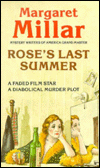
Update: I've found a 1952 example. In the murder mystery Rose's Last Summer by Canadian author Margaret Millar, a self-centered, browbeaten, wimpy, worried and worrisome mother's boy of a man who had a body found in his garden (and has been acting suspiciously ever since) is conversing with a police officer heading the investigation (emphasis in original):

"The poor woman who died - my wife and I were discussing it last night - I hope she'll have a proper burial with flowers and all that?"

"I don't guarantee the flowers, but she'll be buried according to regulation. The county will foot the bill if no one else does."

"It seems so cold-blooded, having no flowers."

"Rose won't know the difference."

Willett turned quite pale. "I wonder - my wife and I were wondering - we feel a certain sense of responsibility in this affair. We're not wealthy by any means, but we're comfortably well off and I thought - Ethel thought - perhaps a check for a hundred dollars--?"

"You're offering to bury Rose?"

"I - yes, you might put it like that. Ethel's very soft-hearted, you know."

Greer didn't know. "You'll have to take the matter up with the County Administrator."

Willett had no idea what or who the County Administrator was, but he nodded wisely. "I see. There's red tape involved. You think it might be better to forget the whole thing? I mean, I certainly wouldn't want my generous impulses to get me into trouble. It wouldn't be fair."

"There are lots of worthy causes to give money to," Greer said shortly. "Flowers are fine, but Rose can't smell them."

Willett took out a handkerchief and wiped his forehead. He hated this callous policeman with such intensity that he felt nauseated. "I - if you'll excuse me - I'm not well."

"Sorry to hear it."

"We - we're not a strong family. Things upset us."

Greer believed it. "I just want to talk to your mother for a few minutes. I'll try not to disturb her."

Willett felt too weak and sick to argue. "Murphy will take you upstairs," he said and headed for the door, pressing the handkerchief against his mouth.


In local lingo, I'd say Millar had Willett's number (and by extension the number for everyone like him).

Rose's Last Summer
Rose's Last Summer

Thursday, March 08, 2007

Author note: Charles Todd

I haven't read any books by Charles Todd. But after reading Wittingshire: WWI and Charles Todd, I've put them on my find-a-copy list.

Oh, you're paying for it? In that case... : Revisited

I invited the blogger at Joust the Facts to weigh in on this post since I remembered him posting on similar topics, and since he's someone who has to deal with this firsthand. He was kind enough to reply. His reply is in the comments box at the original post, but I think it warrants a post of its own, especially since some of it was surprising, at least to me:

Thanks for the invite, Kathryn.

I do have something worth adding to this discussion, possibly. I'm an orthopaedic surgeon, and I'll be the first to admit that my prices are artificially high. But they're not high in order to milk the system; they're not high so I can "get rich quick and retire early"; they're not high because I have an inflated sense of what I do.

I'd be more than willing, happy even, to cut my "usual and customary fees" by 40-50% if someone would simply guarantee me that I'll be paid - by all insurers - what I bill. I'm not. That fact makes my practice's gross income extremely unpredictable, as it's dependent each month on what the insurance mix was for the cases we did.

For some of the complex reconstructive procedures that I do on shoulders government payors and the HMO's pay me, on average, about 24-25 cents on the dollar. You read that right.

As a result I need to keep my fees artificially high because I need the occasional "good insurer" or workman's comp carrier (the private ones pay fairly well) or wealthy self-payor to make up what I lose on the government contracts. I've often said that if everyone paid like Medicare my four physician Ivy League trained group would be out of business. And we would, unless we started practicing impersonal high-volume medicine, which we don't.

So keep pushing for Medicaid, Medicare and HMO's to hold down physician payments and you'll continue to see a warped and unaffordable system for those not so privileged.

You may be interested to know that at high profile medical centers, like the Mayo Clinic, and for in-demand large city physicians most insurances aren't accepted. You pay cash, and if you want some of it back you submit your bill to insurance for re-imbursement. I have a friend from medical school who practices internal medicine in Washington DC who takes no insurance. As a result, he gets what he bills.

This may or may not be related, but it should tell you a little bit about where I'm coming from in this discussion. It took me a long time to realize that our bookstore was never going to survive if we didn't take into account people who wrote bad checks or otherwise managed to take stuff off the shelf without paying for it, or otherwise cost us money through no fault of our own (placing a special order and then not buying the book can hit a small bookstore very hard; more on that someday). It was a hard lesson to learn. It goes against my idealistic streak and a sense of justice to ask honest people to help pay for what dishonest people do, but for the life of me I can't see any other way to do it since we must pay for inventory regardless of what happens to it. We are always working on ways to minimize what dishonest or heedless people can do to us (and by extension our honest and more considerate customers), but the fact remains that every now and then we cross paths with someone who manages to make us bleed financially, and that has to be written into the business plan.

Rocks In My Dryer's Works For Me: The Kitchen Edition

Works-For-Me this week was devoted to kitchen-related tips.

Several more themed editions are coming up.

I'm back, sort of...

The power company has been replacing power poles along our block this week, and after enduring brownout after brownout the other day I unplugged almost everything electronic, plus whatever else I wasn't using. About the time the brownouts seemed to go away, a fellow came to our door to let us know about a three-hour scheduled outage. At that point I decided to enjoy watching guys work in cherry-pickers and marvel at the skill of crane operators, etc., rather than worry about my electrical stuff. So I unplugged stuff again and split my time between watching guys risk their necks way above the ground and digging in and doing low-tech stuff and chores I'd been putting off.

The cranes are gone, the power seems to be steady (knock wood), and now I have several days worth of work to get caught up on, and I've got several offline projects underway...

Side note: When the fellow came to the door to tell us about the outage planned for the next morning from 6 to 9, I thanked him for the info, and he looked at me kind of funny, as if he doesn't get many thanks for delivering that kind of news. That's too bad.

I'm sure the power company knows that losing power for that length of time might mean more than inconvenience for some people. For instance, until quite recently for us it would have meant using oxygen tanks until the power came back on and we could use the oxygen concentrator again. As it was, my husband opted to go without extra oxygen for that length of time since he's generally strong enough to do that these days, without his oxygen levels plummeting. That's not to say I didn't have a tank ready and the oxygen meter on hand and didn't, like, you know, check on him now and then, as he slept. (Sorry, guys. It's a wife thing. Sometimes we can't help it.)

Besides which, silly me, I think simple manners require that you thank people for going out of their way on your behalf.

Anyway, I appreciate that they came to the door to make sure we knew what we would be up against. Not that we aren't prepared for that kind of emergency anyway, but it was nice to make sure we had everything lined up. Thanks again, OTEC.

Tuesday, March 06, 2007

French radio dramas teach French, Polish, German

From the English-language website of radiofranceinternationale (emphasis in original):

RFI's latest bilingual radio-drama set in a video game. Follow Eva on her mission to save the French Republic from time-terrorists. Will she be able succeed?

Eva finds herself in the midst of a huge explosion at the "Gare de l’Est" in Paris. A wounded man gives her a first clue: a series of numbers. She then finds an old book with the inscription: "La statue domine le mort mais la fertilité est retrouvée". What does it all mean? The gamer has to guide Eva through Paris, past its old booksellers, via the painters in Montmartre to the Père Lachaise cemetery. At her disposal is a magic taxi to speed her around the city. Then there’s the handsome Adrien, a fearless fireman. But hot in pursuit are the mysterious Blackhats. Will Eva complete her mission in time and save the French Republic?

every Monday at 12, 14 and 16 UT.


I found audio links, but only got a promo, but elsewhere on the RFI site I found a webpage for people who would like to learn French online. There are fictional adventures,"The news in simple French," tests, more.

And there I found the Mission Europe site (emphasis in original):

Immerse yourself in the world of languages with three exciting Mission Europe adventures. Mission Berlin, Misja Kraków and Mission Paris offer an interesting approach to language learning in 26 episodes. You experience three missions from the perspective of a computer player who joins virtual heroines on adventures in France, Poland and Germany.

In Mission Berlin, the player and the virtual heroine Anna fight against the enemies of re-unified Germany. In Misja Kraków, the player and Suzanna must halt the opponents of Poland's EU accession. In Mission Paris, the player and the heroine Eva compete against an enemy who wants to return France to the era of Napoleon III and restore the Second Empire. After you've successfully completed your mission, you are rewarded with insight into a country, its language and its culture. Choose an adventure and discover the French, German or Polish language. And remember: Danger is lurking everywhere.

Christians growing in Algeria?

I couldn't have dreamed this up. From "God's Time for Algeria" by Deborah Meroff at Today's Christian January/February 2007:

Over the last 20 years I have had the privilege of covering stories of God's people in 94 countries. This was my first trip to Algeria, the fabled northwest African country bordering the Mediterranean Sea. My assignment that April 2005 was to report on the fastest-growing church-planting movement in the Muslim world.

My translator was a product of this phenomenon. On the way to my accommodations, Davy shared how he had loved to listen to Christian music on Radio Monte Carlo when he was a university student. Eventually, at his request, they sent him a copy of the Gospels. Reading Jesus' Sermon on the Mount made a big impact, especially the phrase "love your enemies."


Give me a minute. I've had a lifetime of thinking casinos when I hear Monte Carlo. This is rather unexpected, I must say.

Being openly Christian in a Muslim country isn't safe, however, as Meroff explains later in the article.

The high cost of following Christ means there are few nominal believers. Christians commonly suffer beatings, lose their homes, jobs, and sometimes their lives. Yet they continue to put themselves on the line, even giving their testimonies on television.

Hold on a moment while your hostess googles...

Ah, Radio Monte Carlo isn't broadcast out of the gambling center. It's actually... well, actually it appears to be several stations run by different organizations, broadcasting to and from all sorts of places: France, Monaco, Italy, Russia...

And the Arabic broadcasts originate from Paris, over Radio Monte Carlo Moyen-Orient, which is part of the Radio France Internationale Group? Am I reading that right?

Some Algerians have found Christ through broadcasts from Paris? Am I reading that right?

It certainly is an interesting world in which we live, no?

Saturday, March 03, 2007

Lunar eclipse tonight

I'm not in a good location for it (and we're pretty cloudy right now, too, worse the luck), but there's a total eclipse of the moon tonight. See NASA - Eclipses During 2007 for more. (Via Danielle Bean.)

A request to those of you in a good area for viewing: please keep the outdoor lights to a minimum, if you can. When I was in college, we set up on top of a several-story building to watch and photograph a lunar eclipse. Just as it started getting good, a couple of athletes turned on the floodlights for night playing at the tennis court. Which was situated at the foot of the building on which we were perched. Naturally.

I think we scared them silly with our howls of dismay (there not usually being people on the roof, much less in the middle of the night, much less howly people). When we got coherent enough to tell them why we were upset, they graciously tried to turn off the lights. But couldn't. The lights were on a timeset, and flipping the switch had turned them on for a half hour or hour or whatever. I guess the college had had trouble with people leaving the lights on, and so had opted for a system that turned them off after what was deemed a reasonable lapse of time under normal circumstances.

At any rate, we could sorta see the eclipse, but not very well, and forget using the more-sensitive scientific equipment we'd dragged up there. Bummer. :(

Friday, March 02, 2007

Oh, you're paying for it? In that case...

My husband recently crossed paths with an old friend, and they talked of this and that. At one point, the conversation got around to the costs we've faced because of my husband's illness and that our friend faced when his wife was dying.

Hearing that J.'s experience was so close to ours made me think that there might be some of you out there who could benefit from something we learned along the way, his family and ours.

Long story short: When we staggered, weary and worried, into the medical supply store to arrange for an oxygen concentrator for home use, we ran into a problem. We didn't have insurance that would cover precisely that and we weren't on welfare of any sort and didn't intend to be if we could help it. And the rental fee for an oxygen concentrator was something like $380 or $385 a month. I forget the exact figure, but it was the straw that broke the camel's back; just enough to push us onto welfare, at least for the time being. We didn't want that. On the other hand we had to have supplemental oxygen; under the circumstances an oxygen concentrator was the difference between life and death. The lady watched us crumple in surrender to cruel fate, and then, taking pity, she said it might make sense for us to buy one.

We braced ourselves and asked how much that would cost.

She said we could probably find a refurbished one for around $500. Sometimes you could even find one for $450. Sometimes they cost something more than $500. They were in short supply, but she'd see if she could find one for us, if we wanted.

We wanted. Oh, how we wanted.

She came through for us, for what she'd estimated.

You read that right. To buy a used but refurbished and perfectly adequate oxygen concentrator cost us less than two months' rental fees.

J.'s wife's concentrator also cost him about $500. He'd had insurance, but the co-pay was high enough that it made all the sense in the world to buy instead of rent.

On a related note, when my husband was battling heart failure and pneumonia a hospital nurse told us that they'd ordered up a hospital bed for us to use at home. We asked how much that would cost. She gave us a variation on 'don't worry about that, dearies.' We told her we had to worry about that because we were self-pay. They obviously don't have a lot of self-pay patients; most folks apparently have insurance or government assistance or are deadbeats who have no third-party coverage but also no intention of paying their bills. After taking in that we really were people who paid their own way we got the information that as long as he slept at an incline we'd be all right. The point was that he'd suffocate and die if he tried to sleep without being propped up. A recliner would do nicely, if he could sleep in a recliner. And so we managed with a recliner, which we already had.

Landscaping to cheer the neighborhood

My kind of springtime front lawn. :)

Cakes, decorated to the nines

If you like to get creative about decorating cakes, you might want to check this post and/or this contest.

No harm, no foul (just red faces)

Swiss accidentally invade Liechtenstein (AP, March 2, 2007)

Oh, good. I'm not the only human being who has a bad sense of direction and sometimes gets lost.

(Correct me if I'm wrong, but I thought the AP writer seemed disappointed that both countries treated it as a kerfuffle and not a major incident worthy of "serious repercussions"? As if, perhaps, just perhaps, he/she felt cheated of a story he could really sink his teeth into? Heh.)

Monday, February 26, 2007

On bookplates

Joanne Kaufman appreciates bookplates, and knows a bit of history about them, too. (Still Stuck, OpinionJournal, Feb. 23, 2007)

Taste testing a good book

Brittany Shahmehri, writing in The Christian Science Monitor, Feb. 6, 2007:

My husband is reading "The Secret Garden" aloud to our boys. They are at the part where Mary Lennox has told Colin that she's found the garden his mother loved. It's an exciting moment. But the passage I'm waiting for is a few chapters on, after Colin has tasted his first breaths of fresh moorland air and Mary has grown strong running in the garden. It's just a detail, but my kids will notice it: a luscious description of roasted potatoes and eggs.

We have a tradition of trying foods from the books we read aloud. It started when we read Elizabeth Enright's "The Saturdays," and one of the boys asked, "What are petit fours?"

An answer, my husband and I felt, wouldn't be as good as a sample. So one Saturday we all sat down to tea and little cakes, iced in pink, green, and yellow. It was exciting for the boys to try a dessert they had learned about in a book...

Full article here

That's my kind of tradition. :)

hat tip: Albert Mohler

Burglar's Bane snow

Over the weekend, we had some of the noisiest-to-walk-on snow I've ever walked on. Every step creaked. It wasn't a sharp sound, in that it was somehow cardboardy, but it was loud. More than that, every footstep left behind it a perfect, sharp, clear mold of the sole of the shoe.

I couldn't help thinking that if I were a burglar or mugger I would have hated that snow.

Bread 'from scratch'

My husband told a young man of his acquaintance that I'd started making bread from scratch. The young man likes to cook, you see, and my husband thought he'd be interested in the doings of someone else who likes to cook.

'Oh,' the young man said, perking up, 'What type of bread machine did she buy?'

'She doesn't have a machine. She made it by hand,' my husband informed the fellow. For which information he got something along the lines of a blank stare.

'Why would she do that?' the young man asked, when he got his voice together.

'Because it's fun,' my husband said...

Now, don't get me wrong. I don't think bread machines are inherently bad. If I get gimpier or my hands get to hurting too much, or I have to take on many more work hours, I might use one myself someday. And, if we ate a tremendous quantity of breadstuffs around here, I could see a bread machine might make sense, at least during more harried days and weeks.

But why in the Sam Hill, if you're able, would you let a machine have all the fun? (So to speak.) I ask you.

Perhaps too many of us in recent decades have been influenced by people who look down on housework, including cooking, as drudge work - but at the same time consider cooking, especially from scratch, to be the sort of thing that is beyond their capacity to learn. (Yes, I know that's a bit inconsistent, but people tend to be inconsistent, don't they? Or perhaps it's merely a variation on "sour grapes"?) And bread making in particular is often held up these days as Very Hard Indeed. Not to mention Something That Takes A Lot of Time. And also Somehow Different From Other Cooking. And, of course, Reported to Be Prone to Failure... especially if you aren't born with some vaguely mystical magical inner gift for cooking that some folks seem to think exists. (As if even the best cook around didn't have to learn to cook? Even, for all intents and purposes, learn to cook over and over again as he/she took on new types of food? Hello?)

Well. I'm prepared to be humbled a few times by batches that don't turn out (I've made three types of bread so far, and so far I seem to be having beginner's luck, but I'm not kidding myself that I know what I'm doing yet).

On top of that, bread making doesn't really take quite the time or effort that I'd been led to think it might. You do have to be around at the right times, but that's true of a lot of things. Including the average family dinner.

And it is fun. And a great stress buster.

So I intend to keep at it. I intend, in fact, to make up recipes until I invent a bread or two or three uniquely mine. Translation: I have a hard time sticking to recipes. I love to experiment in the kitchen. :)

(Did I mention that I'm prepared to be humbled by batches that don't turn out?)

Of course, you're visiting the blog of someone whose favorite classes in school included labs for chemistry and physics. People who love chem lab are naturals for cooking, I think, because cooking gives you the same sort of thrills and experience and feedback, and (barring the inevitable, occasional flubs) - tah dah! - you get to eat the results.

But, anyway, even for folks who don't like to 'invent' food, bread baking is fun, I think, and the most fun comes in the stages that people with bread machines cede to the machine.

The dough changes as you knead it. Very curious, that. And that going from a smallish solid mass to an airy largish mass during the risings (aka proofs) is interesting, too. And that whooshing sound that often happens when you punch the dough down? I kind of get a kick out of that. (I know, I know, I'm too easily amused. But there it is.)

Do you ever wonder (I do), how we ever got to this point? I mean, who in their right mind would have tried eating yeast bread in the first place? Really? I mean, if you were sitting around minding your own business and the dough you'd made for flat bread happened to pick up yeast from the air (which fact you wouldn't know, of course) and bubbled and expanded and smelled different from usual, would you turn to someone and say, 'Let's beat the air out of that and pat it into shape and see what happens?'

OK, maybe you'd do that. Maybe I'd do that. Especially if the food supply was tight.

But, when it bubbled and smelled and spilled itself out of a container or crept over the edge of the counter a second time, seeming strangely alive in an odd and unprecedented way, would you even consider trying to cook it and eat it? If you weren't crazy, I mean?

I'm glad our ancestors figured it out, and shared, and that cooks through the ages have improved our knowledge of how all this works. But I wonder - if I'd been at the front end of all this, with no one I trusted to tell me it was good that way - if I wouldn't have been scared of the stuff and thrown it away and started over?

Update: Melissa Wiley and her children are also beginner breadbakers, and they've got a bread blog - Peace of Bread - where they're collecting their successes, failures, recipes, notes, questions and answers. Check out, for instance, The Science of Bread.

Friday, February 23, 2007

Book note: 500 Time-saving Hints for Every Woman, by Emilie Barnes

Jane at Much Ado has info on a book that sounds like it might be a good resource for those of us trying to make our homes more manageable and more gracious/livable/pleasant at the same time.

British World War I records coming online

From WWI soldiers' records go online, BBC, Feb. 23, 2007:

Service and pension records for more than two million soldiers who fought in the British army in World War I are being put online for the first time.

The documents provide a broad range of detail, from name and next of kin to wounds suffered and conduct record.

The release by the Ancestry website, working in partnership with the National Archives, is taking place in stages over the next two years.

The images are available to view on a subscription or pay-per-view basis.

All the records are already viewable on 28,000 rolls of microfilm at the National Archives in west London, but it is hoped the digitisation process will make them available to a much wider audience.


For an account from a man using newly released documents in a quest to learn more about a grandfather he never knew, see Uncovering the trenches, by Rob Liddle, BBC, Feb. 23, 2007.

New Zealand fishermen land a colossal squid that lives up to the name

Colossal squid aren't the same as giant squid. They're much heavier. In this case, much, much heavier (an estimated 450 kg, which means about 990 pounds!).

In the linked article, the BBC provides a size comparison chart, using a London bus as a starting point. The squid is longer.

For those of you into specifics, the squid in question is said to be a Mesonychoteuthis hamiltoni, and it was found in Antarctic waters.

An abundance of toes

Meet a kitten named Extra, and learn about polydactyly in cats, past and present. ("Extra-special cat has 26 toes," Karen Kotze, East and Bays Courier, Feb. 21, 2007)

Thursday, February 22, 2007

Woodlands Web

I've just stumbled across what appears to be a treasure trove of a site. The Woodlands Junior School of Tonbridge, Kent, has information on British life and holidays (see, for instance, What is Lent?), and it has educational games and interactive activities, and it has Pooh traveling down the Thames...

I expect I'll be spending a bit of time in the Guide to British Life, Culture and Customs section. Too fun. :)

They invite questions, by the way.

Tuesday, February 20, 2007

Book note: Around a Rusty God, by Augusta Walker

I came across a Autumn 1954 edition of Reader's Digest Condensed Books, and noticed that one of the books was one I didn't recognize: Around a Rusty God, by Augusta Walker. The jacket blurb says:

In a world threatened by war and famine, a little boy builds a frail security for his most cherished possessions, two spindly goats. Their world is China, but it might be anywhere, for this poignant story tells a universal truth about the way a child grows in maturity by taking care of something he loves.

After reading the book (condensed version), I will say that it's different from anything else I've read recently, and I don't mean that in a bad way. According to the write-up in this book, the author taught English at Lingnan University in Canton, China, from 1947 until 1950, when she was forced to leave the country. She has a distinctive voice and a gift of description, and the assuredness of someone who seems to have noticed a great deal.

I'd disagree a bit with the blurb, in that the story struck me less as being about 'a universal truth' than about the craziness and failings of humankind, some of it being funny, and some being sad, but most of it ringing true:

So Beng Gow became a goatherd. His mother never understood it, although she was always explaining it to people. All the women came with their babies tied on their backs to have it explained to them. A teacher at the Big School had heard about the virtues of her son, who certainly was not worthy of such fame, and went out driving one day to look for him. He found her worthless son sitting on a grave, minding the geese for Ah Lok, who was no account at all minding geese, and he drove her son away in the automobile to give him anything in the world he wanted. But her undeserving son wanted nothing for himself, only to serve the Gow Sow, and so he became the Gow Sow's goatherd, and was so self-denying that he would accept no more than five hundred yen every seven days.

Ah Lok's mother did not like this story, and she told one of her own. One day her son had been out obediently tending the geese, and Beng Gow, whose mother had no geese to tend, nor anything else, came along looking for something to do, and threw a stone and killed a goose. A teacher of the Big School then came by in an automobile and, taking pity on her weeping son, seized Beng Gow and took him to town to make him buy something for Ah Lok. But Beng Gow had no money, of course, so the Gow Sow bought the goats, and Beng Gow was being forced to take care of them for Ah Lok by way of payment until they were big enough to eat. As for the five hundred yen, this did not exist.

Everybody doubted both stories and modified them, and many versions were told. And indeed Beng Gow was not able to bring home the money very often, for the Gow Sow could not remember it. Sometimes he remembered and paid a thousand at once, and then Beng Gow's mother would buy a very large fish, which she showed to everybody as evidence of what she had told.


Neither mother is very close to being right in her version, by the way. Not by a long shot, actually.

A question: I was trying to find out more about the author, and haven't been able to scurry up much yet - but on various bookselling websites I've noticed several copies of a book called The Goat Boy by Augusta Walker, also from 1954, but published by Michael Joseph, London, instead of The Dial Press, New York. I'm guessing this is the same book, but I'm not sure. Does anybody know?

Book note: 24 Declassified: Cat's Claw, by John Whitman

I have to admit that I don't quite understand Jack Bauer mania. I've watched some of the show "24" this year (filling myself in at the show's website for the episodes I've missed), and I'll grant it's heart-poundingly well done, and has twists and turns aplenty, and lots of deep issues, so to speak. In its way, it's rewarding television, in that it deals with duty and self-sacrifice and steep odds and grit and mistakes people make and evil and greed and what goes wrong with people either under duress or when they're being misled or when they smell a chance to become a big player in some way. But so far it eludes me what people see in Jack Bauer himself that makes them elevate him to some kind of hero status. And since the show is quite violent, and since I don't have one of those fancy ways of getting rid of the ads (I don't mind ads per se, but I can't see any reason to sit through ad after ad for R-rated movies and previews for what appear to be highly twisted and super-violent television shows), I might never figure it out, since I'm not sure how much more I'm going to watch.

But for those of you who "get" the Jack Bauer popularity, and can't get enough of his exploits, there are (did you know?), books, too. For instance:

24 Declassified: Cat's Claw


Clicking on the book cover will take you to Barnes & Noble.

Update: Oh, good. The show's executive producer says they'll be cutting back on torture scenes. I'm with Danielle Bean on this. Only, I'd add, "Yay, Mrs. Gordon!"

Narnia, Narnia, and more Narnia

I recovered from my warehouse adventures better than expected, so Sunday I decided to go ahead and try baking bread from scratch. (It turned out all right. Not great, but all right. The consensus is that I got a bit too free adding flour during the kneading stage to keep the dough from being sticky.) At any rate, since the bread baking required some waiting time, I decided to get some reading in. And since I'd recently read “Let them at least have heard of brave knights and heroic courage” by Micheal Flaherty, President, Walden Media (Imprimis, February 2007), I pulled down my omnibus The Chronicles of Narnia, which has the seven books, in the order C.S. Lewis preferred for them to be read (as opposed to the order in which they were written and published).

If you're wondering, the way he recommended was The Magician's Nephew, then The Lion, the Witch and the Wardrobe, then The Horse and His Boy, Prince Caspian, The Voyage of the Dawn Treader, The Silver Chair, and then The Last Battle.

The Chronicles of Narnia One Volume

Months and months ago, I'd read the first two, and later had made a stab at The Horse and His Boy. (Some emergency or something came up, and I'd given up on finishing it, if I recall correctly.) It was no good trying to pick up The Horse and His Boy from where I'd left off - too much time had gone by to remember what I'd read. So I started at the front of that one. And that was Sunday afternoon, and here it is Tuesday afternoon and I've read The Horse and His Boy and Prince Caspian and The Voyage of the Dawn Treader. Not quite in one gulp, but close enough. Whew. I even took a not-quite-full-load of laundry to the laundromat yesterday so I could pretend I was working while I read. :)

I suspect that if I'd tried to read this series when I was young (even into my twenties, and possibly probably thirties) I might have thrown the books down in disgust (being something of a pacifist cum feminist on the one hand, and definitely being squeamish on the other, amongst other reasons) or in despair (from not understanding enough of it). But I've finally grown into them I guess, because I'm getting a great deal out of them besides rip-roaring adventure and mind-bending flights of imagination.

Scho late schmart.

I think I'll let these books digest a bit before I try to finish the series. (Besides, I have a friend who likes the series up to this point, and doesn't like the ending at all. It makes me hesitate, just a bit.)

What's rather hard about these books is that so much of what's in them seems so applicable to other people - try telling me you haven't dealt with Dufflepuds, for instance - but, of course, in the spirit of the thing one probably shouldn't go around calling other people Dufflepuds (for instance), since one has one's own shortcomings to work on...

(And how did C.S. Lewis know what my shortcomings are, anyway? ;)

I can see how the Narnia books could easily annoy the stuffing out of a wide variety of people, from "I am woman, hear me roar" feminists (I expect they'd have heart attacks, some of them; at the very least we're talking major hyperventilation attacks) to a stricter or easily-ruffled sort of Christian (the books are crawling not only with magic, but with ancient myths that aren't at all Christian). But, for me, Lewis handles the myth and magic well, using them to tell his story and make his points, and I don't find it objectionable at all. And I like that the girls are heroines in their own right, while being treated as special and worthy of protection by the heroes.

I am in awe, by the way, of the way Lewis could be blunt but gentle and understanding at the same time. I'm enjoying his method, and his manners, immensely.

One downside, such as it is, is that the way the characters speak is almost contagious. I find myself wanting to say "Oh, bother" and "rot" and "he's a brick" and so on. Actually, I do say "Oh, bother" and "rot" anyway, but this "he's a brick" business might seem odd to people who know me. (I have more or less the same trouble when I read Wodehouse, by the way.)

Saturday, February 17, 2007

Book note: From Baghdad, With Love, by Jay Kopelman with Melinda Roth

I haven't seen this book yet (I stumbled across promos for it while looking for something else on the Internet), but I'm a sucker for dog stories (and the dog in this one has a winning way about him in the videos and pictures at the author's website). So...

From Baghdad, With Love: A Marine, the War, and a Dog Named Lava


More info and links at The Globe Pequot Press.

Clicking on the book cover link will take you to Barnes & Noble.

"Pearl S. Buck on euthanasia" updated

Back in April, I shared a short quote by Pearl S. Buck that I'd found in a dictionary.

Today, following links around, I stumbled on a new blog, Soli Libri, that has the quote in context. The longer quote is much better than the snippet shared in the dictionary. It's a great appeal for recognition that "there is a sacred quality of life which none of us can fathom. All peoples feel it, for in all societies it is considered a sin for one human being to kill another for a reason of his own." The blogger also notes that Buck's brand of feminism was quite a different thing from what feminism has become. (And how!)

Update: Amanda at Wittingshire has more.

Two years old? Already?

Suitable For Mixed Company turns two today. (And your blog hostess just keeps toddling along...)

The Saturday Review of Books...

...is up at Semicolon.

Friday, February 16, 2007

A salute to the the Welcome Home a Hero program

On Feb. 2, 2007, ABC News saluted a man who joins with others to welcome troops home from Iraq and Afghanistan. See Person of the Week: Bert Brady: Veteran Makes Soldier Homecomings a Daily Ritual.

hat tip: Anna

Churches versus worshippers

We were sitting around talking about people in the UK telling survey takers that they hadn't quit going to church because of a loss of personal faith, but because they felt the church had abandoned moral and doctrinal teaching, and about Joshua Livestro's article in The Weekly Standard in which he discusses what he calls Holland's Post-Secular Future. Livestro found evidence of "a Dutch relapse into religiosity" - but one that wasn't as visible as it might be because so many of the newer congregations don't meet in church buildings.

This led to a discussion about how the stats on religion here in Oregon always strike us as suspect, because if you only count the big denominations you miss a whole lot of Christians. Independent and community churches are big here. And although churches and meeting halls of one type and another are thick enough on the ground, we know of one grange hall in our valley that unobtrusively provides meeting space for two congregations, and another that provides meeting space for three. There's a little church tucked into what used to be an office downtown; it's obviously a fellowship if you read the sign, but otherwise it looks like a seminar room of some sort. A cowboy church meets once in a while in non-church settings. And I wouldn't want to guess about home churches. Etc.

All of which led to the following story from a friend of mine. He knew of a town in South Dakota, he said, that used to have several churches all holding their services at the local grange hall. He thought it was seven congregations all told. When the Catholic Church burned and they had to find some place to meet, the only time slot available at the grange was something like 7:30 at night, he thought. At any rate, it was right after the Lutherans, and there had been a lot of bad blood between the Lutherans and the Catholics so nobody was happy about having the Catholics showing up as the Lutherans let out. But after a while of forced encounters and a few hellos exchanged, things began to thaw, and before you knew it the Catholics and Lutherans were holding joint potlucks, etc.

I wish the story ended there, but it doesn't. My friend said that shortly after the Catholics got their church rebuilt the rift returned.

It sounds like folklore to me, but on the other hand I wouldn't be at all surprised if it were true, people being what they are. Sigh.

On a semi-related note, see this post at Mere Comments for links to discussions of Rites & Wrongs of Passage, on (according to the Mere Comments post) "what the Marine Corps remembers about ritual and solemnity that many churches have forgotten."

Making a Ta-Da List

You read that right. Not a to-do list, a ta-da list. It's a nice idea, I think.

The best-laid plans...

I got up this morning with plans to celebrate finally getting the upper hand against yet another winter bug. I was going to bake bread from scratch. Or try to. I figured the worst that could happen was that I'd waste a few cups of flour and other inexpensive ingredients, some of my time, and a bit of electricity heating the oven. Besides, I'd get a bit of exercise doing that kneading, and I certainly could use some exercise after all the napping I've been doing lately.

The weather looked gloomy, wet and gray. No worries. I campaigned for an early spring by putting on a colorful skirt and bright shirt; not winter weight but it's fifty-some degrees outside, nearly seventy inside, and I'd be in a room with an oven on part of the day anyway. An apron would protect my clothes while I worked in the kitchen, I figured. I had to dig out sensible shoes that didn't look too clunky with the skirt, but all in all I was pleased with the effect. Cheered me right up.

I still had work to do, of course (I work at home, thanks to the wonders of the computer age), but I figured I could sneak work in - and run all the errands that needed to be done before the weekend - while the bread was rising. And then tonight, with the smell of bread in the air, I could sit down to do a little blogging, maybe. That would be fun, I thought. I've been spending my spare time sleeping, or reading, or watching DVDs, waiting for my head to unfog from the latest virus.

All in all, it seemed like a nice day I had ahead of me.

And then I took a quick run into the online bookstore's warehouse.

At the bottom of a stack of letter-legal boxes full of books was a box that was wet on the bottom and starting to crumple. And then I saw another. And another. And so on. My livelihood. Getting water damage. And only me to move boxes. And repackage them. And catalog the damage. Yikes.

Did I mention I've been sick? Or that I dressed up a tad this morning? Or that I'm less than five feet tall? Or that these stacks run from four to six boxes high?

I started to count how many boxes I needed to move, but gave it up as a bad business. Sometimes it's better to ignore the magnitude of a task and just do one thing at a time until you're done. This seemed like one of those times.

I've been pacing myself, doing a bit of work and then resting while I work out a game plan. My back's holding up better than I thought it might and I've tackled about half the job already. I'm feeling a bit relieved, too, because I expected to have to throw away more books than I have. I'm not happy about the losses, but it looked at first glance to be much, much worse than this. (Thank goodness for multi-layered boxes. The boxes are a total loss, but they have protected the contents.)

I did intend to get some exercise today, but not quite this much, thanks.

I gave up on the bread making.

Maybe tomorrow?

Probably not. I expect my back to be talking to me tomorrow.

Tomorrow, by the way, is the second anniversary for this blog. Two years already? Can't be. Surely?

Well, I hate to say so, but it's back to the warehouse for a bit more manual work. Wish me luck.

(And yes, I'm still in the cheerful, printed, colorful skirt. It's cotton. It can take it. And it's comfortable. I might look silly, but hey, women for eons managed without trousers, right?)

Update: I am one tired puppy, with sore muscles and joints (hooray for aspirin, hooray for a recliner with a footrest), but the casualties are in the dumpster, the surviving books are in fresh, dry boxes and out of danger, the problem that caused the crisis is fixed (yay husband, yay home supply store), and the fan is going to dry out the floor. Tomorrow I get to put boxes back where they belong. Whew. I really, really could have done without this mess. But mostly I'm relieved it wasn't worse.

Book note: Above Suspicion by Helen MacInnes

One of the impossible-to-answer questions that I like to mull over is how much worse World War II might have been if authors, publishing companies, news people, and the movie industry hadn't helped keep up morale and bust enemy propaganda as much as they did (not across the board, of course, but in general).

The point comes up because this week I finished reading Above Suspicion by Helen MacInnes. My copy is a Fawcett Crest paperback, which shows copyright 1941, 1969 by Helen Highet (Highet being the author's married name). The cover painting, I might add, shows a man and woman hiding from danger in a woodland setting, and the woman is wearing a chartreuse green miniskirt and has a bouffant hairdo, which strikes me funny for a book about Europe in 1939, but I digress.

The book has gone through several printings, but I can't seem to find it currently in print, which would be a shame if true. There are quite a few used copies about, though, so it should be easy enough to find an inexpensive copy if your library doesn't have one.

On my copy, the front cover leads off with "The Famous Suspense Masterpiece by the author of MESSAGE FROM MALAGA." In the early going, I wondered where they got the idea this was a masterpiece. By the end, I still wouldn't call it a masterpiece myself, but I won't quibble with anyone else who would like to. My goodness, it was loaded, and layered, and had some very good twists and turns, and I was both surprised and pleased how it came out in the end. And this was her first novel? Wow.

What annoyed me most at first was the author's insistence on sprinkling the narration with references that clearly expected you to share her very good educational background. I got a fairly standard baby boomer education: short on literature, shallow in history, and completely lacking in architecture. While I've tried to fill in the gaps since I got out of college, I found myself on the outside looking in here and there in the early chapters.

As it happens, I came to appreciate that. Having set it up so the intellectuals and sophisticates of her day could say, with evidence to back them up, "Oh, look, James dahling, here's a book that the rabble can't possibly get as much out of as we can," she proceeds to shoot down (politely, but firmly) various varieties of sophisticated wishful thinking regarding the Nazi threat. She also stands up to anti-British propaganda. And she properly pokes holes in the Nazi idea of proper behavior. All within a lively adventure story that's lush with description without bogging down in it. And it's got some humor, too. Not a bad deal.

There were a few places where I had to stop and flip back to something I'd read earlier to make sure I knew who was who and what was what, but that might be my fault (I'm under the weather again, and hardly in top form). And there were a few places where the educating got a bit obvious. But all in all, a good book.

And, all in all, the sort of book that well-educated people tended to turn out in the 1930s and 1940s, cheering on the home folks while tackling the public's ignorance.

There was a 1943 movie based on the book, starring Fred MacMurray and Joan Crawford, with Basil Rathbone as a bad guy. In the movie, the lead characters, Richard and Frances Myles, are on their honeymoon. In the book, they've been married a few years, just long enough to have learned quite a bit about each other's strengths, weaknesses, quirks, and ways of thinking. Who knows how else the movie differs from the novel? At any rate, regardless of how true it is to the book, with that cast I'd like to see it. I haven't been able to find it on DVD anywhere yet. Anybody?

Wednesday, February 14, 2007

L-net: Oregon libraries network

Via Oregon.gov, I found a website on which Oregonians are invited to chat live with a librarian, or e-mail questions.

From About L-net: Oregon libraries network (emphasis in original):

Librarians online work at libraries all over Oregon.

You can learn more about who we are by looking at our profiles.

[...snip...]

Evenings, weekends, and early mornings you will be connected to librarians all over the United States. You may also be connected to a librarian from outside Oregon if L-net is busy.

The person you are talking to may not be local, but will still be able to help you with resources at your library...

So I'm guessing other states have services like this?

The home page for L-net has links for an L-net for kids and teens, homework resources, colleges and universities, librarians faced with questions they'd like to hand off, more. I'm on the fly right now, so haven't followed the links to check them out. But I thought I'd toss this post online as part of the continuing discussion on the role of libraries (and, by extension, librarians).

Friday, February 09, 2007

Oops

The Suitable For Mixed Company Annex post that accidentally wound up here has been shifted to its proper location. My apologies to anyone who happened to catch it here and wondered where it went.

How It's Made

We've been catching episodes of How It's Made on the Discovery Channel when we can. Online, you can find some info and a few segment videos at The Science Channel. (Which, inexplicably, seem to have the Canadian narration, with metric measures, instead of the United States narration.)

For those of you in Canada, I tried to watch videos at the Canadian site of Discover Channel, and was told I couldn't watch in my country. (But have fun, if you can get it to work for you.)

While looking for the UK link, at Discovery Channel over there I came across an entry for How Do They Do It?, which featured an interactive quiz called What Are They Doing? I found it great fun. (Once I figured out how it's set up so I could, you know, make a stab at an answer before I ran out of time. Ahem. I'd tell you my score but I've been humbled enough for one morning, I think.)

Go straight to the quiz (has sound)

Wednesday, February 07, 2007

More great old movies

Debra at As I See It Now has a list of the movies from the 1940s (give or take a few years) that she enjoys watching over and over again. She's asked for recommendations for others.

In a hurry / Not in a hurry

Kate DiCamillo was in a hurry and (of course) got stuck behind someone in a check-out line who wasn't.

And if I say anything more than that I'm going to ruin the very good story she tells about it.

So I won't say a word. Except: go, read, it's short (but loaded).

hat tip: Krista

The euro debates continue

From Mixed-up emotions 'bad for the euro' by Bruno Waterfield (Telegraph.co.uk, Jan. 30, 2007):

European Union officials yesterday blamed "mixed up" people for letting emotions get in the way of a proper appreciation of the euro.

The remark came in response to a new FT-Harris poll which shows that most of the eurozone's citizens would like to have their old, comfortable national currencies back.

Feelings are particularly strong in Germany, the present holder of the EU's rotating presidency and Europe's largest economy.

Two thirds of Germans now prefer the Deutschmark to the euro and more than half believe that the European single currency has damaged their country's economy.

But the European Commission insists that ordinary people are simply failing to grasp the benefits of the single currency...


Rest the rest of the Waterfield article. It's got some comments from Derek Scott, Tony Blair's economic adviser between 1997 and 2003, who argues against the euro.

I found that article via Brussels Blames the People for Euro’s Unpopularity, The Brussels Journal, January 30, 2007 -- which also links to Europeans still take a dim view of the euro, by Ralph Atkins, Financial Times (FT.com), January 28, 2007. Atkins' article appears to be a bit more rounded, shall we say, and has the poll particulars. A taste:

"[The survey] results will disturb the European Central Bank, which has faced stiff criticism in recent weeks from both Ségolène Royal and Nicolas Sarkozy, the main candidates in April’s French presidential elections, who accuse the central bank of hampering growth. The ECB regards its public credibility, and that of the euro, as essential to its battle against inflation, which is sees as the prerequisite for growth.

The survey also shows that most adults in the largest European countries think migration has reduced wages and only a quarter have a positive view of the entry into the European Union this year of Bulgaria and Romania.

However, eurozone citizens generally see wider benefits of the euro. More Germans, Italians and Spanish see a positive impact on the EU economy than a negative effect, according to the survey. That suggests they see others benefiting rather than themselves. The exceptions are the French, more of whom see a negative rather than positive impact.

The results come at a time when eurozone growth prospects have brightened, thanks largely to a pick-up in Germany, the largest of the region’s 13 member countries. The ECB is expected next week to prepare financial markets for another interest rate increase in March.

Read the full Financial Times article.

P.S. Just so you have a point of reference:

This FT/Harris Poll was conducted online by Harris Interactive among a total of 5,292 adults, within France, Germany, Great Britain, Italy and Spain. The survey was conducted between January 10 and January 22 2007.

Tuesday, February 06, 2007

Sociology, then and now

Wilfred M. McClay compares sociology's age of free-wheeling inquiry with the present state of things in the field. The present doesn't come off looking so good, on the whole. (The Twilight of Sociology, OpinionJournal, Feb. 2, 2007)

Teach a man to fish...

From Wellspring House Gives Homeless Hope, Many Families Have Homes Because Of What They Learned At A Unique Shelter - CBS News:

Schwoyer runs Wellspring — easily America's nicest homeless shelter. Families who stay there are considered guests. They eat the same food at the same time and table as the staff. And they can stay as long as they need to.

Schwoyer says she does it "because it's the human thing to do."

So how does she get people to leave? Not a problem. "Oh, as beautiful as this is, it's not their own home," she says.

Wellspring started in 1981 when Schwoyer and a group of friends from church decided to buy a house, live in it together and share it with homeless families. "And support them in whatever they needed to get on their feet," Schwoyer adds.

Since then, through donations and grants, Wellspring has expanded its building and its scope. It now offers everything from classes on finding jobs to the clothes for landing them. Perhaps because Wellspring is so comprehensive, its success rate is phenomenal: 80 percent of people who come to the homeless shelter are never homeless again.
Saying "never" about people who are still alive is always stretching your luck, but still, that's one amazing success-rate-so-far, isn't it?

hat tip: Miss O'Hara (last part of post)

Semi-related: The Samaritan Awards spotlight programs that provide effective compassion.

Author note: Rumer Godden

Julie at Happy Catholic writes about the author Rumer Godden and her books, and links to what others have written.

As a side note, I am beginning to feel like the last person in America who hasn't read Godden's In This House of Brede. I know I've read reviews and discussions of it on several blogs, at any rate. A surprising variety of people seem to really like this book. (Yes, it's on my to-read list. I'm getting to it, really...)

If you've got a suitable-for-this-blog post on a Rumer Godden book, feel free to drop a link in the comments box. The more the merrier.

hat tip: People of the Book

The good news in the federal budget

From Fiscal Revelation (OpinionJournal, Feb. 6, 2007):

Politicians are typically late in picking up trends, so it will be interesting to see how long it takes Washington to acknowledge the big story in the Fiscal 2008 budget that President Bush unveiled yesterday: To wit, with a little spending restraint, Congress could balance the budget in no time.

You wouldn't know this from all the garment-rending yesterday in response to Mr. Bush's proposal to spend the not-so-meager sum of $2.9 trillion. Our favorite agonist is Kent Conrad, the Senate Budget Committee Chairman, and he didn't disappoint. "The President's budget is filled with debt and deception, disconnected from reality, and continues to move America in the wrong direction," said the Senator who was himself blocked from sneaking nearly $5 billion in "emergency" farm spending into a military construction bill in the final days of the last Congress. The North Dakotan needs to keep shouting disaster in a crowded political theater so he can justify his desire for a big tax increase.

The news Mr. Conrad won't broadcast is that over the past three years the federal deficit has shrunk by 58%. The Congressional Budget Office--not the White House--is estimating that the current year's deficit (for fiscal 2007) will fall to $172 billion. That's not bad given continuing Katrina relief spending, $30 billion for homeland security, and a couple hundred billion or so to fight the war on terror.

The White House is projecting that its new budget will eliminate the deficit by 2012 assuming Mr. Bush's tax cuts are extended after 2010. We don't put much stock in future budget forecasts because they depend on so many variables. But even CBO predicts the deficit should remain near or below 1% of GDP for the rest of the Bush Presidency. That's well below the 40-year average of 2.4% of GDP.

This also means that the federal debt burden will continue to fall...

[...snip...]

The other news you won't often hear concerns the soaring tax revenues in the wake of the 2003 supply-side tax cuts. Tax collections have risen by $757 billion, among the largest revenue gushers in history...

The numbers are too big for me to get my head around, but I like that "over the past three years the federal deficit has shrunk by 58%" bit, and the debt burden falling business...

Read the rest of the OpinionJournal editorial.

OpinionJournal is a free online site of The Wall Street Journal editorial page.

Monday, February 05, 2007

On car doors and locks

My husband went to the store yesterday. When he got there, he noticed a group of people in the parking lot, bunched around a car, trying to get into it using a piece of wire.

No, no, don't get ahead of me, here. One of the people was a respected grown-up my husband recognized. It was clearly a case of a young woman having locked herself out of her car, and people on hand coming to her aid as best they could, given their lack of knowledge of car thievery and the car's doorlock design.

When my husband went back outside, the group was still at it. On a hunch, he walked over and said, "You have tried the back door, haven't you?" as he reached out for the door handle for the passenger seat behind the driver's seat.

Which. Opened. Nice. As. You. Please.

I'd laugh harder except I've made mistakes just as silly in my lifetime. Ahem.

As it happens, I read a locked-out-of-car post just the other day. See Joe McKeever's It Takes a Professional for a story taken from Ron Dunn's book "Don't Just Stand There, Pray Something."