Monday, April 18, 2005

Notable Book: Tinker, Tailor, Soldier, Spy, by John Le Carre

As a bookseller, I thank "Smiley" over at The Daily Demarche for his recent plug for this book. (See comments section on their 6 months/200,000 hits post.) I've been selling books since the tail end of 1995 and this is one of the better sellers over the whole decade - and we've sold it to an astonishing variety of people. That kind of staying power and broad appeal in fiction is rare.

(Me? It's still in my to-read-someday stack, I'm afraid. I'm still working my way through the Tommy Hambledon books by Manning Coles, thanks. Tommy's no George Smiley, and was never meant to be, but he's a hoot as a hero. I'm afraid I'm one of those lightweights who generally prefers her fictional spies to be humorous as well as daring and ingenious. But I do plan to read this book. Really. But I have a huge stack of books to get to. Really.)

Tinker, Tailor, Soldier, Spy

Barnes & Noble has a lengthy, detailed review by one of their own over at their website (click on the book cover - it should take you there). The review starts:

Tinker, Tailor, Soldier, Spy, which first appeared in 1974, is arguably Le Carré’s masterpiece and is surely one of the great spy novels of the 20th century. Loosely inspired by the career of Kim Philby, a Russian double agent who worked his way into the upper reaches of the British Secret Service, Tinker, Tailor tells the story of donnish, unprepossessing master spy George Smiley and his quest to identify the "mole" -- the deep-penetration agent -- who has turned Britain's Intelligence Service (commonly known as the Circus) inside out....

A side note, to any author out there trying to think up a pseudonym for yourself: If you pick one with a prefix, you are apt to get misfiled both on bookstore shelves and in Internet databases. In the bricks-and-mortar world, Le Carre gets put in both "L" and "C", for instance. (And no matter where you put his books, some customers will be upset that they're not in the other place. Trust me on that.) In addition, in databases he gets listed both as LeCarre and Le Carre, which don't always show up together in some book searches. And in some databases the fact that the last 'e' in his name is really an é, well, that can cause minor havoc, too. Pick something that can't be broken apart quite so many ways, please. Pretty please. Thanks.

The Scotsman - Business - How a high-stakes poker game stoked a bitter banking rivalry

This is a companion piece to the Royal Bank story to which I linked yesterday. (That's another nice thing about The Scotsman's business section - it will run related articles, to provide more than one perspective or more than one focus. You know - background, depth, those old-fashioned things.)

This also is by Martin Flanagan and Bill Jamieson:

SIR George Mathewson does not recall the Battle for NatWest in the clipped tones of a stuffy businessman. Reminiscences are punctuated by scowls and an occasional fist in the air, as if the events happened only last week. This isn’t a banker’s tranquil recollection of balance sheets, it is Marshall Zhukov reliving the Battle for Berlin...
I tell you, if you don't read business news, you're missing out on a great deal of drama and action. I didn't know that until recently. But I have had quite an education reading business news like this.

Here's the history bit I want to keep in my files, though:

...The Battle for NatWest was brutal, a combination of a fist-fight and a high-stakes poker game played out by Scotland’s two banking leviathans. It was a civil war which had been coming for more than two and a half centuries, as Royal Bank faced old adversary Bank of Scotland.

The animosity runs deep. The Royal was founded to counter the Jacobite links of the Bank of Scotland and the very different traditions were well illustrated in September 1745. As Prince Charles’s Highland army crossed the Forth, John Campbell, the Royal’s chief cashier, moved the bank’s cash, securities and plate into Edinburgh Castle, only to find Bank of Scotland had moved in its assets the day before...

Sunday, April 17, 2005

Darfur Diary

Check this out.

Daryn Kobata, editor of Caltech 336, is taking a leave of absence to serve as the communications officer for the World Relief Darfur Relief Collaboration, a group of six humanitarian agencies working in conflict-affected areas of West Darfur, Sudan. The views expressed here do not necessarily reflect those of Caltech...
(I wonder if the disclaimer has anything to do with the fact that Kobata is a person of faith? Nah, couldn't be. Right?)

Anyway, it's an interesting read, from somebody actually on the ground in Darfur.

The entries start February 14, 2005, and end March 23, 2005. Does anybody know what's happened to Kobata since then?

UPDATE: http://pr.caltech.edu/periodicals/336/articles/Volume%205/03-10-05/darfur.html is an article on the author and her project, and has a picture of her on a camel.

Alexander F.C. Webster: Death of a Patriarch

In this April 15, 2005, article for OpinionJournal, Alexander F. C. Webster looks at the life of a man who tried to unify America's Orthodox Church:

With the eyes of the world fixed on Rome--upon the death of Pope John Paul II and the gathering of cardinals to pick his successor--many Americans might have missed the quiet passing of another prominent bishop. Earlier this week, His Eminence Archbishop Iakovos died peacefully at the age of 93. Today he will be interred in Brookline, Mass.

Though not a pope in any familiar sense of the term, Archbishop Iakovos wielded an almost papal authority among the roughly two million Greek Orthodox in America, as well as among two million Orthodox Christians of other assorted ethnic origins. He was the senior Orthodox hierarch in the U.S. from 1959 to 1996--a reign half again as long as Pope John Paul II's celebrated pontificate in Rome...
Father Webster is a priest in the Orthodox Church in America and co-author of "The Virtue of War: Reclaiming the Classic Christian Traditions East & West." I'm not familiar with this author or this book, but it's an important topic, certainly.

The Virtue of War: Reclaiming the Classic Christian Traditions East and West

FROM THE PUBLISHER (via barnesandnoble.com):
The way of life in the West is currently under assault, and Western Civilization hangs in the balance. Christians need to reclaim the great moral teachings on war and peace from the contemporary revisionists who would have Christians believe it is necessary to choose a "lesser evil" for a good cause or as a way of being "responsible" citizens of a nation-state. Professors Webster and Cole explore in detail the great moral teachings found in Holy Scripture, the ancient and Byzantine Church Fathers, canon law, manuals of penance, lives of the saints, liturgical texts, visual icons, the medieval Scholastics, the great Reformers, and even among modern theologians and literary authors. They present a powerful, genuinely ecumenical, meticulously documented, incontrovertible case on behalf of the moral teachings known to Eastern Orthodox, Roman Catholic, and Protestant Christians as the just or justifiable war traditions...

Oh, this is interesting. I went looking to see if Alexander Webster had any other books. Here's an earlier (and pricier) title from another publisher. From 1999, we have:

Pacifist Option: The Moral Argument against War in Eastern Orthodox Theology

FROM THE PUBLISHER (via barnesandnoble.com)
In this path-breaking study, Fr. Alexander Webster convincingly demonstrates that a distinctive pacifist trajectory, characterized by the moral virtues of non-violence, nonresistance, voluntary kenotic suffering, and universal forgiveness, has endured through two millennia of Eastern Orthodox history in unbroken continuity with the ancient Church. Webster consults a vast array of primary texts including Holy Scripture, patristic writing through the Byzantine era that terminated in AD 1453, Orthodox canon law from the Seven Ecumenical Councils and other Byzantine Greek legal sources among others. Of interest to historians and to students of theology and religion.

The Daily Demarche: 6 months and 200,000 hits later...

Late last December, I got steered toward a wonderful, wise, witty, very grounded blog called The Diplomad. Within weeks, though, he signed off.

His farewell message is a classic, by the way. We should all be able to take new turns away from old paths with such grace. See: "Hello! Hello! I really must be going!" at http://diplomadic.blogspot.com/.

The Diplomad called himself a member of the State Department Republican Underground, and he put out some pointed truths, in a very civilized fashion.

But he stopped. Just when I thought I was starting to really learn something from someone wiser and more experienced than myself, he stopped.

Luckily, he left a few pointers on who to check out, and through those suggestions I found several nice blogs, among them The Daily Demarche, another blog of the Republican Underground.

I'm not the only one who found them, obviously. In only about six months, The Daily Demarche has busted through the 200,000 visitor mark:

Just over six months ago I launched this blog, inspired by the now defunct and sorely missed Diplomad- not long after that Smiley joined me in this adventure in blogging. I think if anyone had told us at the time that we would last this long and attract any readers, let alone average about 1,800 hits per day we would have asked them to pass the bottle. We are having a lot of fun doing this, and don't plan to stop anytime soon, so please don't take this as a swan song- just a stroll down memory lane...
And, by the way, anyone else who is on a China Watch these days should definitely check them out. They do regular China-related round-ups, with many folks putting their heads and expertise together, and they also provide lots of good links.

Congratulations, Dr. Demarche and Smiley. And thanks for being there.

The Scotsman - Business - How Royal Bank came back from the brink

Two of my favorite (or would that be favourite?) business writers - Bill Jamieson and Martin Flanagan of The Scotsman - take a look at how the Royal Bank of Scotland went from being essentially broke in 1992 to being a world giant today (bigger than Ford, General Motors, McDonald’s and Nike combined, according to these reporters).

They also provide a glimpse at its early history:

IT IS an intense rivalry rooted deep in history. The hostility between the Royal Bank of Scotland and its arch-enemy Bank of Scotland dates back to the very foundation of the Royal in 1727. It came into being because the Bank was thought to have Jacobite tendencies and dirty tricks were never far from the surface in the early days.

A favourite ruse was to stockpile the rival’s notes, then present them in vast quantities for cash "payment on demand". The aim was to induce bankruptcy and the Royal proved the more adept at the scam, forcing the Bank to close for several months in 1728.

This ushered in a ferocious competitiveness between the pair which peaked with the epic battle for NatWest in 1999. The fight was ultimately won by the Royal, a victory all the more remarkable considering it had been on the verge of disaster less than a decade earlier...
File under: Project Columbus, banking, business coups, old boys' networks, Scotland.

Saturday, April 16, 2005

Chasing After Zorro, by Britt Lomond

Chasing after Zorro
Chasing after Zorro

Don't forget, the unofficial Zorro Fest is Monday (the anniversary of Guy Williams's screen test for the part).

I haven't actually seen a copy of the above-pictured book (in fact, I hadn't heard about it until today, when I stumbled across it while hunting down Zorro trivia). But there's more information on it at http://www.zorrovsmonastario.com. That website also offers autographed copies, plus signed photos, scripts, and other items related to the show.

Author Britt Lomond played the wonderfully wicked Capitan Monistario in the Disney version of Zorro. He was a highly ranked amateur fencer when opportunities opened up for professional fencers in motion pictures. His work as a fencing double in the film 'Scaramouche' reportedly helped clinch his casting as Monistario. See the Zorro vs Monistario website (link in previous paragraph) for more on his fencing career.

Lomond also served in the Pacific Campaign during World War II, and in then again in the Korean conflict.

Jefferson - The 51st State - Northern California / Southern Oregon - A State of Mind

Ever since at least 1850 there have been repeated attempts to form a separate state out of the region currently found in southern Oregon and northern California. Many of the efforts have been tongue-in-cheek, or at most a media-savvy effort to get the attention of lawmakers or governors who have started paying too much attention to urban folk at the expense of rural communities. Some, however, have been serious.

The most famous effort was in 1941. From http://jeffersonstate.com/jeffersonstory.html:

...Jefferson made the papers nearly every day, competing with headlines of Germany's ravaging of Europe. The San Francisco Chronicle sent a young reporter, Stanton Delaplane, to cover the events. He traveled the rain-soaked roads to speak with locals to get a feel for the secession movement from their point of view. He got stuck in the mud down the Klamath River but that did not stop him from writing a series of colorful articles on the rebellion which earned him the coveted Pulitzer Prize.

On December 4, Judge John L. Childs of Crescent City in Del Norte County was elected governor. A torchlight parade complete with horses, marching bands and sign-carrying young people riding in trucks was held in Yreka followed by a ceremonious inauguration held on the courthouse lawn...
When the Japanese bombed Pearl Harbor the secession movement stopped, and people dove into helping the war effort instead.

The favored name for the proposed state has varied, from Klamath to Shasta to Siskiyou to Jefferson. These days, the favored name seems to be Jefferson. The title link connects to a website devoted to the history of the various efforts, and to keeping the idea of secession alive. Well, that, and promoting a little tourism, of course.

For a list of Pulitzer Prizes for 1942, including Delaplane's award for reporting, see http://www.pulitzer.org/cgi-bin/year.pl?559,29.

UPDATE: I just went looking for more articles on Jefferson, and came across http://www.humboldt.edu/~sojmc/history.htm, which, among other things, implies that Delaplane helped manufacture the stories he was covering:

...On December 1 the movement both gained and lost a county. The Board of Supervisors of Modoc County adopted a resolution unequivocally stating that Modoc wanted no part of the secession attempt. Balancing that setback was the announcement from Weaverville that the Trinity County Board of Supervisors had unanimously voted to support the secession drive. In addition to Trinity County, the movement had picked up another supporter who proved to be extremely valuable: a cub reporter from the San Francisco Chronicle.

This young man -- Stanton Delaplane -- had heard about the secession attempt and thought there might be a story in it. He convinced his editor to send him, in spite of the fact that he was only a beginner. Upon arriving in Yreka he did not find much happening that was newsworthy; so he joined in the planning to provide the kind of stories his readers might find interesting.

One of his proposals was to blockade the highway every Thursday, distributing window stickers and proclamations to passing motorists. And they requested the people to withhold their penny sales tax as a protest against the lack of support for the development of copper mining. The movement was rolling...

Oh, dear.

Mail Tribune: Family benefits from bright idea

You just never know what kids will come up with...

In this April 13, 2005, article in the Mail Tribune (it serves southern Oregon), reporter Bill Kettler talks about a rural success story that started with a 15-year-old boy tinkering with batteries and diodes and switches and other fun stuff.

(Is this where I mention that certain very dear relatives of mine were lucky to have a house left after their various and assorted sons got through with their various and assorted youthful scientific experiments in the basement?... Or that one of my brothers once managed to knock a radio station temporarily off the air as the result of some enthusiastic but uninformed Thomas Edison wannabe work? I don't know what would happen these days, but I'm here to tell you that in the 1960s it was amazing how quickly law enforcement could react to suspected sabotage pertaining to duly authorized broadcasts... Boys can be very interesting to have in a family, that's for sure.)

The Henry family has had better than average luck with its sons, apparently:

A backpacking trip spawned a family business that brings light to people across the United States and around the world.

Barclay Henry wanted a small, dependable flashlight that wouldn't need replacement batteries while he walked from Mexico to Canada on the Pacific Crest Trail. His younger brother, Ben, made a flashlight from a cordless phone battery, a 35 mm film container and a light-emitting diode.

By the time Barclay reached Oregon, Ben had refined the flashlight to its bare essentials - a nine-volt battery and a tiny snap-on plastic cap that includes a waterproof switch and two light-emitting diodes.

The little light drew rave reviews from backpackers along the trail. Vic Henry, Ben's dad, realized his son might be on to something, and encouraged Ben to seek a patent on the design as a home-school project.

Ben was only 15 when he designed that first crude flashlight six years ago. Now, at 21, he has a patent for the 1.5-ounce Pak-Lite, and the Henry clan - mom, dad and four brothers - has a home-based business that could help them fulfill a long-held dream of self-sufficiency...

The Henry family lives on a homestead off the power grid (not all that uncommon in this state). Read the title-linked article for more on the family and their chosen lifestyle and how this one invention has changed things.

By the way, if you aren't from Oregon, you might not understand how we carve up the state by regions. What is called Southern Oregon isn't the southern half of the whole state (as you might expect it to be), but is pretty generally considered to be the most southern portion west of the Cascade mountains. In most other states, of course, a region so situated would be called Southwest Whatever. What can I say? This is Oregon. Our history and politics are a little confusing, to say the least.

Thanks, SiteMeter

I get my stats through www.sitemeter.com. I get the basic service, which is free. The reason it is free is that it provides a good advertising platform. I don' t mind that in the least, really. As I told them yesterday, I appreciate a good ad. Good ads are educational. I have found some great products and services and companies through good ads. I have kept abreast of fads and fashions through ads. Some ads are even great entertainment. I appreciate good, free entertainment.

But there are ads and then there are ads. And recently, going to get my stats has been something of an ordeal because, uhmmm, well, one company seemed to be advertising on my stats page a lot, and not only was I not interested what they were trying to sell (which meant that they were wasting their time), but the ads were flat-out offensive (which meant that they were not only wasting my time, but in essence slapping me in the face at the same time).

Last night I got aggrieved enough to fire off a message to the webmaster.

Are you sitting down? (One generally is when one is at a computer, of course, but I'd like to make sure.) This morning I got an e-mail back from a fellow by the name of David Smith, saying the ads should be blocked now and asking me to please let him know if I was still seeing them. Mr. Smith I could almost kiss your feet. In this day and age it's hard to find an e-commerce company that responds, much less one that responds politely and promptly and personally.

Now, to be honest with you, I wasn't sure when I sent this complaint off whether the folks at SiteMeter could do anything even if they wanted to - I don't know how all this technology works. And I still don't know how the technology works, so I don't know how much extra work I caused for anybody. So, please, don't go running off and asking for special favors for no good reason, OK? I'd hate to return their consideration toward me with an avalanche of inconsiderate special requests. (Ads for pet food won't hurt you if you don't currently have a dog, for instance. Let's not get silly and demanding.) But, on the other hand, if you're like me and can't stand garbage being shoveled into your field of vision every time you turn around, I do want you to know that this particular company cares.

Joel Engel: Take Back the Word / Duty Bound

In this April 12, 2005, article for The Daily Standard (www.weeklystandard.com), author and journalist Joel Engel takes a sharp look at how the term "liberal" has been hijacked by people who are behaving in ways that are decidedly not "liberal" in the sense that the word held until recently.
IN EDWARD ALBEE'S PLAY The American Dream, Mommy proudly delights in her new beige hat until the moment someone refers to it as wheat colored, at which point she hurries back to the store in a fit of pique. Albee, of course, was being ironical, ridiculing his character's weak-mindedness before an audience who would surely agree that roses smell good no matter what they're named, and that insisting the sky is green can't really change what the eye sees.

So what are we to make of the word "liberal," whose current meaning is likely beyond the ken of both Albee and Shakespeare?...
He gives a long, pointed list of examples of what so-called liberals are doing these days which run counter to the liberal tradition, even to a point of Orwellian inversion, as he puts it.

On a related side note, if you'll visit the Acton Institute (use links list), they have an archives section called "In the Liberal Tradition" which bears this out. For that matter, if you study history at all, it's seems a safe bet that what passes for liberalism these days would have been fought head on by the dedicated liberals of yesterday.

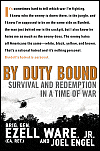
Joel Engel recently co-authored the book Duty Bound: Survival and Redemption in a Time of War, the story of Ezell Ware. Ware is the primary author. From the publisher (via barnesandnoble.com):
"Raised in the segregated South, Ezell Ware was determined to excel beyond the lines drawn by white power brokers. He became the top recruit in his Marine training class; having grown up without running water, electricity, or sufficient food, he wasn't daunted by military life. He eventually earned a chance to join the Army's helicopter pilot program, realizing his dream of flying. It was a role that would change his life, and the life of an unlikely partner in valor at the height of the Vietnam War." Downed by enemy fire while on a mission over thick jungles, Ware and his badly injured captain endured a three-week descent into hell, with one canteen and little defense against countless deadly forces. But when his captain revealed his membership in the Ku Klux Klan, their situation took a turn that surprised them both - and put Ezell on the road to becoming a general.
I've just done a quick tour around the Internet, and at this point the professional reviewers (Publisher's Weekly, Kirkus Reviews) are sneering at this book, but most customer reviews are proclaiming it inspiring. The panning in the 'official' reviews is not altogether surprising, since many professional critics appear to think it is their job to find fault instead of review (did I say that?). But one of the main problems appears to be that the 'pros' are quite obviously choking over Brig. Gen. Ezell Ware's assessment that it was right to go into Vietnam, and that certain aspects of the war went better than portrayed in press reports.

This book sounds a little too rough and gory for me, but I'd like to know whether to recommend it to some of our regular customers who generally go for military, history, or political reads. If you've read it, I'd appreciate a note in the comments section. Thanks.

By Duty Bound: Survival & Redemption in a Time of War

Friday, April 15, 2005

Good Book: Dear Mad'm, by Stella Walthal Patterson

This book was first published about fifty years ago and it just keeps right on quietly selling a copy here and another copy there and picking up fans in each generation.

Dear Mad'm relates the adventures and misadventures of a delightful lady who decided - at the age of 80, mind you - to go off by herself and manage a placer mine in the north California mountains for a year. Stella Walthal Patterson was one of those people possessed of a rare zest for life. When she figured she still had 'young legs' at her age, well, by golly, she was going to find some way to use them. And besides, she'd didn't know how to live in the mountains. Yet.

The woman had a good sense of humor as well as a sense of adventure. This is a spunky, funny read, straight out of the 1950s.

It's still in print, in a 1982 edition published by Naturegraph, ISBN 0879611316. The front jacket copy says, "The refreshing adventures of a woman who at the age of eighty found a new life in the wilds of the Siskiyou Mountains near Happy Camp, California."

Dear Mad'm
Dear Mad'm

Murdoc Online: Dear Pack 3311

Here's a great story about Cub Scouts and a Captain in the United States Marine Corps. Hats off to both the kids and the Marines. These folks have some class.

Hat tip: Expat Yank.

MazeWorks - Java Games and Puzzles

This looks to be a fun website for those of us who like brain teasers. It also features a daily chess problem, for those of you who play chess.

Hat tip: www.math.com. (Which is still under construction, but has some useful stuff already.)

'Don's' arrest sparks protest - JAMAICAOBSERVER.COM

This article is rather unpleasant, or at least it is about unpleasant happenings, but it does provide a useful contrast to politics in much of the rest of the world. I don't know about the rest of you, but I'm worried about Jamaica these days. I'm not sure it would stack up favorably side by side with Iraq just now, to be honest about it.

This is from the April 13, 2005, Jamaica Observer online. I notice that the reporter is listed semi-anonymously as "Observer Reporter". But if these guys are scared, who can blame them? There has been just a whole lot of violence down there lately, from what I've read.

(Of course, mass media always provides a balanced and accurate overall view of things, doesn't it?)

RESIDENTS of the tough Spanish Town community of Tawes Pen yesterday locked down sections of the old capital to protest against the detention of their area 'don', Andrew Hope, better known as "Bun man", the reputed leader of the One Order Gang, one of the two gangs said to be at the centre of the deadly intermittent violence plaguing that town...

Residents of Tawes Pen, home to some members of the One Order gang, claimed that they were justified in blocking the roads as the police wrongfully detained their "father" and abused them in the process.

"Him (Bun Man) a di father fi di whole a wi, a him sen wi pickney dem go a school so wi caan do without him roun' ya," shouted one female resident.

"Anyhow dem (police) try tek him weh again wi ago lock down di whole place or jus' mash it dung," another woman blurted.

Some of the residents claimed that they were boxed, kicked and verbally abused by members of the security forces.

But Inspector Robinson denied the claims. "Anytime you have situations of this nature there are always claims of abuse," he told the Observer. "I have been here all morning and I have not
witnessed any such incident."

The One Order gang, which is aligned to the Opposition Jamaica Labour Party, has been involved in bloody conflicts with members of the Klansman gang, which backs the ruling People's National Party...

Thursday, April 14, 2005

Technical difficulties

I tried to add some links to my template, and garbled the template. (Well, actually, I also managed somehow to delete about half the template. Don't ask me how.)

I finally admitted temporary defeat and started over with a pristine template. This means that I am having to start over on all sorts of little stuff.

So, naturally, Blogger and the Internet both seem to be having problems right now.

Please bear with me. I'll try to rebuild the links list, etc., sometime tomorrow or the next day if I can get everything to work long enough to get the job done.

Thanks.

UPDATE: Friday, 10:15 a.m. - OK, so I've almost recovered everything I'd lost. (For now, at least.) Now comes the fun part. Now I start trying to do the modifications that blew me out of the water yesterday. Please be patient. For the next few days I'll be experimenting, trying to improve the site. But since I'm a techno-rookie, I expect there will be some interesting mistakes along the way. If the links disappear again (or anything else for that matter), it's only because I'm learning. (Isn't that what we tell children who are attempting something unfamiliar and are positively botching the early proceedings? :)

Good Book: The Ordinary Princess, by M. M. Kaye

M.M. Kaye, known for sweeping historical novels like The Far Pavilions and Shadow of the Moon, and for her mystery/romantic suspense books (Death in Zanzibar, Death in Kenya, Death in Cypress, Death in Kashmir, Death in Berlin, etc., etc.), also, once upon a time, sat down under an apple tree in Kent and, fed up with fairy tales that featured only gorgeous princesses, wrote a small gem.

It's a shame, really, that The Ordinary Princess is generally marketed to young girls. Not that grade school girls aren't a natural audience for a book about a princess who is, as it happens, quite normal and ordinary (hooray!), but I'm afraid that such marketing might alienate another natural audience for this book. Don't laugh (OK, go ahead and laugh), but if you enjoy P.G. Wodehouse and are looking for a fresh dose of British wit and whimsy, mixed with a dose of razor-sharp perceptiveness when it comes to human shortcomings, you might check out this title. I don't want to oversell it here - just like its heroine it makes no pretense of being more than it is (nor, for that matter, is it quite the sustained over-the-top madness you tend to find with Wodehouse). But it's a nice, light, sometimes wickedly funny read all the same, in a very British way, and although it is quite different from the Jeeves and Wooster books, I can't help but recommend it to fans of that series. It's just too much fun, really.

Here's the part that explains where this story veers off from the usual run of princess stories:

She raised her twisty coral stick and waved it three times over the cradle of the seventh princess. "My child," said the Fairy Crustacea, "I am going to give you something that will probably bring you more happiness than all these fal-lals and fripperies put together. You shall be Ordinary!"

And nodding her head briskly the Fairy Crustacea turned away and hobbled rapidly out of the throne room, leaning on her twisty coral stick and leaving a faint smell of seaweed and a damp track on the polished floor behind her.

For quite a minute after she had gone there was a stunned silence in the red and gold throne room of the palace...

The Ordinary Princess, by M.M. Kaye, is available new in a reprint paperback edition from Penguin Group, ISBN 0142300853.

Addition: For more from Barnes & Noble, click on the book cover.

The Ordinary Princess

Wednesday, April 13, 2005

Expat Yank: For Fed-up Voters

The UK is suffering election run-up madness at the moment. Luckily, there are a few people who can translate political babble, among them Robert Tumminello of Expat Yank, who takes on the Greens in this post (use title link).

And lest you think he gives other parties a free pass, in a recent post he quite properly zeroed in on one addle-brained (one hopes he is addle-brained instead of crooked) Tory candidate who doctored a photo for his campaign material - a photo, mind you, that had run in its undoctored condition in a newspaper. (I keep hoping Tories will stop shooting their own feet, if even just for a little while. But, no...) See http://expatyank.blogspot.com/2005/04/altered-but-accurate.html for that bit of nonsense.

Elisabeth Sifton: Editing Saul Bellow

A woman who worked with Saul Bellow pays tribute to the late author.
When the Viking Press published Mr. Sammler's Planet in the fall of 1971, I happened to be the new kid on the Viking editorial block. I guess all of us knew, and I learned quickly, that the great man liked to read proofs in-house when he could, turning up to attend to this or that when he was in New York in the peri-publication period. Since he revised his texts heavily in the late stages (sometimes with up to four sets of proofs), he was around plenty....

Sense and Sensibility Bookstore - Books on Fashion History and Costuming

This is quite a collection of books. File under fashion, history, clothing, stage costumes. Hat tip to Pipsqueak at The Common Room (see previous post).

The Common Room: I'm making a regency dress

"Pipsqueak" at The Common Room has made Regency gowns for herself and three sisters, and is already working on a fifth, for a friend. She recommends the patterns at www.sensibility.com., especially if (as she says) you are a fan of books like Pride and Prejudice, Jane Eyre, and Emma.

Go, girl!

UPDATE: I guess it wasn't Pipsqueak, but someone writing under her account. See comments.

Go, Jenny-Any-Dot and friends!

Laura Hirschfeld Hollis: Protecting your family in a culture that's gone stark raving mad

This links to a book review of Home Invasion: Protecting Your Family in a Culture That's Gone Start Raving Mad, by Rebecca Hagelin.

John Leo: Baking up a controversy

Who would have thought that cookie sales could stir up this much trouble?

I'm not sure who came up with the idea for affirmative action bake sales - where prices are rigged according to the usual criteria used in affirmative action - but they've caught on among conserverative and moderate students wishing to make a point. As John Leo points out, the opposition forces are acting like this is of earth-shattering importance and are using any argument they can get their hands on to shut them down.

(One nice touch is that one university allowed a satirical feminist wage-gap bake sale, but not the affirmative action one...)

Tuesday, April 12, 2005

PBS - THE WEST - Junipero Serra

And for another take on the dauntless Father Serra, here's a write-up from "New Perspectives on The West" at PBS.

There are many other biographies at this site.

The Miracle of Padre Junipero, by Bret Harte

Many history books and most modern references seem to have this poem's title character as Father Junipero Serra (instead of Serro, as in the poem).

According to The Golden Book of California: From the Days of the Spanish Explorers to the Present, by Irwin Shapiro, Golden Press, New York, 1961, Father Serra was partially lame, ill, and "not a young man" when he was sent in 1769 to establish missions in Upper California. By 1773, he had established five missions. By the time he died in 1784, there were nine missions along El Camino Real, or the The King's Highway. Until shortly before his death, he had traveled from one to another, limping, leaning on a staff or riding a mule, his health getting worse and worse, but refusing to give up his travels until just weeks before his death. By then he had overseen a mission field in which more than 6,000 Indians had been baptised, and over 5,000 confirmed. He spent the last weeks of his life at the San Carlos Borromeo Mission at Monterey.

Here is Bret Harte's version of one of the Father Serra legends.

THIS IS the tale that the Chronicle
Tells of the wonderful miracle
Wrought by the pious Padre Serro,
The very reverend Junipero.

The heathen stood on his ancient mound,
Looking over the desert bound
Into the distant, hazy South,
Over the dusty and broad champaign,
Where, with many a gaping mouth
And fissure, cracked by the fervid drouth,
For seven months had the wasted plain
Known no moisture of dew or rain.
The wells were empty and choked with sand;
The rivers had perished from the land;
Only the sea-fogs to and fro
Slipped like ghosts of the streams below.
Deep in its bed lay the river’s bones,
Bleaching in pebbles and milk-white stones,
And tracked o’er the desert faint and far,
Its ribs shone bright on each sandy bar.

Thus they stood as the sun went down
Over the foot-hills bare and brown;
Thus they looked to the South, wherefrom
The pale-face medicine-man should come,
Not in anger or in strife,
But to bring—so ran the tale—
The welcome springs of eternal life,
The living waters that should not fail.

Said one, “He will come like Manitou,
Unseen, unheard, in the falling dew.”
Said another, “He will come full soon
Out of the round-faced watery moon.”
And another said, “He is here!” and lo,
Faltering, staggering, feeble and slow,
Out from the desert’s blinding heat
The Padre dropped at the heathen’s feet.

They stood and gazed for a little space
Down on his pallid and careworn face,
And a smile of scorn went round the band
As they touched alternate with foot and hand
This mortal waif, that the outer space
Of dim mysterious sky and sand
Flung with so little of Christian grace
Down on their barren, sterile strand.

Said one to him: “It seems thy God
Is a very pitiful kind of God:
He could not shield thine aching eyes
From the blowing desert sands that rise,
Nor turn aside from thy old gray head
The glittering blade that is brandishèd
By the sun He set in the heavens high;
He could not moisten thy lips when dry;
The desert fire is in thy brain;
Thy limbs are racked with the fever-pain.
If this be the grace He showeth thee
Who art His servant, what may we,
Strange to His ways and His commands,
Seek at His unforgiving hands?”

“Drink but this cup,” said the Padre, straight,
“And thou shalt know whose mercy bore
These aching limbs to your heathen door,
And purged my soul of its gross estate.
Drink in His name, and thou shalt see
The hidden depths of this mystery.
Drink!” and he held the cup. One blow
From the heathen dashed to the ground below
The sacred cup that the Padre bore,
And the thirsty soil drank the precious store
Of sacramental and holy wine,
That emblem and consecrated sign
And blessed symbol of blood divine.

Then, says the legend (and they who doubt
The same as heretics be accurst),
From the dry and feverish soil leaped out
A living fountain; a well-spring burst
Over the dusty and broad champaign,
Over the sandy and sterile plain,
Till the granite ribs and the milk-white stones
That lay in the valley—the scattered bones—
Moved in the river and lived again!

Such was the wonderful miracle
Wrought by the cup of wine that fell
From the hands of the pious Padre Serro,
The very reverend Junipero.

Terra Galleria photography: travel, landscape, and nature pictures

Quang-Tuan Luong, also known as Q.T. Luong, shares the beauty of the world. I love this guy's photography. He also generously offers some of his pictures for free for computer wallpaper. (Read the rules, please. Play fair. The man has to eat, you know.)

Preface - Those Extraordinary Twins - Mark Twain

I think it was John Dickson Carr, under one pseudonym or another, who bragged that some books came into his head essentially ready-made and only took a matter of days to write down. (How much time the publisher's editors spent whipping it into final shape after that never really got mentioned, as I remember...)

And I'm sure that happens sometimes, particularly with authors who have a few books under their belt and have some momentum built up.

And, for the record, I happen to like some of Mr. Carr's rapidly-written wonders, particularly some of the Carter Dickson ones, especially the Sir Henry Merrivale ones. (He's such a big, blustering, old softie, he is.)

But, for most authors of fiction, most of the time, I suspect the process is less like the legendary hack model and much more like what Mark Twain describes in the preface to Those Extraordinary Twins, as reprinted over at http://whitewolf.newcastle.edu.au/words:

A MAN who is born with the novel-writing gift has a troublesome time of it when he tries to build a novel. I know this from experience. He has no clear idea of his story; in fact he has no story. He merely has some people in his mind, and an incident or two, also a locality. He knows these people, he knows the selected locality, and he trusts that he can plunge those people into those incidents with interesting results. So he goes to work. To write a novel? No—that is a thought which comes later; in the beginning he is only proposing to tell a little tale; a very little tale; a six-page tale. But as it is a tale which he is not acquainted with, and can only find out what it is by listening as it goes along telling itself, it is more than apt to go on and on and on till it spreads itself into a book. I know about this, because it has happened to me so many times.

And I have noticed another thing: that as the short tale grows into the long tale, the original intention (or motif) is apt to get abolished and find itself superseded by a quite different one. It was so in the case of a magazine sketch which I once started to write—a funny and fantastic sketch about a prince and a pauper; it presently assumed a grave cast of its own accord, and in that new shape spread itself out into a book. Much the same thing happened with “Pudd’nhead Wilson.” I had a sufficiently hard time with that tale, because it changed itself from a farce to a tragedy while I was going along with it—a most embarrassing circumstance. But what was a great deal worse was, that it was not one story, but two stories tangled together; and they obstructed and interrupted each other at every turn and created no end of confusion and annoyance. I could not offer the book for publication, for I was afraid it would unseat the reader’s reason. I did not know what was the matter with it, for I had not noticed, as yet, that it was two stories in one. It took me months to make that discovery. I carried the manuscript back and forth across the Atlantic two or three times, and read it and studied over it on shipboard; and at last I saw where the difficulty lay. I had no further trouble. I pulled one of the stories out by the roots, and left the other one—a kind of literary Cæsarean operation...

A Touch of Brass (washingtonpost.com)

The bad news is that this April 6, 2005, Washington Post article by Paul Farhi drips with condescension (for three pages, no less). The good news is that it is about Herb Alpert's music being reissued, albeit by a little label, Shout! Factory, of Los Angeles. The article is rather exasperating, but it does contain some nice Herb Alpert & the Tijuana Brass information despite itself.

(OK, so now I'm being condescending. Sorry.)

Here's to more upbeat music hitting the shelves, old or new. I don't know about you, but I'm tired of ugly lyrics and downer attitudes in music.

Hat tip: Bookworm Room

Monday, April 11, 2005

Power Line: More on the Second Anniversary

I don't have a clue how to read Arabic writing, so I'll have to take their word for it.

John at Power Line has a post saying that many of the demonstrators in Iraq marking April 9 were marching in a show against Saddam, although you wouldn't know it from media coverage. He reprints a picture showing demonstrators with a banner and provides the English translation.

Zorro - A history of the series

If you are looking for an excuse for a bit of silliness, a week from today marks the anniversary of this bit of show biz history:

...Walt immediately set to work on a search for someone to play Zorro, knowing full well that whoever he picked, comparisons to Tyrone Power were inevitable. This was a much sought after role, for Disney's success with Davy Crockett was not lost on a host of other actors who could only dream of being the Studio's next Fess Parker. More than 20 actors were tested for the part, including Hugh O'Brian, John Lupton, Jack Kelly, Dennis Weaver and David Janssen. On April 18, 1957, the Studio held a screen test for a relatively unknown actor, Guy Williams. When Walt saw the results, he knew he had found his Zorro...

See you at the Mexican restaurant? To raise a toast to the memory of Williams? What do you say? (Will they forgive us if we sing the theme song, do you think? Out of the night, when the full moon is bright, comes the horseman known as Zorro...)

The above link takes you to Bill Cotter's website. He has a great collection of Zorro information, including episode notes.

Sunday, April 10, 2005

The Independent: Pigeon fancier's flight of fantasy brought to earth but dream lives on

Here's a look at some unconventional horse owners, Fergus and Judith Wilson, who have their own way of trying to win the Grand National. The reporter is Paul Newman, and the article is in the April 11, 2005, The Independent, Online Edition:

Fergus Wilson is the most affable of owners, but as the field approached the Canal Turn there was a hint of exasperation in his voice. "The commentator hasn't even mentioned Astonville," he said, peering into the distance from the top of the Owners and Trainers Stand. "We're second in the Grand National and he hasn't even mentioned us."

Most boys dream of playing for Manchester United or of opening the batting for England. "I dreamed of owning a Grand National winner," Wilson had said before the race. "It's what I've always wanted to do, ever since I was five years old."...

Scotsman.com: From tail to tale on the path of pilgrims in life

Controversial biologist Richard Dawkins talks about what is in and behind his book The Ancestor's Tale, in this April 9, 2005, article for the Scotsman (use title link). The article ran in conjunction with Dawkins' appearance at the Edinburgh Science Festival.

From the publisher's write-up for this title:

The renowned biologist and thinker Richard Dawkins presents his most expansive work yet: a comprehensive look at evolution, ranging from the latest developments in the field to his own provocative views. Loosely based on the form of Chaucer's Canterbury Tales, Dawkins's Tale takes us modern humans back through four billion years of life on our planet. As the pilgrimage progresses, we join with other organisms at the forty "rendezvous points" where we find a common ancestor. The band of pilgrims swells into a vast crowd as we join first with other primates, then with other mammals, and so on back to the first primordial organism. Dawkins's brilliant, inventive approach allows us to view the connections between ourselves and all other life in a bracingly novel way....

Oh, dear. I just read a couple of reviews on barnesandnoble.com, and "A reviewer" faults the author for too many digs at George W. Bush - not because the reviewer likes Bush (he clearly doesn't), but because he's afraid this will make the book seem dated too quickly. Sigh.

Oh, well. Just so you know, Dawkins does seem to be riding something of a wave right now - not a huge one, perhaps, but he is making noticable ripples.

An interesting side note: as I go to post, this title is ranked 569 in books at Amazon, and has a Barnes & Noble sales rank of 1,495. You don't usually see quite that much disparity between the rankings on the two sites. It does happen though, especially in nonfiction. But, still, what a difference.

The amazon.co.uk ranking is 659. (Anagrams, anyone? 569/659??? Or would that be something like 'numagrams', this being numbers instead of letters?) By the way, the UK cover is more professional looking than the US cover, in my humble opinion.

The Beginner - The Muse Among the Motors - Rudyard Kipling

This is for a friend of ours, who just repaired a fancy car for a client who promptly managed to tear the new trimming off by driving too close to a wall...

The title is The Beginner. It is one of several auto-related parodies written by Rudyard Kipling.

LO! What is this that I make—sudden, supreme, unrehearsed—
This that my clutch in the crowd pressed at a venture has raised?
Forward and onward I sprang when I thought (as I ought) I reversed,
And a cab like martagon opes and I sit in the wreckage dazed.

And someone is taking my name, and the driver is rending the air
With cries for my blood and my gold, and a snickering news-boy brings
My cap, wheel-pashed from the kerb. I must run her home for repair,
Where she leers with her bonnet awry—flat on the nether springs!

For more on Rudyard Kipling, including information on his adventures with early automobiles, see http://www.solarnavigator.net/history/rudyard_kipling.htm.

James Thomson's zinger

Inspired by Wittingshire's bit on Longfellow (see earlier post), I pulled a poetry book off the shelf. (Poetry of the Victorian Period, Third Edition, Jerome Hamilton Buckley and George Benjamin Woods, published by Scott, Foresman and Company, 1965). I opened it at random, and got something long and dreary. So I opened it a second time at random, to page 582 (which is roughly halfway through the book), and came across this:

JAMES THOMSON (1834-1882)

ONCE IN A SAINTLY PASSION

Once in a saintly passion
I cried with desperate grief
"O Lord, my heart is black with guile,
Of sinners I am chief."
Then stooped my guardian angel
And whispered from behind,
"Vanity, my little man,
You're nothing of the kind."


Oh, ouch.

Book to Watch: The Last Voyage of Columbus, by Martin Dugard

I haven't had a chance to read this yet, but my husband has just finished reading the Advance Reading Copy of The Last Voyage of Columbus: Being the Epic Tale of the Great Captain's Fourth Expedition, Including Accounts of Swordfight, Mutiny, Shipwreck, Gold, War, Hurricane, and Discovery (how's that for a subtitle!), by Martin Dugard, due to come out in June from Little, Brown, and on Time Warner Audiobooks.

He says it's a good read: a little graphic in places, but within context - i.e., the rough stuff is integral to the story and not out of bounds.

And, hurrah, it sounds like Columbus gets treated as a real guy, instead of either a whipping boy for modern sophisticates on the one hand or a gooey goody-two-shoes on the other.

Dugard is the New York Times bestselling author of several other nonfiction books, including Farther Than Any Man: The Rise and Fall of Captain James Cook, Knockdown, Surviving the Toughest Race on Earth, and Into Africa: The Epic Adventure of Stanley and Livingston. He has also written for Esquire, Outside, Sports Illustrated, and GQ.

The hardcover ISBN is 0316828831.

The Last Voyage of Columbus: Being the Epic Tale of the Great Captain's Fourth Expedition, Including Accounts of Swordfight, Mutiny, Shipwreck, Gold, War, Hurricane, and Discovery

Wittingshire: Poem Sunday: Longfellow

Over at Wittingshire, Amanda has reprinted Longfellow's "A Psalm of Life" and has background on the poet.

I'd forgotten that his wife died after a sentimental family project using sealing wax went tragically wrong. (She was sealing envelopes containing cuttings of her children's hair, and her dress caught fire. Yikes.) That's why he grew his famous beard - his face got scarred when he rushed to help her.

Amanda has that story and more, plus links.

TheDenverChannel.com - Wicked Storm Pounds State

We've been getting much-needed rain and snow here in our part of Oregon lately - but perhaps not enough to fend off a drought this summer. (The nice thing about living high up in this watershed is that in the good years you can look at the mountain to the south of you and see at a glance that there's enough water to make it through the summer. The bad thing about living high up in this watershed is that in years with poor snowpack you can look at that same, solitary mountain, and know you're in trouble. This year, we're really close to being in serious trouble.)

So I'm hoping for more snowstorms this spring, at least around here.

But, oh my, look at what's happening in Colorado. They needed more snow, no doubt, but this is wild! (Use title link for details.)

Mae Magouirk Update - The Contrarian Edition Version 2 :: BlogsforTerri

This week, I faced some technical difficulties (i.e., Google's usually wonderful system wouldn't allow me to do anything blogwise for two full days, zilch, nada), which wouldn't have been either here or there, except that a glance at the Blogs For Terri website showed that there was another person in danger of being dehydrated to death - and this despite having legal protections in place. By the time I was up and running again and ready to lend my voice to the emergency efforts, the reports from various quarters were so conflicting that I didn't know quite where to start or what to believe. And then the lady got rescued - pulled out of hospice and taken to a hospital. Ah, blessed breathing room.

Today things seem to be starting to sort themselves out nicely. To their credit, the folks at Blogs for Terri are opening up their space to comments by the judge and to both sides of the family in this case. It is looking more and more like the judge thought he'd assured that removing food and water was not an option (which means he got as blindsided as everyone else), and it also looks more and more as though the guardian got temporarily outmaneuvered by doctors who thought Grandma ought to get along a little faster in her dying (which would mean that she got blindsided, too).

Blogs for Terri has background on all of this, and links to other sites that fought for this one elderly woman's life. And, as I said, most people involved in this rush rescue are being careful to give the benefit of the doubt to both the judge and the guardian in this case. Now that Mae Magouirk has been moved to safety, we have the luxury of sitting back, taking a deep breath, and trying to figure out how she got placed in harm's way in the first place.

The old saying "Live and learn" has a new twist these days, it seems like.

Perhaps I'm getting ahead of myself or ahead of reality here (call it wishful thinking, perhaps), but I'm starting to wonder if something fundamental is happening here. Is what happened to Terri Schiavo (may she rest in peace) going to result in something good? I am thinking about John Walsh here, and what happened after his son Adam was murdered. That one horrible, inexcusable murder of an innocent little boy has irretrievably altered the world, I think. Adam's father responded to his family's cruel loss by setting about fixing shortcomings in law enforcement and by promoting victims' rights. Whoever it was who killed Adam stole a sweet kid from his family and from his own future, but they also unleashed something. It is much harder these days to be a fugitive. It is less likely, also, that cold cases will just sit there. Murderers have fewer places to run. John Walsh and his America's Most Wanted programs see to that. Even internationally, things have changed, as other countries have picked up on the success of America's Most Wanted and have built on it.

I don't know. It's early days yet. But it feels like something similar is happening in the shadowy land of hospice care, where mercy is sometimes replaced with killing. Here we had a case where family members saw an elderly and ill, but not dying, loved one strangely sent to a hospice instead of to a nursing home, and as far as they could tell she was slated for a cruel death - and they had somewhere to go. They cried for help, and help rained down from the four corners of the world. Total strangers pleaded that the hospice not be allowed to kill a specific somebody, and that specific somebody is now out of the hospice.

How does the old song go? Something's happening here, What it is ain't exactly clear...

I'm proud of the people who saw an emergency and responded to it. I'm glad we have people on standby in the blogosphere, ready, willing, and able to drop whatever else they might be doing to help total strangers, if they can. Thank goodness they, and certain news organizations (World Net Daily, for example), are making a point of looking out for helpless people.

This is not to say that I like all the blogs that are on the Blogs For Terri blogroll. At least twice a week I vow I'm going to take the blogroll off my site, because one or another blogger on the list has, uhm, caused me much embarrassment, I guess you could say. But it is an old truth that you cannot pick either your enemies or your allies, but your allies least of all. And man, what a difference these allies, even the very odd ones, seem to be making. A family thought their beloved grandmother/aunt/sister was going to be killed. And they had somewhere their screams were heard and heeded in time to make a difference. Wow.

I expect things won't sail smoothly on this effort. Scam artists and crooks and weirdos will undoubtedly try to mess things up. (Any Blogs for Terri affiliate who hasn't been attacked, please raise your lonely hand. I'm a little guy, and I got attacked, more than once actually. What is it with these people, anyway?) People will lie, and people will be mistaken, and so sometimes we'll have to apologize or regroup, at a guess. But, in the end, it's worth the struggle, isn't it? Disabled people need help, and as far as I can see, there's no excuse for giving up.

P.S. In case you're unfamiliar with John Walsh and his crusade for justice, http://amw.com/about_amw/john_walsh.cfm gives a brief overview. I don't like everything he does, either, but wow, what a force for good he's been overall.

Saturday, April 09, 2005

FT.com / Arts & Weekend / Books - Vaccine nation

Andrew Jack, writing for the Financial Times online, looks at the history of polio and polio vaccines, plus four books on the illness and the crusade to wipe it out.

This coming week marks the 50th anniversary of the public introduction of the Salk vaccine.

A French Fight Against Google | Deutsche Welle |

The headline on this Deutsche Welle article, i.e. "A French Fight Against Google", is ridiculous and misleading. The article is about Jean-Noel Jeanneney, the director of the French National Library, proposing that Europe launch a project similar to the Google Print project (which aims to make millions of English-language books available on the Internet). Applauding the effort and suggesting a coordinated plan to complement it with non-English books is hardly an attack on Google, is it?

What's sad (or funny) is that the article itself notes that:

...The early works to be digitized are likely to be old history books and literary classics whose authors are long dead. In the short term authors’ rights should be less of a problem than which works to choose. For Jeanneney, the task is how to convince his American rivals that his European mission is not, as has been reported, about declaring cultural warfare.

"It's not at all a war cry," he insisted. "It's normal that America is in the first rank to develop that wonderful gift to humanity. I'm not criticizing it, I just tell Europeans that America will play its game, and we must play ours."

Expat Yank: A Prince's Civil Wedding

I hadn't quite decided whether I'd post anything on the Charles/Camilla wedding. I didn't watch it. It seemed almost too painful to want to watch it, really - rather like watching grown-ups get chastised by relatives in public, if you know what I mean? Besides, the run-up to the wedding has almost felt cursed, hasn't it?

But then I ran across this posting by Robert Tumminello, a New Yorker living across the pond with his English wife, which has some nice bits. He and his wife did watch the fuss - well, the fuss that happened when they weren't out on shopping breaks, etc.

The Surrender

On April 9, 1865 after four years of Civil War, approximately 630,000 deaths and over 1 million casualties, General Robert E. Lee surrendered the Confederate Army of Northern Virginia to Lieutenant General Ulysses S. Grant, at the home of Wilmer and Virginia McLean in the town of Appomattox Court House , Virginia...
Let's see, if I've done my math correctly, that's 140 years ago today. I sometimes wonder why, in school, it seemed much, much longer ago than that? Ancient history, if you wanted to get right down to it. And where did I get the notion that this one surrender meant the war was over? I have to keep reteaching myself that there were other armies besides Lee's, and they had to surrender also, over a course of several months. I mean, for most of my youth I thought that Grant versus Lee was essentially all there was to the Civil War. (Sigh.)

Peggy Noonan: 'We Want God'

Peggy Noonan, writing for the April 7, 2005, OpinionJournal, looks back at John Paul II's 1979 trip to Poland, and says it changed the world.

Iraq the Model: The Eid of Liberty

An Iraqi man explains why April 9 is his "brightest day" (use title link).

I didn't know what his title meant, but according to The Penguin English Dictionary, Second Edition, Eid is used to refer to both Eid-ul-Adha, which is a Muslim festival celebrating the strong faith of Abraham, and Eid-ul-Fitr, the Muslim festival marking the end of Ramadan.

(As I mentioned in an earlier post, this dictionary has been worth every penny I had to spend to import it from the UK. The ISBN is 014051533X. Overall it's been invaluable for reading international writing.)

Many years ago, I was in Nicaragua with a group of college students.

I think it was Nicaragua where this happened. We were visiting all the countries of Central America in one winter, and like in any whirlwind tour, some of the memories from one place get muddled up with memories from another. (And I haven't seen my diary from that trip since about three houses ago. Isn't moving fun?) Certainly it was one of the countries where people were under the boot back then. El Salvador, perhaps?

I think it was Nicaragua where this occurred. Let us assume it was. It doesn't really matter. It was in a very bad corner of Central America, in any case. That I'm sure about.

Many years ago, back in the 1970s, I was in Nicaragua with a group of college students. We were confused. Our impression of the people where we were was that they were all retarded. Literally. At some point it dawned on me that the reason everyone was coming across as stupid was because people were not communicating with each other on the street. People were not making eye contact, they were not chatting. When they came across us, they wandered off with dull eyes, as if they didn't notice that we were in any way different or otherwise possibly interesting. They did not seem to pick up on our hints that we thought that they might be interesting to get to know. Offers of friendship went unacknowledged. No one showed the open curiosity that we had met with elsewhere in our travels - not about us, not about their neighbors, not about what was going on around them. It was this lack of normal connectiveness that made them seem stupid.

When they couldn't avoid talking to us, they shouted what they were saying. It took a while to understand that they were being very careful to make sure that everyone in the vicinity knew exactly what they were saying to the gringos. Exactly what they were saying, and everything they were saying.

Something curious happened there. Some of us, myself included, did wind up talking to people, but only after someone smuggled us into his or her home and closed the curtains as well as the doors. (I would like to thank my guardian angel here, for getting me out of Nicaragua. In hindsight, being talked into going alone into a private home, much less one in a foreign country lorded over by a ruthless police state, was not the sort of thing conducive to survival. What can I say? I was a college student, from a nice family, going to a nice school, and I had not a street smart in my body. Yikes.)

I don't know about how things went for the other students, but as I remember it my smugglers mostly looked at me. A family gathered and then just sat there and cried and looked at me. You don't know what it's like, they whispered, to finally have contact with the outside world. You have no idea.

Being a sophisticated college student, I thought they were the ones who didn't understand. Oh, those poor, uneducated urban peasants.

Later, after I was out of the country, later, when I was older and had seen more and had more time to put things into perspective, I realized that I had been a world-class fool. Indeed, they were right. Unspeakably right. I had had no comprehension of how valuable, how rare, how precious it was to have contact with the outside world, or to live in a place I could say hello to anyone on the street without worrying that thugs might then target my family to shove me back into line.

I guess that I see Iraq through that prism, shaped by that small, short glimpse into what life is like under oppression.

I am in awe, quite frankly, of the people of Iraq. How much courage must it take to face down what has ruthlessly trampled them for generations? I can't fathom it, not really.

I am sure I have no idea, none, not really, of how important April 9 must be to them. But I'd bet my frightened citizens from Central America - who risked who knows what just to sit with a free person for a while - I'd bet they'd understand.

Don't try to tell me the Iraqi liberation wasn't worth it, or wasn't the right thing to do. I have seen people crying just because they met a free person who did not understand what it means to be free.

David McCullough: Knowing History and Knowing Who We Are

The written version of historian David McCullough's Feb. 15, 2005 speech in Phoenix, Arizona, at a Hillsdale College National Leadership Seminar starts:
Harry Truman once said the only new thing in the world is the history you don’t know. Lord Bolingbroke, who was an 18th century political philosopher, said that history is philosophy taught with examples. An old friend, the late Daniel Boorstin, who was a very good historian and Librarian of Congress, said that trying to plan for the future without a sense of the past is like trying to plant cut flowers. We’re raising a lot of cut flowers and trying to plant them, and that’s much of what I want to talk about tonight...
The speech is published in the current issue of Imprimis.

Thursday, April 07, 2005

About bestseller lists

I'm hearing a lot of nonsense lately about how Men in Black by Mark Levin can't really be selling to actual readers despite its rankings on bestseller lists. Surely radical right-wing groups are buying it by the case and handing it out free and that explains everything, is more or less the argument being floated. This, by the way, was exactly the argument floated by careless pundits on the right when Hillary Rodham Clinton's book hit the bestseller lists. Surely nobody would read something written by her? It must be all those radical lefties buying the books en masse for publicity purposes or as some sort of money laundering arrangement.

Yes, and that explained all the people standing in line for hours for an autograph, too.

(Should I point out that our recent national elections showed rather dramatically that there are fervent supporters for just all sorts of things on either side of the middle? Actually, I think I'll let that go, for now...)

Ladies and gentlemen, while undoubtedly sometimes people get horribly excited about a book and buy it by the truckload to give to supporters (or to send to enemies), and while modern publishers/authors are probably not immune to the temptation of occasionally pulling off a publicity stunt or two (including, at a guess, covertly helping to arrange bulk sales at key times), could we please get a grip?

We are not dealing with our grandparents' bestseller lists, okay?

In the old days, in fact right up until a few years ago, bestseller lists were rather open to 'gaming' in that they were (for the most part) based on wholesale sales - i.e., how many books were sold to bookstores and/or distributors. If a publisher wanted a book on an influential bestseller list, the publisher could send out very astute and aggressive agents to persuade big bookstores to place huge advance orders. This was no skin off the noses of big bookstores because they had the option of returning any of the books that didn't sell within a few weeks. (In case you've missed the point of that last sentence, the publishing industry set it up so that large chain bookstores didn't have to assume the risks associated with overstocking any given title. Whatever didn't sell didn't have to be paid for. Nor did it hang about tying up precious shelf space or filling up warehouses. Such a deal.)

This was, to put it mildly, not a perfect system for tracking sales to customers, but given the technology of the times, and given that many wholesalers were happy to share sales figures for individual titles and many booksellers balked until there were privacy safeguards in place, etc., it probably worked about as well as anything could under the circumstances. And, still trying to be fair here, although the bestseller lists were very good at supporting books pre-selected for stardom, books that sold well through word of mouth could claw their way onto the charts. Little guys didn't get the breaks up front, in other words, but the field was open to some honest competition.

But, still, it was a bad system.

I don't know who was the first to tie in to the real-time inventory control data which became available to bookstores, but I first noticed it at the Wall Street Journal. To be honest, I subscribed to wsj.com several years ago because, as a bookseller, the fact that it had a bestseller list based on actual week-by-week retail sales was much more valuable to me than the New York Times list at the time.

How times change. This is what is currently noted at the bottom of the New York Times bestseller list:
Rankings reflect sales, for the week ending March 26, at almost 4,000 bookstores plus wholesalers serving 50,000 other retailers (gift shops, department stores, newsstands, supermarkets), statistically weighted to represent all such outlets nationwide. An asterisk (*) indicates that a book's sales are barely distinguishable from those of the book above. A dagger... indicates that some bookstores report receiving bulk orders.
You did catch that bit about "bulk orders" at the end? I still don't like the New York Times' list as much as some of the others, because it does do 'statistical weighting' and it does rely heavily on wholesalers - but, then, it is now upfront about it, and it clearly is keeping an eye out for anyone who might be trying to cheat, as it were. Good for them. (And whoever came up with the dagger as the symbol for bulk sales gets my applause. I think it is a nice touch.) And I do like how they have broadened their base to include outlets that aren't primarily bookstores.

The Wall Street Journal list is based on different sales figures:
The Wall Street Journal's list reflects nationwide sales of hardcover books during the week ended last Saturday at more than 2,500 Barnes & Noble, B. Dalton, Bookland, Books-a-Million, Books & Co., Bookstar, Bookstop, Borders, Brentano's, Coles, Coopersmith, Doubleday, Scribners and Waldenbooks stores, as well as sales from online retailers Amazon.com and barnesandnoble.com. The business list also includes figures from 800-CEO-READ. A sales index of 100 is equivalent to the median number of copies of the No. 1 fiction bestselling titles sold each week during 2004.
There are other bestseller lists out there, of course. As far as I know, most if not all of them are based at least to some degree on recorded retail sales. Most of them are likely based exclusively on actual retail sales.

I'm sure that it's still possible, somehow, to outwit the system, but it would be very hard to do given today's very broad and rather transparent data sources, and I'd hate to be the one caught trying it.

Now, as to the question of what percentage of buyers actually read any given title, that's a whole 'nother question (as we say around here). Books that make bestseller lists, by their very nature, have a skewed buyer/reader ratio. More on that someday.

Wednesday, April 06, 2005

Mommy Life: Where the Wild Things Are

Author Barbara Curtis gives her take on how to use Maurice Sendak's Where the Wild Things Are to help kids learn to tame their emotions.

UPDATE: Mommy Life is in the process of changing hosts. If the above URL doesn't work, try http://mommylife.net/archives/2005/03/where_the_wild.html

The Polish Seminary Student and the Jewish Girl He Saved

From the New York Times, as printed in the International Herald Tribune April 6, 2005, Roger Cohen shares a family story, of how Karol Wojtyla went out of his way to help an abandoned 13-year-old stranger.

UPDATE: I goofed. I had the International Herald Tribune article as printed in the New York Times instead of the other way around as noted above. Not that this would usually make any difference, but - James Taranto, in his April 7 Best of the Web column, notes in the "Mysteries of the Times" entry that the Paris version and the New York version of this story are edited differently. For instance, the European version had "I do not know what moved this young seminarian to save the life of a lost Jewish girl."

Taranto notes:
When the New York Times proper republished Cohen's story, it changed that last sentence: "What moved this young seminarian to save the life of a lost Jewish girl cannot be known" (emphasis ours).

Hmm, could it have been his religious faith?
Sigh. The ways of the New York Times are sometimes hard to understand...

The International Herald Tribune online version is "Globalist: A personal glimpse of the pope's belief in life", and can be accessed at http://www.iht.com/bin/print_ipub.php?file=/articles/2005/04/05/news/globalist.html or through Taranto's column http://www.opinionjournal.com/best/?id=110006527 (fourth item).

Tuesday, April 05, 2005

HistoryLink Essay: Play Ball! A Slide Show History of Early Baseball in Washington

All right, all you baseball fans out there. If you can find time away from poring over current stats, here's a look at baseball in the old days:

...Colorful team nicknames were the order of the day in the early part of the century. Consider the franchises in the 1903 Class D Southwest Washington League: the Aberdeen Pippins, the Hoquiam Perfect Gentlemen, the Centralia Midgets, and the Olympia Senators. Other team nicknames included the Seattle Clamdiggers, Siwashes, Purple Sox and Indians, Everett Smokestackers, Grays Harbor Lumberman, Chehalis Gophers, Raymond Venetians, North Yakima Braves, and the Spokane Hawks...
There are more than thirty old photos to go with the write-up.

NASA Shares Its Vision for a New Form of Air Travel

Airlines tend to rely on hubs, hubs tend to get congested, but you can't just toss a lot of planes in the air, send them any which way, and hope they somehow stay untangled and safe. Nor can you fully staff and equip every remote airport. So:

...The Small Aircraft Transportation System is a vision for a new kind of air travel that will complement the congested airline system. It is a partnership among NASA, the FAA and NCAM, which represents at least six state research groups.

Technologies being developed now will allow new classes of aircraft, including very light jets and other advanced small planes, to use neighborhood airports to fly people from place to place. Families will be able to go to their community airport and take a plane to grandma's neighborhood airport 600 miles away without having to deal with changing planes at a major hub....

The SATS project is developing technologies to show pilots their location, identify hazardous terrain, visualize the weather outside and locate other air traffic and airports.

Later this year in Danville [Virginia], the team will demonstrate that planes can land safely in bad weather at minimally equipped small airports with these new technologies. They will also show how these new displays will improve single pilot performance and how these improvements and capabilities will help small aircraft fit seamlessly into the national airspace system.

"During the three days, June fifth, sixth and seventh, planes will fly in and out of Danville Regional Airport," added Hefner. "They plan to beam the pictures of what the pilots are seeing to giant screens on the ground, so spectators can get an idea what's happening just like being a co-pilot."
Somehow this reminds me of the popular science magazines of my youth, which promised we'd all be flying atomic-powered helicopters to work by now. Except, of course, when we were driving our amphibious cars across the harbor to catch the latest 3-D movie.

Let's just say I'm skeptical that it will wind up as rosy as the NASA write-up envisions. I still would like for this to work to some degree. (Full disclosure: I live near one of those "minimally equipped small airports" that's supposed to benefit from all this.)

Wittingshire: The Soul of the Matter

Amanda at Wittingshire ties in to "The Soul of a Controversy: After Terri Schiavo's death, questions remain", an essay by David Hart (use link in her post or go directly to http://www.opinionjournal.com/taste/?id=110006500). I have to admit that David Hart was new to me when I read his essay on the Orthodox Christian way of looking at tragedies. (See: "Tremors of Doubt: What kind of God would allow a deadly tsunami?" at http://www.opinionjournal.com/taste/?id=110006097)

Since then, when I see his byline, I beeline. I find that I want to know his take on things.

Amanda provides this wonderful bit:

I'd love to listen in on David Hart's family gatherings; he's an Eastern Orthodox theologian, his brother Addison Hart is a Roman Catholic priest, and his brother Robert Hart is an Anglican priest.

George Weigel: Mourning and Remembrance

George Weigel, via the April 4, 2005, www.OpinionJournal.com, offers an insightful look at Pope John Paul II and at history:
...So there are many ways of remembering and mourning him. Pope John Paul II should also be remembered, however, as a man with a penetrating insight into the currents that flow beneath the surface of history, currents that in fact create history, often in surprising ways...

Mr. Weigel is a senior fellow and director of the Catholic Studies program at the Ethics and Public Policy Center. He is author of "Witness to Hope: The Biography of Pope John Paul II," (HarperCollins, 1999) and "The Cube and the Cathedral: Europe, America, and Politics Without God," just out from Basic Books.
This article is one of the best I've read on John Paul II. File under: culture, religion, human nature, morality, history, human dignity.

Monday, April 04, 2005

The Blind Men and the Elephant

Speaking of fairy tales, I admit to spending some time this week trying to write a modern version of the old legend about the blind men and the elephant.

Silly me. I just chanced upon the John Godfrey Saxe nineteenth century version. I can't match it, much less surpass it:

It was six men of Indostan
To learning much inclined,
Who went to see the Elephant
(Though all of them were blind),
That each by observation
Might satisfy his mind.

The First approached the Elephant,
And happening to fall
Against his broad and sturdy side,
At once began to bawl:
"God bless me! but the Elephant
Is very like a wall!"...
Etcetera, etcetera, etcetera.

Thanks to Duen Hsi Yen at noogenesis.com for his page on this (use title link). It has the complete verse, an illustration by Jason Hunt, plus commentary and links.

BBC NEWS | Danes parade fairy tale king

From an April 4, 2005, BBC report by Thomas Buch-Andersen:

Denmark has kicked off a year-long celebration of fairy tale author Hans Christian Andersen with a television spectacular, helped by the magic charms of celebrities.

Saturday's event in the capital Copenhagen marked 200 years since the birth of Andersen, who created such memorable tales as The Ugly Duckling, The Emperor's New Clothes and The Little Mermaid.

The Danish Queen, Margrethe II, was joined by other European royals, plus film star Sir Roger Moore, Chilean writer Isabella Allende, Danish football star Peter Schmeichel, Irish politician John Hume and many others.

The biggest Danish cultural event ever was broadcast to millions of TV viewers worldwide...

Amid all the razzmatazz some critics asked what stars of the 1980s, such as Olivia Newton-John and Tina Turner, had to do with Denmark's literary icon...
Ahh, who cares? If Newton-John and Turner, among others, like Danish-born fairy tales and are willing to help promote a bit of worldwide heritage (according to this report, Andersen's tales have been translated into 150 languages), why worry about it?

The above-linked article includes links to related articles and websites. (By following some of these I found that even Chinese television has gotten into the spirit of what is being called "HCA2005". Amazing.)

Sunday, April 03, 2005

Mission at Ahtanum creek is founded on April 3, 1852.

HistoryLink has a short history of the Saint Joseph Mission of Yakima Valley, Washington, from its founding in 1852 to the present day (use title link).

Scotsman.com Heritage & Culture website

Whether you are interested in Scotland's history, Scottish culture, Scots-Americans, myths, castles, genealogy, traditions, timelines or Tartan Day, this website put together by the folks at The Scotsman is likely worth a peek.

Saturday, April 02, 2005

Chrenkoff : The Salt of the Earth

Chrenkoff provides a side note about John Paul II and an underground chapel in Poland, at the salt mines of Wieliczka. He also has links to some of the better blogosphere round-ups on the Pope.

See also his post just prior to this one, called "My Pope". Chrenkoff, now living in Australia, was in Poland before the Soviet Empire fell. He talks about what this Pope meant to Poles like himself - how John Paul II brought hope to them "in the dark winter of our history".

We're better for his having lived among us

As you almost certainly know by now, John Paul II has died, quietly, bravely, in his own bed, with hope in his heart and after leaving gentle chidings that we should not mourn too much.

Allow me a few tears. I am old enough to vaguely remember other popes, and other popes always seemed to draw sharp lines between their flock and the rest of the world, leaving people like myself on the outside wondering why they were so stand-offish, so exasperating.

John Paul II spread his arms wide open and shouted ‘let us stop our quibbling - you don’t have to be Catholic to be good, or to be beloved of heaven.’ Of course, he made it very clear that he thought to be Catholic was best, and good for him. (Why be a leader of a church you do not think is right?) But he embraced us all, and somewhere along the way I embraced him back.

A great man has died. I hope Catholic teaching is right – that he now joins a gathering of saints, standing by, waiting for someone to call up to them, ‘I don’t quite see my way out of this – can you lend me a little advice or help from where you stand?’

We already know he is a great listener, with the whole world in his heart. We already know he sees people for what they are, and isn’t afraid to say what they need to hear instead of what they want to hear.

He will be a tough act to follow. I almost feel sorry for the next pope. Almost. The good news is that John Paul II hands over a world where no small measure of Jews and Muslims and Catholics and Protestants and members of the Orthodox church, among others (including a cheerfully unaligned theist or two that I know about), have found common ground, in large part because this one man insisted upon finding common ground.

Part of his genius, a portion of his legacy, is that he could find common ground without searching for or accepting the lowest common denominator.

Let us lift up the world together, he said, perhaps not in exactly those words.

We can do better, he said.

This is how to do better, he said.

I am hardly perfect, but I’m here for you, he said.

Some of the people in the media keep trying to portray Catholics as quaint or backward or as unthinking sheep. Yet here was this man, this remarkable man, calling out, ‘use your heads – think’, and the silly sophisticates could not bury his message. He went to great lengths to make sure that people heard what he had to say.

Thank goodness.

Open your eyes, he said. Look around you, he said.

I am looking. And today I am seeing a world that is that much better because one man from Poland lived among us, and stood up and spoke clearly when others inched away toward handy exits, or mumbled excuses.

A good man has died. I toast his life and mourn his passing.

Friday, April 01, 2005

TheAnchoress: Delivering a message to my Military readers...

The Anchoress has a nice post thanking people in the military - and not being too shabby about promoting the Boy Scouts, either:

...You see, last year, Buster visited Washington D.C. with his Boy Scout Troop. Buster is a big kid - over 6 feet tall, and built like a giant Scots warrior - and his scout uniform has a fair amount of decoration on it.

As he was leaving the Lincoln Memorial, he was stopped by an elderly gentleman who pulled himself fully erect and gave my son a grave and solemn salute. “Grazie,” he said, “grazie, Joe” followed by some more rapid-fire Italian.

Buster, who speaks a little bit of Italian, tried to explain that he was not a soldier, only a Boy Scout. “Grazie, but no...Boy Scout.”

The man said, “Ah, Boy Scout! Bene! Americani GI Joe, molto bene!

Buster thanked him for appreciating our troops...

Go, Buster!

UPDATE: The Anchoress has moved. The new URL for this post is http://theanchoressonline.com/2005/03/31/delivering-a-message-to-my-military-readers/

Civilization Watch - Whose Life Is Worth Living?

This appeared March 20, 2005, over at The Ornery American. The author is Orson Scott Card.

It wasn't that many years ago when I happened to be in Raleigh at a gathering of literary folk who were quite full of their own superiority. They started talking about people who (gasp!) let years go by without reading a single book.

"Why do they even bother being alive?" asked one of them. Almost everyone laughed...

Free Lectures - How Are Popes Elected?

The Teaching Company is offering free lectures to all comers:

How Are Popes Elected? Two Complimentary Lectures

Welcome, Friend of The Teaching Company.

We are pleased to present two complimentary lectures on the history and workings of papal elections: “How to Elect a Pope” and “Papal Elections: Then and Now.” These lectures are presented by Professor Thomas F. X. Noble, the Robert M. Conway Director of the Medieval Institute and Professor of History at the University of Notre Dame. These lectures were first commissioned by The Teaching Company last year and reflect Dr. Noble's research interest in the history of Rome and the papacy.

We offer free lectures to our customers at various times throughout the year as part of our goal to provide a lifelong learning experience.

You may listen to these lectures at your computer by choosing to "stream" them, or you may download them to listen on your computer without being attached to the Internet. You may also burn them to a CD or load them on a portable listening device if you download them.

You may access your free lectures online. Please feel free to send the link to the lectures to any friends of yours who might also enjoy them. The lectures are free for them as well.

As always, thank you for being our customer.

Tom Rollins
President and CEO
The Teaching Company

P.S. A note on timing. We had planned to send these lectures the week of March 28, 2005, for some time. After the collapse of John Paul II's health on Thursday, March 31, I considered withholding these lectures out of respect for the pope. After much reflection, I believe that sending the lectures is appropriate, even at this hour. You will hear much on papal succession in coming weeks, but little of it will offer the detail and depth of historical perspective contained in these two lectures. In the end, I decided that the better service to our customers, perhaps especially our Catholic customers, would be to send the lectures. A papal succession is an extraordinary moment in history, continuing the longest surviving human institution of government. John Paul II has made important changes in the process, and would, I hope, want us to help it be understood.
I haven't listened to these yet, but the lectures that I have bought from The Teaching Company have been quite good.

Miffed Bavarian Town Wants Divorce | Current Affairs | Deutsche Welle |

Aggrieved officials of a mountain hamlet in southern Germany accuse the Bavarian government of leaving them out in the cold and want to join Austria instead.

Residents of the tiny town of Kiefersfelden in the Bavarian Alps have long been driving across the border to fill up in Austria. What's more, their train connections are almost completely supplied by the Austrian national rail network and soon they'll only be able to receive television programs from the neighboring country as well.

"Why shouldn't we completely belong to Austria then?" Werner Schroller, head of the spa in the tiny vacation hamlet, told German news agency dpa.

The town in the south of Germany feels forsaken by the Bavarian state. So with a fest, called "Welcome to Austria," to be held on April 1, the city wants to call attention to this issue...
I hope they have better luck than Huntington, Oregon. Back in the 1980s (I forget the year), city leaders in Huntington made a big push to secede from Baker County and join up with Malheur County. Being right on the border, it wouldn't have required much in the way of moving the county lines. And they had some legitimate grievances - ambulance services, police protection, etc., all took quite a while to get to their remote location. They felt slighted, even somewhat abused. So they fluffed their feathers and said they wanted to leave.

But. Poor Huntington. Malheur County officials patiently explained that, given Huntington's size and remoteness, and the realities of the budget and the size of the sheriff's department, that they weren't in any position to provide any better services. In fact, they might not be able to match the services currently being provided by Baker County.

Such a deal. They'd meant to make a point, and wound up looking a bit silly. It was all a bit sad, really.

John Stossel: Give me a break: State of Fear

John Stossel looks at Michael Crichton, and Crichton's newest book, State of Fear:

Michael Crichton's scary movies, like "Jurassic Park," have made billions. He has sold 100 million copies of his scary books. And now he's telling us: Don't be scared.

He almost didn't write his latest book, "State of Fear." "I'm 62 years old," he told me. "I've had a good life. I'm happy. I'm enjoying myself. I don't need any of the flak that would come from doing a book like this."...
Stossel's book, Give Me a Break: How I Exposed Hucksters, Cheats, and Scam Artists and Became the Scourge of the Liberal Media..., is now available in trade paperback, ISBN 0060529156, list price $14.95.

The House Guests

The House Guests: An Account of Life with Two Cats, including Some Random Comment on Other Matters, as well as Stories of Incidental Beasts, among them One Goose.

Sounds charming, doesn’t it?

The copy I saw, a paperback, had cute pictures of animals on the cover, and jacket copy that hinted at humor.

I settled in to read something sweet and funny – not to mention well written, because the author was John D. MacDonald, a famous and popular mystery writer.

Oops.

What’s that about not being able to judge a book by its cover?

This book has a few nice bits, but it has some sickening accounts of cruelty and suffering, too.

Well, let me give an example, and maybe the most awful story in the book. (I’m doing this from memory. I put my copy out for sale long since. I didn’t want it on my shelf, reminding me of the ugliness within. So bear with me, please. I’ll do my best.)

The author, as a boy, is astonished one day when a bigger boy invites him to go for a walk, just the two of them. This is an honor. Excited, he goes. Along the way, they come across a cat. The older boy decides the cat should be thrown in a pond. I can’t remember whether young John MacDonald was talked into helping throw the animal into the water or whether he just stood by and let it happen. What I remember is his horrified fascination that this other boy, this hero of his, would get a great deal of satisfaction out of tossing a dumb animal into the water again and again until it was dead – and his horror and fascination that the cat, again and again, with the whole wide world to steer toward, invariably, and to its detriment, would surface, look around, and then would swim toward the only people in sight. Them. The two boys who were tormenting it, and would not stop the torment until the animal was dead.

I need help. Oh, there’s somebody…

I hasten to add that John D. MacDonald was not proud of his participation. It haunted him, clearly.

The House Guests has become a collectible book, with copies in poor condition fetching ten to thirty bucks, and ones in good condition rarely showing up for less than $50, and the prices above that ranging up to $750 (for a presentation copy, with inscription and autograph).

Death Be Not Proud

Johnny Gunther died well before I was born. He was seventeen when he died, after having spent more than a year fighting brain cancer. And I mean fighting. His was not an era that glorified giving in or giving up, much less getting on with your death so your friends and caretakers don't have to put up with your illness any more.

Even in such an era, Johnny stood out, because even toward the end his generous spirit touched those around him. He lifted people up, even as he fell.

His father, John Gunther, immortalized his son in a memoir called Death Be Not Proud. It's still in print, all these decades later.

I was a teenager when I first read the book, and I resented that anyone would write a story about a teenager who had faced such trouble - and lost. The future seemed too big, happiness too uncertain, life too daunting, without having to contend with the possibilities of debilitating disease and untimely death, too. It wasn't fair. (Did I mention that I was a teenager at the time?)

And yet I remember that I memorized a poem - a prayer - that Johnny wrote when he was ill, and for years it helped to see me through when things got tough. After all, nothing that I faced came close to what he and his friends and family had gone through.

I was trying to be a dutiful humanist at the time, so I modified the version that I put on my poster-infested, poem-plastered bedroom wall. But my heart knew the original: "Accept my gratitude/for all thy gifts/and I shall try/to fight the good fight/Amen."

Terri Schiavo died yesterday, after fighting the good fight. She joins Johnny Gunther, and Helen Keller, and all the others who have shown what folly it is to judge a life by the amount of good fortune that accompanies it.