Tuesday, November 28, 2006

Toddler logic

A friend of ours was cooking dinner with her just-turned-two granddaughter in the kitchen with her. She suddenly realized that the child had managed to move a chair over and was on the chair, at the stove. Grandmama rushed over and told the little girl that the burner was hot and would burn her hand if she got it too close. She carefully held the little girl's hand somewhat near the burner, to give her the idea. She told the little girl she must not put her hand on the burner because it would burn her hand.

So, what did the little girl do when Grandmama let go of her hand?

She put her elbow on the burner.

Of course she did. Grandmama had explained about what would happen to that hand. Not that elbow. Silly Grandmama.

The girl will be fine, but she did get a lovely small burn, I'm told.

This is the same child that a few days ago was on a drive in the country with Mama and Papa, out exploring the forest. The parents stopped near a firetower to take in the view. They warned the little girl not to get out of the car, because they were near a steep slope and if she got near the steep slope she and the snow would go sliding way down the hill very fast and get hurt and maybe they couldn't get to her if she went down there. (You know where I'm going with this, don't you?) A couple minutes later, at most, there was knocking above the parents' heads. Daughter was not in the car. Daughter, carefully avoiding the steep slope as instructed, had climbed the icy steps of the firetower, all the way to the top, and was knocking on the door for the lookout guard's quarters. This time of year there is no lookout person on duty. Papa was volunteered to go and get Daughter down, Mama being afraid of heights. I don't think Papa likes heights either, but he managed somehow, for his family's sake.

Daughter didn't understand the fuss, I'm told. Daughter had been told to not go down over there. So what could be wrong about going up over here?

Most families I've known have a ready supply of stories like this, if they've had toddlers in the fold. The most common one I've heard is that when you teach the child to not put his hand in the cookie jar, you must expect to have to repeat the lesson for the other hand. Getting in trouble for using the right hand for something, after all, doesn't necessarily mean that you will get in trouble for using the left hand doing exactly the same thing. Not if you really want to do whatever it is, at any rate. At least in toddler-think.

One of my favorite stories on these lines involves an older brother of mine. My parents were going to repaint part of the house and he was eager to help. They told him he could help paint in the morning, but he had to go to bed now. (You know where I'm going with this, too, don't you?) In the morning, my parents were awakened by an eager, helpful tot who said he needed help getting the other paint can open.

The other can?

Upon arising, which I understand was done in some haste, they found that he had used up an entire can of paint and was, indeed (thank goodness) having no luck at all in opening the second can.

His idea of painting, by the way, involved painting all the canned goods in the pantry and putting a racing stripe down the stairwell... Since he'd painted over the labels on the cans, fixing dinner was an adventure for a while, since there was no way to know ahead of time what you were opening for dinner. Or so I'm told. This was before my time.

Book note: Invisible Engines, by David S. Evans, Andrei Hagiu and Richard Schmalensee

My understanding of computer technology, electronic gadgets, and related consumer markets is happily camped somewhere back in the intellectual equivalent of the Oligocene, but for those of you who are more up to speed and interested in that sort of stuff, Om Malik recommends the following book. See How Profits Launch From Platforms: The right software and strategy can create their own thriving economic ecosystem (OpinionJournal, November 28, 2008) :

Invisible Engines: How Software Platforms Drive Innovation and Transform Industries


Clicking on the book cover link takes you to Barnes & Noble.

Monday, November 27, 2006

So, there were about ten volcanic eruptions...

...in Iceland from June 1783 through February 1784. The Nile River had record low water levels in 1783-84, after the Laki eruptions. There was also low Nile River flow in 939 A.D., following the Eldgjá eruption in Iceland. In 1912, the Niger River had a record low level after the Mount Katmai, Alaska, eruption. Volcanic eruptions in high latitudes have happened right before weakened African and Indian monsoons and slow tree growth in Alaska and Siberia. Etc., etc., etc. See Historic Volcanic Eruption Shrunk the Mighty Nile River, November 21, 2006, at NASA's website for the story.

See also CALIPSO's First Images Offer New Dimension to Air Quality and Climate Research, July 24, 2006, for info on one of NASA's newest satellite missions, which amongst other things can detect and track volcanic plumes in the atmosphere. CALIPSO, if you were wondering, is the easy way of saying Cloud-Aerosol Lidar and Infrared Pathfinder Satellite Observations.

I didn't know what lidar meant, but the article explains:

CALIPSO's innovative lidar system is an active remote sensing technique, similar to radar in operation. The lidar emits short pulses of green and infrared light -- rather than the microwaves used by radar -- which are reflected from cloud and aerosol particles in the atmosphere. Each lidar sample produces a 300-feet wide snapshot or profile of the atmosphere. Profiles collected along an orbit are streamed together to paint a picture of what a vertical slice of our atmosphere looks like.

No, I don't know how to pronounce lidar. I'm still looking for that bit of info. (Or, more precisely, I will look when I have more time.)

"CALIPSO is a joint U.S. (NASA) and French (Centre National d'Etudes Spatiales/CNES) satellite mission with an expected 3 year lifetime," according to this NASA website.

Encore: books on liberalism

I linked to Jonah Goldberg's list of useful books on liberalism back in January, with every intention of reading several of them before the end of the year (ahem). I somehow lost track of that project but thought I ought to make another run at it, so here's the article again.

Friday, November 24, 2006

Are bad listeners bad readers?

From The Plymouth Adventure by Ernest Gebler (Doubleday & Company, Garden City, New York, 1950):

Sometimes at night he tried to read; but did not often succeed in doing so for very long. Reading was too like listening to someone else talk; and he had never learnt how to listen. His attempts at reading usually ended in his holding imagined polemical dialogues between himself and an adversary - who was always roundly outtalked, if not outwitted.

Hmmm. Food for thought.

Thursday, November 23, 2006

Preborn stars

On Sunday, December 10, the National Geographic Channel will debut a documentary showing the journey from conception to birth of an elephant, a dog, and a dolphin. You can find out more, and see clips here. Amazing stuff.

Hat tip: The first remarkable close-up pictures of animals in the womb (The Daily Mail, November 22, 2006) via Best of the Web Today (OpinionJournal, November 22, 2006)

Life in a small town, holiday road condition edition

Today is Thanksgiving Day in the United States. The DJ on our local radio station (we have only one regular radio station, plus a couple of religious ones), got to the part of his broadcast where he usually shares the weather information given to him from the folks who run the airport. He noted in passing that the airport hadn't sent him the weather information, but because it was Thanksgiving and people might be traveling he was going to read the road conditions from around the state. He proceeded to read a whole lot of road condition reports.

And then he said, I kid you not, that if anyone hadn't heard a road condition report for where they wanted to know about, to call him there at the radio station and he'd look it up for them. He also provided the phone number, on air.

Now, that's service. Or one lonely holiday-staff DJ...

By the way, you can also get Oregon road conditions online at TripCheck.

Wednesday, November 22, 2006

At the store

If I were half as sane as I like to think I am, I probably wouldn't go to the grocery store the day before Thanksgiving. Right before Thanksgiving, grocery stores are madhouses around here.

But I like going to the store the day before Thanksgiving. I like the bustle and the crowds. I like that so many people are shopping in gaggles, excitedly catching up on what's happened since the last time the family gathered, and conspiring on what to buy. I like the grandparents who have valiantly offered to run to the store to complete the planned feast, who are gamely trying to find their way about, especially the old guys who probably haven't been in a grocery store in months, if not years. I don't mind waiting for people to decide what they want, not when they've got that 'this is just what Cousin Joe would like, I'd bet' look in their eye. I like the yuppie on his cell phone half-blocking an aisle while he tries, redfaced, to explain to a distant friend why he's deigned to spend the holiday in the boondocks so the kids could have "quality time" with Grandpa.

No, wait. That last fellow bugged me a little, earlier today when I was at the store. I wish he hadn't acted embarrassed to be in the town where I live, and I cringe every time somebody says they're arranging "quality time." (Can't you just say that you wanted to visit?) I was tempted to say something to him, but I kept my holiday demeanor and grabbed butter and kept going. (Besides, he had on what I call the anthropologist look. You know, he's the scientist and the rest of us are natives. Sigh. I just wasn't up to dealing with that today.)

Anyway, most people seemed to be in the spirit of the holiday, and were exuding good cheer. I enjoy that. Immensely.

Friday, November 17, 2006

Welcome...

...those of you coming over from Dewey's Treehouse.

Please, make yourself at home.

Election result maps

If you hand people the technology to morph maps to try to better represent the results of elections, you can wind up with maps like these.

I have a cold and I haven't had my morning cup of tea yet. Tell me, should I be laughing, crying, or studying these things for my edification? I'm not quite sure...

One thing they don't do, of course, is take into account that a whole lot of people don't vote for a party, but for one actual, real person candidate versus another. (Imagine that. People might vote mixed ticket if given a reason? What a shock! They care who runs? Stop the presses!)

Sigh.

Anyway, I thought some of you might find the maps interesting. I did, for all my joking.

hat tip: Betsy's Page

Thursday, November 16, 2006

More discussion on coddled kids

A teacher weighs in on coddled kids.

He thinks some of his colleagues aren't exactly helping matters.

RIP Milton Friedman

The blogger neo-neocon has an interesting post on economist Milton Friedman, who died today.

More from Greg Burns writing at The Chicago Tribune.

Milton Friedman wrote several books, many of them with his wife, the economist Rose D. Friedman. Most were about economics, as you might expect, but the pair of them also wrote a memoir which was published in 1998.

Two Lucky People: Memoirs

Book notes: Moving to the country memoirs

Some people we know decided to raise chickens and have their own supply of fresh eggs. After some early disappointments, they have had more success than they anticipated.

Therefore, I have in my refrigerator, as a gift, more eggs than I need -- and they are not like the store bought eggs I'm used to. These are a bit smaller, but that's not a problem, not really, not for most things. What has me feeling like a novice cook is that these eggs have deeply orange, high yolks, quite different from the flat pale ones I've grown up with. The whites seem different, too. These eggs whip up into something not at all what I've come to expect. It's almost like moving to a foreign country or something when the commonplace task of scrambling eggs presents itself as something new. And let's not talk about me standing poised above cake mix, wondering if there was some adjustment I should make to offset the use of exotic eggs. It is odd, all these years after becoming a cook, to find myself stopping to wonder about such things.

One of the things that strikes me funny about all this is that for as long as I can remember, I have run into people who think they want to raise chickens. If they want to go back to the land and be a child of nature, they dream of raising chickens. If they want to go into business for themselves, they often dream of raising chickens. If they've lived in the city and want to retire to a pastoral life, the picture they paint tends to include feeding chickens. And yet I know precious few people who have the first idea about actually raising chickens. They do like the sound of it, however.

As far as I can see, this has been a national weakness for generations in America. Certainly, there have been some funny accounts in literature and in movies, wherein it is acknowledged that people do tend to expect more from chicken farming than it is likely to provide. I've also heard some awfully funny family stories told at the expense of people who caught egg fever, so to speak. (In reading English literature, I've noticed that fictional characters often dream of beekeeping or raising turnips or beets. Why is that? Is that equivalent to our personal chicken flocks, do you think? I haven't noticed the parallel disasters-brought-on-our-own-head comic stories about the inevitable failures, though. Hmmm. Do Europeans take such things more seriously, or sweep them under the rug, or what? Have I just read too narrow a range of books?)

Anyway, just in case the present generation doesn't know what is probably the most famous we-decided-to-be-chicken-farmers account out there, this is it.

Egg and I
Egg and I


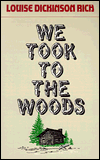
I haven't read it in years, and I made the mistake of reading it in a flurry of we-chose-to-become-self-sufficient books (like We Took to the Woods by Louise Dickinson Rich, which is another American classic) so my memories of it are a bit muddled (along with all the other books I read in that binge). But I remember it was funny. It also spawned a host of films. (See Adventures of Ma & Pa Kettle, Vol. 1)

I'm pretty sure I liked We Took to the Woods better than The Egg and I, but to each his own.

We Took to the Woods

While I'm on the subject of self-sufficiency, I'd be a bit remiss if I didn't mention a modern-day homesteading-experiment-that-didn't-go-as-planned here in eastern Oregon. The author, Jane Kirkpatrick, has gone on to become a popular Christian fiction author, but the nonfiction Homestead is the book that put her on the map around here, back in the early/mid-1990s. You gotta love a couple of city folk who move to a place called Starvation Point with high hopes... Especially, perhaps, when one of them is a mental health professional...

Homestead: Modern Pioneers Pursuing the Edge of Possibility

So, what other books in this vein do you know about? If there are any you'd recommend, please leave info in the combox. If you've done a review on one, feel free to leave the link info. Thanks.

Related post: Good Book: Dear Mad'm, by Stella Walthal Patterson

Crescent City tsunami damage

Yesterday evening as I walked into my husband's office, he waved me into silence and pointed wordlessly at the radio, upon which someone was announcing that five to six foot tsunami waves had hit Crescent City, California, and caused extensive damage. Now, I'd be shocked to hear that about any city, but Crescent City is dear to our hearts and we were devastated. I ran to the computer and surfed the internet and found just all sorts of reports, most of them headlining five to six foot waves, but relaying that damage seemed to be confined to the harbor and no one had been killed or injured so far as anyone knew. The lead-ins were of waves, the later text leaned toward people talking about rivers forming in the ocean. There seemed to be all sorts of disconnects, even contradictions, and I didn't know what to believe.

I finally found my way to the Crescent City paper, The Daily Triplicate, which had a notice to the effect that everything was under control, everyone was OK, and there would be a full story today. Somewhat relieved, I went to bed.

With permission, here's an article written by Karen Wilkinson, Triplicate staff writer and published online earlier today:

TSUNAMI SURGE SMASHES CRESCENT CITY HARBOR

A series of small tidal surges slammed into the Crescent City Harbor Wednesday afternoon, destroying two docks, taking chunks out of another and damaging at least 10 boats.

"It was like a river going through here a little while ago," said fisherman Jeff Ruth of the Orca. "I've never seen the tide surge like that ever."

A magnitude 8.1 undersea earthquake that struck Japan's coastline at 3:14 a.m. Pacific time created tidal surges that starting hitting the Crescent City Harbor just before noon.

Fisherman Victor Reneau said the first surge measured about 8 inches, an estimation he recorded because "we were all standing around curious."

Harbormaster Richard Young said he thought the harbor was in the clear after the initial surge, which he'd been warned of earlier in the day.

But some time after 1 p.m. he noticed the water quickly running in and out of the harbor from his harbor office.

"We thought, ‘Gee, look at that, it's the tidal wave,'" Young said jokingly.

Shortly thereafter, he saw that H dock had broken in half, so he jumped up and helped secure a floating boat.

Young said H and G docks were completely destroyed and F dock was "severely damaged."

Though it's still too early to give an exact figure, Young said replacement costs of the docks could range from $400,000 to $600,000 range.

Other reports estimated the damage as high as $700,000.

"We're going to have a lot of work to do," he said. "So it's going to be very expensive."

On top of the damaged docks, between 10 and 15 boats were damaged and 10 had to be resecured.

The rate and speed that the waters rushed did more damage than the size of the surges, Young said.

"It didn't even look like a wave — the water was just raising and falling rapidly," he said. "It was the rate of change rather than the magnitude of change."

Fisherman John Hale said the surge came in quietly, without warning. "It was just a little wave, then all of a sudden (stuff) started falling apart," he said.

Lori Dengler, chairwoman of the Humboldt State University geology department, said the largest surge measured five feet. "And it occurred at low tide, which was nice — very polite of it so far," she said. "The Crescent City Harbor is just the right size and shape to get excited when tsunamis come."

More than just the harbor got excited by the damage the surges inflicted.

Local residents flocked to the harbor just after the dock damage occurred, flying through the parking lot in cars while onlookers snapped photos and took video recordings. Others stood around relaying messages to friends and family via cell phone.

Lester Cramer, who owns a boat but parks it out of the water, agreed that the surge was eerie. "I've lived here for 39 years, and this is the first time I've seen anything like that," he said.


The Triplicate has more articles and photos.

The main reason Crescent City is dear to my heart is that every time I've visited there, total strangers have made me feel right at home. I haven't been able to visit for several years (as friends and regular readers know, we've had our own troubles which have made travel impossible), but there was a genuineness about that town that impressed me.

The folks there struck me as the sort who know how to bounce back from setbacks like this, but if there's some way you can toss a little help or business their way I'd appreciate it.

hat tip: The Curry Coastal Pilot

Wednesday, November 15, 2006

Top flight tapping

Bookworm found some tap dancing clips, showcasing a couple of the masters. That would be Mr. Fred Astaire and Mister Bojangles (aka Bill Robinson).

Update: Bookworm has found another one, Fred Astaire and George Murphy this time. In top hat and tails and with, uhm, attitude I guess you could say.

Baby Contest

Lands' End has launched a baby photo contest. Once a month they'll give a $250 Gift Card to a winner. That being a lot of money, and many of the photos so far being adorable, and everyone being invited to submit and rank photos...well, I thought some of you might want to check it out.

Yes, I know it's a marketing ploy. But it's a delightful marketing ploy, no?

Tuesday, November 14, 2006

Book note: The Blessing of a Skinned Knee by Wendy Mogel

From Shielding Our Children (aish.com, October 29, 2006), by Emuna Braverman:

Leaving aside the generally accepted physical dangers -- no dark alleys, candy from strangers or cell phones while driving -- what exactly is our responsibility?

Many educators and psychologists -- Wendy Mogel, author of "The Blessing of a Skinned Knee," being among the most prominent -- are encouraging parents to step back. Their over involvement is counterproductive, she claims. The Wall Street Journal abounds with stories of parents filling out college applications, going along on interviews and even post-college calling their children's bosses about raises and promotions. And then they wonder why their children move back home.

Starting with the Talmudic dictum to teach our children to swim, the Torah supports independence and greater degrees of mature and "adult" behavior.

And this training needs to start young. From very small infants, our children pick up their clues from our behavior. If they fall and scrape themselves and we react like it's a major trauma, so will they. If we treat it matter-of-factly, so will they. They will learn that falls and scratches and cuts and bruises are a part of life, to be accepted with minimal complaint. And even more importantly, they will learn that these 'injuries' are a small price to pay to learn a new skill or participate in a group game.


Full article

I went to Barnes & Noble to read reviews and a sample chapter of the Mogel book, and it looks to me like it might be a good resource for non-Jewish parents as well as Jewish. Click on the book cover to go to Barnes & Noble to read for yourself.

Blessing of a Skinned Knee: Using Jewish Teachings to Raise Self Reliant Children

On living with quirks

Rabbi Yaakov Salomon has some observations on quirks and marriage. :)

What to watch out for, from a New Yorker

Ned Crabb, The Wall Street Journal's letters editor, writes:

As New Yorkers enjoy the coming run of holidays, bustling about the streets in their customary jolly way, they are ripe targets for scam artistes. Ergo, I am issuing a fraud alert for some new scams recently added to the grifter mélange. Take heed...

Whereupon he writes an entertaining article about experiences that have happened to him. Forewarned is forearmed, as they say. Read the article. Even if you don't live in New York. Grifters have been known to look for easy marks even in small towns. Trust me on this.

Monday, November 13, 2006

Book Note: Lake Martin: Alabama's Crown Jewel, by Elizabeth D. Schafer

I think it's funny that the same week I post a review at the Saturday Review of Books for a book about the building of the Panama Canal, someone else posted a review that mentioned the building of the Panama Canal. What are the odds on that, I wonder?

Laura's review is about Lake Martin: Alabama's Crown Jewel, by Elizabeth D. Schafer. In the review, Laura says the book covers the local history from "...1540, when Hernando de Soto and his men marched across Alabama, to the present day BASSMASTERs and water wars with Georgia...".

(Side note: I hate to admit this, but way out West here we sometimes tend to think of water wars as a way out West thing. I had no idea Alabama and Georgia had that sort of fuss and bother. Live and learn.)

Anyway, I have a weakness for local history books, and for books about large and complicated undertakings. Please drop a note in the comments if there's a particularly good or interesting book about something in your part of the world. Thanks.

I see from the Barnes & Noble write-up that Lake Martin is one of the books in a "Making of America" series.

Lake Martin: Alabama's Crown Jewel (Making of America Series)


I'm not familiar with the series, but it appears to be pretty extensive and wide-ranging. Here are a few more:

Lockport: Historic Jewel of the Erie Canal (Making of America Series)


Edgecombe County: Along the Tar River (Making of America Series)


New Haven, Connecticut: From Puritanism to the Age of Terrorism (Making of America Series)


Canton, Ohio: A Journey Through Time (Making of America Series)


Matawan and Aberdeen: Of Town and Field (Making of America Series)


Hawaii: A History of the Big Island  (Making of America Series)
Hawaii: A History of the Big Island (Making of America Series)


Santa Monica: A History on the Edge (Making of America Series)


Clicking on any book cover above will take you to Barnes & Noble. Buying anything on that visit will put a few pennies in my pocket. For which I thank you.

Toy book

When I was little, I had my own toy phone, on which I made calls. This was probably a good thing, because it kept me off the real phone.

But when a little kid settles in to read stories from something that's not a real book...

Let's just say I have mixed feelings about it. Give the kid kudos for imagination. Give somebody kudos for teaching him enough about storybooks so that he knows enough to invent the game, and knows to pick something booklike for his toy book. But... if he's doing it because of a dearth of appropriate books in the house...

Hats off to the folks at The Common Room. You can't always tell what a neighbor needs unless you ask.

And, uhm, folks, most librarians I've met love helping little kids find lively and wonderful books to borrow. And besides, going to a library is an adventure for kids. Let's not forget that option, shall we? (I'm assuming the child is a normal child with some training in how to handle a book, and not a wildish one who likes nothing better than to shred paper, of course. If you've got a child in a wild phase, borrowing books might not be such a great idea. Toddlers are dangerous enough to property even in their sweet phases, yes?)

Noticing the good stuff, staying positive, singing, etc.

Three Beautiful Things is a blog with a tagline that says, "Every day I want to record three things that have given me pleasure." It has a links list of other bloggers who "3BT" as they call it.

I found it via Just Muttering By Myself's post on speeding, i.e. Saying something Positive Each and Every Day.

What is that old song about accentuating the positive? Don't let the tune get stuck in your head, now... ;)

While looking for background on that song, by the way, I came across The Johnny Mercer Foundation, which has a clips of "Ac-cent-tchu-ate The Positive" and other songs and which has, the website says, been working to introduce schoolkids to the songs of Mercer and Berlin and Gershwin and Ellington and other great American songwriters.

Saturday, November 11, 2006

Pelosi favors adding two seats in Congress

U.S. Rep. Nancy Pelosi, the incoming speaker of the House of Representatives, is supporting a move to give full voting rights to a representative from D.C., which trends left.

On the plus side, she is also supporting adding one more congressional seat for Utah, which trends conservative.

It's a nice bipartisan move, if you're sure you want D.C. to have a seat. Congress goes from 435 to 437 (just what we need, more politicians), but neither party gets more than the other.

But...

In the inexplicable column, the deal as it stands wouldn't have Utah drawn into new districts, but would just add a statewide seat.

An at-large seat in Congress? Since when? On what authority?

I'm with Betsy Newmark, who says, "I don't understand how the Utah part of this bill would pass constitutional scrutiny. I'm not a lawyer or constitutional scholar, but this seems mighty fishy to me."

Chinese honor German businessman's memory

Now, if somebody told you that the Chinese revere a German Nazi who died in 1950 you might get one idea. But if they told you that the reason the Chinese still honor John Rabe is because he is credited with using his Nazi credentials to save thousands of Chinese lives during the Japanese invasion of Nanking in 1937, you might modify your opinion, yes?

See Memorial Dedicated to the "Oskar Schindler of China" (Deutsche Welle, Nov. 8, 2006) for the story.

If you'd like to follow up, I see there is a book based on John Rabe's journals in English translation.

Good Man of Nanking: The Diaries of John Rabe


Noted in passing: The German editor, Erwin Wickert, claims in this interview [parental discretion advised] that a chapter that appears in German editions was left out of the American edition.

The Saturday Review of Books...

...is up at Semicolon.

If you're not familiar with it, it's where bloggers can provide a link to a book-related post written in the last week. I've found it a good way to discover blogs as well as books.

Book note: The Path Between the Seas by David McCullough

Reading Theodore Roosevelt Departs for Panama - Nov 9, 1906 at Projecthistory.com made me think of The Path Between the Seas by David McCullough.

The Path Between the Seas: The Creation of the Panama Canal 1870-1914

I don't know about you, but for most of my life I had no idea of how incredibly big and dangerous and expensive and controversial and exciting the Panama Canal project was, or about the spectacular failures and side issues associated with it. I'd even visited the Panama Canal, but it just didn't register with me, from where I was at, that this was really much more than the result of tedious ditch digging for maybe a few years and then the building of fairly standard structures. I waved at people on the ships in the canal and they waved back at me on shore, and I had great fun watching the locks open and close, but until I stumbled across McCullough's book several years ago I never really thought about what it took to build the locks or the waterway. Shame on me.

I was in need of an education and this book gave me one, not just on the canal itself but on the swirling activities of people and governments jockeying for influence or trying to shift blame or find a way out of disaster, or taking credit whether it was due or not. (People are interesting, aren't they?)

It was also a good read, as I recall. (David McCullough's books generally are, if you don't know.) What more could you ask of a nonfiction book for laymen?

As it happened, the Panama Canal opened just as World War I broke out. The news of the great triumph in the Americas got buried underneath news of despair and horror in Europe; another reminder, I guess, that our ancestors didn't have a calm, rational world to work in any more than we do, and that their best plans and hopes got dashed now and then, too.

This is one of the author's early works, c. 1977, but it's still in print. In fact, it's in print in paperback, hardback, and several varieties of audiobook. And yes, a David McCullough book read by Edward Herrmann is my idea of good casting, if you're wondering. (I haven't heard this particular audio book, but I have enjoyed Herrmann's narration of other projects.)

The Path Between the Seas: The Creation of the Panama Canal 1870-1914

As of post time, Barnes & Noble also had a bargain book version of the audiobook available. Precise format isn't listed but I'm guessing it's audiotape: The Path Between the Seas: The Creation of the Panama Canal 1870-1914.

Friday, November 10, 2006

Stamp causes stir in Florida elections office

According to Robert Nolin, reporting for the South Florida Sun-Sentinel, an absentee ballot came into the Broward County elections office with what looks like an Inverted Jenny on it.

It hasn't been authenticated yet. And there are forged Inverted Jenny's out there, of course. This might be much ado about nothing. Time will tell on that.

Since the ballot was not in a certification envelope, it has been disqualified. There's no clue to who sent it, either.

So somebody sent in an uncountable vote (ouch) using what might be a several thousand dollar stamp (double ouch).

If it's a real rare stamp, there seems to be a bit of disagreement on what the county should do with it. I'd like to see it go to auction. That could be fun, seeing how much somebody would pay for a canceled stamp (on the downside) with a ripping good story (on the plus side).

hat tip: Best of the Web Today (OpinionJournal)

Addition: Here's some information on "Inverts" - Inverted Jenny and otherwise - from the Smithsonian's National Postal Museum.

Update: Stamp thought to be rare Inverted Jenny is probably a fake, expert says (AP, Nov. 14, 2006)

Thursday, November 09, 2006

This could be interesting

The editors at Popular Mechanics are:

...collecting examples of reader projects, with a focus on creativity, ingenuity and inventive spirit. And, we're open to anything. Whether you've turned your lawnmower into a hovercraft, tricked out your computer for high-performance gaming, or simply built the coolest shed in town, we'd like to hear from you...

The deadline for submissions is Dec. 31.

Let me know if your project gets chosen for publication.

Norwegian-American humor (and its relatives)

I didn't run into many Scandinavians prior to my marriage, and sometimes I still don't "get" some of their jokes.

Some of them, yes. Certainly. Some of the Sven and Ole jokes, and especially some of the Lena and Ole jokes, some of those are pretty good.

You don't know Sven and Ole and Lena?

Let's see. Their jokes go something like this.

Sven and Ole went in together to sell some hay. It cost them fifty dollars a ton, but they scraped together enough money to buy enough to put a huge flatbed truck almost onto its axles. They drove to another state where hay sales were supposedly going pretty good. There, the best they could sell their hay for was thirty dollars a ton. They sold it for thirty dollars a ton. Then they sat down to calculate. They calculated that, losing twenty dollars a ton, it was going to take a few more trips to make any money at it. So they went home and bought more hay and made another trip...

Ole and Lena were snowed in. For three weeks they'd been snowed in, snow right up to the rafters. One day they heard a knock on the door. Ole answered the door. A man said, "We're from the Red Cross." Ole said "I gave at the office" and closed the door. Ole turned to Lena. "Gee, I don't know Mama. Maybe we might send a donation this year. They must be pretty hard up, if they'd go to the trouble to come through a blizzard and tunnel through the snow like that."

OK, those I get. But why folks on my husband's side of the family are emailing Lars Walker's comments about Vikings and coffee all around, and laughing so hard, that I'm not too sure of. I thought the comments were cute, but c'mon. (The coffee jokes are in the last third of the post.)

Project Valour IT Update

So, the friendly interbranch contest to raise money for laptop computers for wounded troops is going pretty well overall. The good news from the project's home page is "We have raised $ 122,912 towards our goal of $180,000 so far!"

But Air Force is fourth out four teams right now? I'm shocked. (OK, I'm not shocked, but I am surprised. I thought the Air Force had more esprit de corps than that.)

Navy is leading by a wide margin (thanks in large part to Power Line giving them a push).

Air Force, Army, and Marines are actually pretty close right now, but Air Force is in last place... C'mon, Air Force. Give me an A. An I. An R. An F. An O. An R. A C. An E. Gooooo Air Force!

hat tip: Anna

Fire safety for children

During a fire is not a good time for a kid to have to grapple with the question of whether the big suit and face mask on a firefighter make him a monster or not. Barbara at Mommy Life covers that and other kid-specific fire safety topics in this post.

Life in a small town, anti-truancy edition

A few minutes ago on the radio, the DJ read a list of "first period absences" from the high school. He does this every school day.

Would you skip class if you knew your folks and friends were going to hear about it on the radio? Heh. Thought not. (Not that you would anyway, of course, you not being a kid who would dream of cutting class in the first place.)

Of course, most of the absences are excused ones, because of illness or some other reason the parents know about. But still, once in a while, I'm sure there are some surprises on that list. Surprises followed by action, I hope.

Sometimes, too, when there are lots and lots of absences, it can be a good clue that we've got a flu outbreak or something of the kind going on around here. In that respect, it can feed the grapevine in a useful way.

When we first moved here, I was shocked to hear this daily report. I'd never heard of such a thing. But now it's just another small piece of what makes this place what it is.

My thanks...

...to every politician in this recent election who conceded defeat graciously, on the first round, without calling foul or employing lawyers or demanding recounts or any of that noise. Our electoral system isn't perfect, but it is good enough to be treated with respect. Thanks for showing some.

Wednesday, November 08, 2006

The Chinese are promoting Pearl Buck's work?

Wonders never cease. Author Pearl Buck's work used to be banned in China. Now it's being studied by academics, places associated with her are being turned into museums, and in general her books are being smiled upon even by government officials, according to The Resurrection of Pearl Buck by Sheila Melvin (The Wilson Quarterly, Spring 2006). China’s Central Television network has even produced several documentaries and docudramas about Mrs. Buck, according to Melvin.

Who would have guessed?

The article includes a fair amount of biographical and historical background, including a short passage recounting the troubles MGM ran into when it tried to film part of The Good Earth in China in the mid-1930s. The movie, finally released in 1937, is available on DVD, by the way. (Barnes & Noble link: Good Earth)

Check your grasp of American history

Via Jonah Goldberg, here's a place where you can take lots and lots of American history quizzes.

Election 2006 will be remembered in Oregon...

...and Washington not only for the results, but for the heroics of some folks in getting the election to come off at the appointed time, given record rains, flooding and road closures in parts of both states.

I heard that a dump truck had to be sent to Cannon Beach to pick up ballots, because other vehicles couldn't get through. Is that true?

Actually, I've heard all sorts of stories - of people being deputized especially so they could handle ballots, for instance. The day was full of rescues and heartache, buildings being washed away, roads being washed out.

This might be one time it was all to the good we do vote by mail because it meant many, many ballots were already collected before the storms left some people trapped and sent others racing from their homes.

I heard that one little town might have had more than 13 inches of rain in one day. At any rate, many cities and towns have had more rain already in November than they usually for the whole month. The weather guys say it was one of those Pineapple Express storms we do get from time to time, with wet, warm air rolling up from around Hawaii and dumping its moisture here and melting snowpack at the same time.

P.S. If you're wondering, we're OK where we are.

Not all campaigns are alike

See A different campaign: Orthodox congressional candidates bring Jewish text study techniques to campaigning (Jewish World Review, Nov. 6, 2006, by Eric Fingerhut) for the story behind the runs for office of Jeff Stein and Michael Moshe Starkman. They were awfully young to be running for Congress (Stein is 31, Starkman is only 28!), but each of them wound up with about twenty percent (more or less) of the vote yesterday, at least according to current tallies. They were the Republican candidates for U.S. Congress in Maryland's 8th and 4th districts.

And here you thought all politicians were the same...

Tuesday, November 07, 2006

English acronyms translated

Katherine, recently moved to England, is starting to get a handle on various locally-used acronyms.

(She would, however, like someone to explain "CIA: Seen on outer wall of a small train station in Virginia Water, Surrey.")

Monday, November 06, 2006

On voting and government, etc.

Among other things, I wrestled with my ballot today. I live in Oregon, where all votes are absentee, if you want to put it that way - I think the official line is vote-by-mail.

I've had the ballot for days and days now, but there are still some blanks where I haven't decided on a race or ballot measure. At this point, they might remain blank. Either I don't care which side wins on that particular contest, or I wish to vote "none of the above" and that's not an official option, or I can't figure the durn thing out. Honestly, sometimes I rely on the endorsements provided, albeit usually in a negative manner. In other words, there are some folks and organizations that serve as red flags: if they're for it, I'm wary. What a way to run a railroad country, eh?

At any rate, I don't vote on an issue unless I feel I have some sort of a handle on it. I hate the idea of government "by wild guess." Don't you?

Sometimes I think our way of referring all sorts of sometimes-wild ideas to a public vote is just plain crazy. On the other hand, I'm not quite sure how to rein in ballot measures without forfeiting a very useful tool for correcting the sometimes-wild ideas that the professional pols push through. What I'd like to see, of course, is a gathering of legislators who understand that their job is not to pass new laws, but to try to make sure laws are sensible and do what they're supposed to, and who aren't afraid to get rid of bad laws and... and I'm dreaming here, aren't I? Sigh. I'd love to vote for somebody who pledges to not add one tiny bit more regulation if it can be helped. Do such people exist? That are willing to walk through the minefields of political campaigns and careers, I mean?

And must people refer to people who come close to following that line as "do-nothing" politicians? Like it's an insult? As if someone in a legislative branch who doesn't have oodles of legislation with his name attached has sidestepped his duty, flubbed his job? I'd appreciate it if more senators and representatives did less, wouldn't you? All those folks trying to do a good job by passing legislation left and right have resulted in a mess of laws and regulations that can be impossible to know, much less understand.

A suggestion, if I might, for new countries just setting up a democracy... How about limiting the total number of bills a Senator or Representative may propose in their lifetime? It might make them think harder about what they're doing, for one thing. And it might keep the total number of bills to within what the populace can keep up with? And.... and I'm probably dreaming here, too.

But it's a thought. You'd have to limit how long each bill could be, I think, to make it work. I suspect that bill-limited politicians might try for astonishing, staggering, omnibus bills. Just a guess. Something worthy of their name, you know. ;)

-------------

The Oregon Secretary of State Elections Division is a go-to place for Oregon results, starting tomorrow about five minutes after the polls close.

Some trivia. According to information at the above link, Oregon has 2,002,927 registered voters, of whom 803,250 had returned ballots as of Nov. 5.

If you want reporting, commentary, analysis, and predictions (along with victory whoops and loser whining, most likely) along with the numbers, you can find it at The Oregonian's online Elections Central page.

-------------

A postscript. This weekend I was feeling under the weather and wanted rather badly to get away from politics and the insanities of some of what passes for political debate these days. So I picked up The Best Science Fiction Stories and Novels: 1956, edited by T. E. Dikty, published by Frederick Fell, Inc., New York. I used to enjoy science fiction. I haven't read it much in a while. 1956 seemed like far enough back to avoid the topics I wanted to avoid.

Hah.

The first story I read, picked at random, revolved around corruption in 2177. Little guys, who were being destroyed by government regulators who were accepting bribes from their competition, had pretty much decided to throw in the towel, if they could find enough money to file for bankruptcy, that is. But a crazy Irish-Swede drunk looking for a good fight offers to help outfox the opposition. Having no more shame or scruples than the opposition gives Swenson a fair chance at beating the bad guys at their own game, you see...

The second story I picked, also more or less at random, involved a crazy man who is weighing the relative merits of blowing up the whole world. He doesn't care if he, personally, lives or dies, but he would like to take lots of people with him, and he's discovered a way to explode all the iron in the Earth's crust...

The third story got too gross, too strange, and I gave it up. But it involved some guys in government service, as far as I could tell from the first few pages.

The fourth story involved a sneaky, underhanded government plan to get enough people to work in space. First they made a show of preventing boys from stowing away on spaceships. Then they made sure all ships were stocked with enough provisions for one or two stowaways. Then...

This collection of old views of the future didn't provide me much of a break, all in all, after all.

Saturday, November 04, 2006

Cries coming from beneath the floor

If, by the title, you were hoping for a good ghost story, sorry. This is a story of a feral kitten that has adopted our house's crawl space for his home. I call him Gremlin. Grem for short.

My husband and I like to feed stray cats, but it's the sort of hobby that can get out of hand. After we moved here last winter, we found ourselves the soup kitchen of choice for rather more cats than we meant to support. Besides that, we were drawing skunks. Having skunks on the back porch doesn't strike me as a great idea. Obviously, keeping the food dish full for whatever happened to swing by for a bite wasn't working. It was expensive, noisy, and sometimes smelly.

So I switched to only putting out a little food when I saw a cat outside, lurking. This worked better. This especially worked better for one cat, named Gizmo by the previous tenants. Gizmo learned quickly how to make her presence known by meowing. If meowing at one window didn't work, she tried another. She trained me rather better than I should have let myself get trained, to put food out when she begged for it.

Enter Gremlin. Grem first came by when he was barely big enough to be wandering around without a protective mama cat as escort; a funny mix of bravado and standoffishness packaged in fuzzy black and grey swirls, still figuring out how to use his legs in an orderly fashion. He saw Gizmo meowing and then me coming out and feeding her. Grem is a quick learner. At first he merely toddler-ran closer to the porch - while carefully keeping a safe distance - and added his earnest, loud voice to hers and shared in the bounty, wolfing down her leftovers. Then he figured out he could do it on his own, without her help, and have the food dish to himself. He also doesn't wear himself out going around the house like Gizmo: he concentrates his efforts at the windows nearest the feeding dish.

We haven't seen Gizmo lately. Sometime back, shortly pre-Gremlin, she went off to have kittens somewhere. For a while after that she'd show up now and then, ravenous, obviously nursing a litter. Just about the time I was keeping an eye out for a baby or two trailing clumsily in her wake, with or without her permission (you know how kittens are), she stopped coming. I'm hoping beyond hope that she's been taken in by a nice family, instead of meeting a crueler fate. She's not a very smart cat on balance, if we are honest about it. I have seen her walk morosely through a small herd of deer in the back yard because they happened to be along the path she was already on. She is not, in other words, great at coming up with a Plan B if Plan A falls apart. But she is a friendly cat that adores petting.

Gremlin, in contrast, will have nothing to do with petting, has set up camp, and spends much of the day underneath our house. When we walk about over his head, he cries. All hours of the day or night, he talks to us, sometimes from underneath one place, sometimes from underneath another. He is obviously lonely, but hasn't discovered the concept of being friends with a human. He'll make full eye contact with me when he's begging underneath one window or another - that, after all, is how this food dispenser business seems to work best, I'm sure. But as soon as I come into full view on the back porch, he dives underneath the house again.

It puts me in an odd position. He looks at me like I'm some sort of trigger-happy tribal god who must be appealed to but who might destroy any creature who gets too close. He is afraid of me. Sometimes when he's crying to me for food, he's shaking with fear. Sometimes when he's looking into my eyes, it's like he's asking why the universe is so horrid that an honest, innocent kitten must go through such an ordeal day after day.

Well, piffle. We got off to a bad start and it bothers me that he's latched onto this view of the world. Living under a house and mainly coming out to beg for food is no fit life for a cat. I don't want to encourage it. He does play a bit now and then in our semi-wild back yard (if he doesn't know someone's watching), and he hunts some (if he doesn't know someone's watching), but he's really spending too much time cringing, feeling sorry for himself, hiding, wearing out his nerves.

Enough is enough.

Yesterday morning when I fed him, I sat down on the stoop. The food dish was in its usual spot, halfway between me and where he comes out of his hidey-hole at one side of the porch. He wasn't happy to have me there. He cried. Yelled. Fidgeted. Stared at me wide-eyed and wary. Kept going back toward his hole. Finally he managed to make it to the food dish, but flinched or bolted at every movement or sound from me, each leaf falling from the apple tree behind him. I stayed put, and kept talking to him. Finally he settled in to eat: quickly, nervously but, when all is said and done, bravely eating under the watchful gaze of his monstrous feeder (that would be me). The way he eats, he must close his eyes for part of each bite. For a while, he tried eating without opening his eyes between chomps. I might have laughed if it hadn't been so very sad.

After a while I got cold, and also started feeling sorry for him, having to put up with that much unaccustomed stress. So I stood up and came in. He ran for his den, of course, but came out later, after I'd come inside and closed the door behind me.

Yesterday afternoon, he appealed to his monstrous feeder again, so I put some food out and sat down on the stoop again. He held back, crying in fear and frustration at the top of his lungs. When that didn't move me, he inched forward, belly low and muscles tight. After several false starts he managed to grab a bite and run back, grab a bite and run back. After a while he almost settled in to eat, but just then a couple of women and two toddlers started doing yard work in the back yard next door. Grem couldn't see them from the food dish, so he moved out on the porch to peek around the corner at the strange noises. He settled in where he could watch both them and me. He had to turn his head one way to see them, and the opposite way to see me. After whipping his head back and forth several times, he settled in to watch -- them. Granted, having his back to me meant he was poised to run away from me - but after a while he seemed to not worry much about me being behind him.

Last night I gave him a break, and just put out a little food before going to bed.

This morning when I stepped out back he ran toward the porch but stopped near cover, and tried yelling at me for a while. Yell, duck, stick head out to see if the dreadful food god is still there. Repeat. Repeat. Then he tried going in circles. None of these actions magically making me disappear, he walked nervously to the feed dish and ate. He tried the 'if I close my eyes and don't see her maybe she'll go away' routine for a while, but then switched to eating a few bites, staring wildly at the monster, and then to eating a few bites before staring appraisingly at the maybe-monster. We ended with him looking more puzzled than terror-stricken.

Well, no, we ended with me standing up to come back inside and him exploding in a mad dash to get under the porch. But before that, if I didn't move he didn't run. Already he's decided I can talk at him all I want to, as long as I don't move much.

This afternoon when I fed him I leaned against the doorframe, looming instead of sitting. He called foul a few times, but went to the dish and ate with me standing there. He wasn't happy, but he didn't run off.

It's a start. Sort of. Maybe.

He might have run wild too long to be tamed completely, but we'll see.

June 30, 2008 update: Since Gremlin is now caring for her second batch of kittens, the "he" in the above post should be read as "she." Grem is almost too friendly some of the time, but is too hyper to be confused with a lap cat. All in all, things turned out reasonably well, regarding Gremlin. We never did see Gizmo again, or her kittens.

Friday, November 03, 2006

On naps

Naps are getting good press. :)

There's even a company in New York that sells naps at $14 for 20 minutes. No, really. (Follow either link. Keep reading. It's toward the end.)

The second link above quotes Sara C. Mednick, a psychologist at the Salk Institute for Biological Studies in La Jolla, Calif., author of the forthcoming book Take a Nap! Change Your Life:

Take a Nap! Change Your Life.


This time of year I'd love to take more naps. Shorter days make me sleepy.

New York Times corrects itself on Kerry misquote

I couldn't believe it when I read that a New York Times article on the John Kerry flap did not include what Kerry actually said, but erroneously gave a modified version of what were presented as his prepared remarks. But it was true. Today, however, they've caught up, and to their credit have issued this correction at the bottom of the article:

Correction: Nov. 3, 2006

A Political Memo article yesterday about the fallout for Senator John Kerry over what he called a “botched joke” referred incompletely to the differences between prepared remarks and what he actually said about the Iraq war to students at Pasadena City College in California on Monday. Mr. Kerry not only dropped the word “us,” but he also rephrased his opening sentence extensively and omitted a reference to President Bush. Mr. Kerry’s aides said that the prepared text read: “Do you know where you end up if you don’t study, if you aren’t smart, if you’re intellectually lazy? You end up getting us stuck in a war in Iraq. Just ask President Bush.” What he said: “You know, education, if you make the most of it, you study hard, you do your homework and you make an effort to be smart, you can do well. If you don’t, you get stuck in Iraq.”

So, please. If you've been dealing with someone who relies on the New York Times for their information on this, cut them a little slack. They were badly misinformed.

If I might make a suggestion to the New York Times? When dealing with politicians, it's often a good idea to go to the tape of a controversial speech instead of letting the politician's spin doctors or aides tell you what he said. Sometimes they will try to pull a fast one. It happens. Yeah, sure, it's crazy to lie to reporters, but people have been known to do it.

(Full disclosure: I used to be a newspaper reporter. I did get lied to now and then. Once I didn't find that out until a story I'd filed got picked up by the wire services. Gee, that was fun. Not.)

Update: Before you say anything, I am not excusing the original mistake. As far as I can see, in this case the reporter and/or editor either had to be clueless or in on the stunt, neither of which you want to see at any paper, but especially a big one.

Tuesday, October 31, 2006

A friendly blogger battle amongst the military branches (for a good cause)

There's a friendly blogosphere competition going on right now, to raise money for voice-activated laptop computers for wounded servicemen and women. Valour-IT: An Amazing Program! at A Rose By Any Other Name has some info and the links you need to either donate money or join a team. The competition ends Nov. 10.

Teams are divided by military branch. I would have signed up with one already, but we're having a debate around here because this is a family with ties of one sort or another to more than one branch of service. This might come down to a coin toss, folks.

The money from all the teams goes to the same place, for the same cause. Which team can generate the most money in donations is a matter of pride.

Yeah, maybe a coin toss would be safest. ;)

Call rewrite! No, wait... real life doesn't have rewrite.

The message came to me something like this:

Helpful Family Message Relayer (in a shaky, hesitant voice): I just talked to my mom... Your nephew [insert name here] was ziplining... you know what that is? ... where you slide along down a rope, you know?... and the rope broke or something... and he fell thirty feet.....onto some iron bars or something...........

The pause goes on a very long time. I fill in the blanks. One of my nephews, on the brink of manhood, has fallen to his death. About the time I'm ready to prompt the Helpful Family Message Relayer that I'm not only braced now but I'm about ready to scream and/or go nuts if the pause goes on any longer, he says:

....and he's OK, can you believe it?

I break the next long pause with a feeble, and perhaps rather stupid, "I presume he's in the hospital?"

...yeah, but he's alive and the doctor thinks he'll recover just fine.

All right, let's put aside that the story by the time it got to me might possibly not be identical to the story as it first came out of the hospital, much less that it might vary somewhat from actual facts - I mean, people do not fall thirty feet onto hard surfaces and survive, do they? I mean, I don't know but it seems highly unlikely. Let us also put to the side that although I'm delighted that they've found a doctor who has the guts, confidence, and politeness to offer a good prognosis, I am going to be worried for a week or two or three, until I'm more sure this young man is all right. Let's put that all aside and look at the presentation.

I hasten to say that I've forgiven my informant. He was shaken and incredulous and not quite himself at the time. Fine. No worries. Forget about it. He wasn't trying to draw the story out for dramatic effect (I don't think so, anyway). And it's not like I've always said things in the right order myself - but I hope we can agree that it might have been at least a wee bit better if the start of the conversation had gone something like: Nephew So-and-so is probably going to be OK but you are not going to believe what just happened to him...

Yes?

Seriously.

One of the more frightening moments of my childhood came when somebody from a sheriff's office or something called our house, got Mom on the phone, confirmed her identity, or more specifically confirmed that she was my brother's mother, then without further ado said "Your son crashed his plane into Such-and-so Lake."

Not a good idea. Mom freaked. Silently, but totally. She didn't comprehend - perhaps didn't even hear - the next words out of the man's mouth, which was a doggone shame because the next words out of his mouth were that my brother was essentially unhurt but needed to find some way to get home. We didn't know this, you understand, until someone grabbed the phone and asked what was going on. The man was astonished that my mother hadn't heard his reassurances, but there it was. If he'd started with "Your son is all right, but..." I think there wouldn't have been much fuss at all. OK, there would have been a lot of fuss, but not like what we had. Certainly there wouldn't have been the confusion.

Do kindly try to remember that the next time you have an amazing survival story to pass along to someone who cares about the person who just had the close call. Please. Thank you.

Oh, wait, on second thought let's end this on a somewhat lighter note. Many moons back Amanda Witt posted a classic "how not to call a mother about her child away at camp" story. It's not just the brushes with death that call for some consideration of how to break the news, you know.

P.S. If you are wondering, my brother was trying to make an emergency landing on a frozen lake, but the ice didn't cooperate. Not in the least.

Saturday, October 28, 2006

Supporting the guys in the field

Have you see the music video for "Poster Girl"? (More direct link here.)

If you have a loved one in the armed forces, don't miss it. It's made for Aussies by Australian singer Beccy Cole, but I think it's pretty universal, myself.

(Ed. note: This is a repost replacing an earlier post. Long story. Never mind.)

The Saturday Review of Books...

...is up and growing. (It's an add-your-own-review-to-the-list endeavor.)

Thursday, October 26, 2006

Book note: You Know Me Al by Ring Lardner

If you like 'baseball books' - and even if you don't - you might want to check out this American classic.

You Know Me Al: A Busher's Letters (Library of Essential Reading Series)

Several publishers have it in print, there are lots of used copies floating about for sale, libraries always appreciate your patronage, or you can read it online. Take your pick.

From Barnes & Noble Books:

Ring Lardner's first published fiction created a sensation, catapulting a regional sports journalist into the national literary spotlight. Presented as semi-literate letters written to a friend by a baseball player embarking on a professional career, Lardner's short stories first appeared in the Saturday Evening Post in 1914. Readers couldn't get enough of "busher" Jack Keefe, the unpolished, exasperating, charismatic narrator. Since being published in book form in 1916, You Know Me Al has retained its place on the list of essential readings in baseball literature. In a 2002 ranking of the one hundred greatest sports books ever, the editors of Sports Illustrated placed Lardner's masterpiece at number five.

In the "oops" department

A friend of mine, after reading about Goodwill's good fortune in having been donated a painting worth rather a lot of money, told me about a recent incident in which a guy who had finalized a deal to sell a Picasso painting for $139 million stuck his elbow through the painting. It was just a little hole he punched, about coin-sized according to reports, but so much for that deal. At last word, he's having the painting repaired. (I should hope so.) I don't know what he hopes to do with it after that. According to the BBC article linked above, he bought it for $48.4 million in 1997, if you're wondering.

My friend also tells me that there are supposed Frank Weston Benson paintings popping up all over the place for sell right now. (Benson was the artist of the painting donated to Goodwill.) I wouldn't be the least little bit surprised.

The funny-sad thing is that, since there are so many Benson paintings out there but unaccounted for, not all of the offerings will be just from con artists. What a deal. The honest sellers will have to be doubly careful not to get caught up in the eddies left by shysters, I reckon. Welcome to the world of the art market, I guess.

Real beauty

Via this post at Danielle Bean, I know that the Dove Campaign For Real Beauty has been discovered by folks in her blog neighborhood (Catholic, mommy blogs mostly.) Mrs. Bean has asked for some discussion on the matter, if you're interested. If you haven't seen the short video that's prompted the buzz, I suggest you do. It shows a real woman being made up, photographed, and then her image computer-enhanced for a billboard ad. It's a slick way of pointing out that what passes for beauty in marketing is often faked, and not even within reach of real women.

As a good companion piece, may I suggest "Inside Out"? It's a 51-second film from Jewish Impact Films. Go here, and scroll down. (As of post time, it was third down on the left.) What I like about it is that it goes beyond the Dove film's emphasis on looks.

Something else you might put in your arsenal when dealing with girls or women who want to look like models is that fashion shoots have been known to involve the use of lots of pins and clips and tape and other such fun stuff, to make the clothes hang just so. This is not to mention all the lighting expertise and equipment, and so on. In short, even those models don't look like that, not without the sort of help you can't take around with you on an everyday basis.

Several years ago I was on a job that involved being on set for a television commercial shoot. It was a low-budget shoot, but even there they stopped filming frequently so the hairstylist could spritz the actress's hair with a fine mist of water, to give it the proper bounce, and so the make-up people could swarm over both the actor and the actress to repair even the slightest smudge or fading of lipstick or foundation or eye shadow or mascara. It was unreal. (Which, of course, is the point of the Dove film.) If I could have somebody following me around spritzing my hair just so and brushing it with a practiced hand every few minutes I'd have phenomenally bouncy hair, too, I'd bet. ;)

On a different front, although it was marketed to girls, I'd recommend that parents check out the out-of-print book Lisanne, a Young Model (often listed with Betsy Cameron as author, although it's written in the first-person from Lisanne Falk's point of view). (Barnes & Noble Link: Out of Print, Used & Rare) The synopsis reads "Fourteen-year-old Lisanne Falk describes her career as a photographic model." Most of it is innocuous - she comes across as a nice kid - but there are some sections I think show clearly some of what's wrong with the fashion and glamour industry, especially when it tries to make kids come across as sexy. It also helps explain, I think, how so many fashion models managed to be doe-eyed in the days before fauxtography (as I see it's being called these days). Many of them were doe-eyed because they were teens and pre-teens being passed off as women. Many of us knew that then, but I'm not sure people remember.

The lies about 'stem cells'

Mary L. Davenport, MD, writing at The American Thinker, lays out, clearly and succinctly, what 'stem cell' controversies come down to. The folks trying to wheedle lots of tax money for their own ends apparently assume you're both stupid and ignorant. I know you're not stupid. Please don't be ignorant. Read the Davenport piece. It's not long, and it says better than I can something that needs saying.

Hat tip: Bookworm Room

Tuesday, October 24, 2006

Heads up, those who love someone with a severe disability

I was searching for something else, and rather serendipitously ran across a newspaper blog called Crocker Stephenson:Meeting Baby Doe at the Milwaukee Journal-Sentinel. (Gotta love the Internet.)

The blog description made me uneasy, but when I got into the posts, I got a different picture.

The blog description:

Join Crocker Stephenson behind the scenes as he pieces together the story of a young man, Tim Krahling, whose birth 19 years ago sparked a headline-grabbing debate over the rights of parents and society to care for a child born with severe abnormalities. Watch, even participate, as Stephenson gathers the facts he will use to tell Tim’s story, and explore with him the ethical, emotional and moral issues that inevitably arise when a reporter journeys deep into the lives of private people to make public their most personal stories. Crocker can be e-mailed at cstephenson@journalsentinel.com

I am not a 'reporter journeying deep into the lives of private people' person. I nearly dove for the exits. But I'm glad I didn't. The blog itself, at least so far, shows a depth and openness (and humanness, for that matter) I have come to not expect from reporters these days.

From Oct. 20, 2006:

I drove to Waukesha, where Kathy lives, expecting to spend, at most, a few hours with her.

On the ride there, I felt a little nervous. My feelings in the presence of severely disabled children are unresolved. I worry that I will insufficiently recognize their humanity. I worry that I will do or say the wrong thing. I have three children of my own, and I wrestle with the idea of fairness in a world where innocents are born to a life of struggle.

And so I knocked on Kathy’s door. A few hours and I’d be gone.

Kathy opened the door and invited me inside, invited me into a world I could never have imagined, one which I expect -- even now, even as I am learning it -- will remain with me for the rest of my life.


In the next post, Oct. 23, he lets Kathy Krahling explain in her own words why she decided to work with him on this.

In the next post, Oct. 24, he lays out more background on how he got to where he's following up on this story, although he hadn't meant to at first. At the end of the post:

Also in my notebook, near the end, after Kathy had described all the children she had given birth to, adopted, or cared for, I wrote, in large letters: “WHY?”

I must have asked her. For in my notebook is this quote:

“When your first child is born with disabilities, you learn two things. One, you learn not to be afraid of people with disabilities. Two, you learn they can be God’s greatest gifts to us as people.

“This is from my perspective. We can reach out and touch God – ‘Whatsoever you do to the least of my brothers, that you do unto me.’ In everybody’s life, something speaks to them. And that is what speaks to me.”

Months later, Kathy would tell me: “Caring for these children is the closest I can come to touching God himself.”

When it comes to religious matters, I am not so much cynical as I am perennially baffled. I believed her, of course, but I also wondered what it was about Kathy in particular that she found God’s presence, of all places, here among these children.

I have no idea, of course, where this reporter might head with all this. But I think the opening volleys are encouraging. I've read/heard one too many accounts of a mother of a disabled child being asked to justify why she didn't have an abortion. Anything that counters that cruelty is a step forward, I think.

I wonder if a little encouragement from people who have 'been there' when it comes to living with disability wouldn't be in order? Be polite, please. It's not Mr. Stephenson's fault that so many other reporters are jerks and/or euthanasia fans.

Previous related posts:
Children with extra challenges, and the parents who love them
Person First, Disability Later
Team Hoyt
Tom McMahon: What I Have Learned in 15 Years
Book notes: Fragile Innocence by James Reston Jr

Update: Another previous related post is The Disappearance of the Disabled.

For a particularly heart-rending story of a couple being pressed to abort their possibly-retarded baby, see Tragic, over at The Common Room. For the sad follow-up, see the second half of Heartbreak, same place.

Monday, October 23, 2006

Dances with waterfall

Yinga. That's some landscape!

That's some donation

Did you hear about this? Somebody anonymously dropped off a 1923 watercolor by the American artist Frank Weston Benson at a Goodwill store. Goodwill auctioned it off on its website last week. The winning bid was $165,002.

The Goodwill press release is here. It has a picture of the painting, and also a link to a website about the artist.

At the website, by the way, is a plea for help finding paintings that are known to have been painted by this artist, but whose location is currently unknown. There are, apparently, hundreds of them. (Benson seems to have been prolific as well as popular.)

A time and a place for everything: what a quaint idea...

Catherine Seipp has a funny-sad column at National Review Online, in which she relays stories of trying to deal with people who "think any social encounter is an invitation to a grad student-style bull session" or who, although old enough you'd think they would know better, subject the rest of us "to teenaged displays of frustration at any perceived unfairness."

Baking to order

Now, then, I'm basking in having the most comfortable kitchen I've ever had - nothing fancy, just old-fashioned, and with room to work - so I wouldn't hire out the fun part of doing any actual baking. I'm having too much fun honing my skills. Experimenting. (OK, playing.)
On the other hand, there are some recipes I don't want to tackle but I would like to serve.

If I lived in the Chicago area (and thought I could afford it - details, details), I'd have somewhere to go for those, according to Janet Rausa Fuller, staff reporter Chicago Sun-Times, Just like grandma used to bake (October 23, 2006):

Home cooks lacking the skills or energy to attempt that treasured family recipe for seven-layer coconut cake need not throw in the towel just yet.

Bring the recipe to Flourish Bakery and Cafe in Edgewater and they'll bake it for you. No questions asked -- or maybe a few, if that recipe is too smudged with fingerprints to make out.

The bakery's "family traditions recipe support" system isn't limited to sweets -- or to strictly family recipes. Bread recipes are welcome, as are savory dishes, owner Dan Fitzgerald says.

Pricing depends on how complicated the recipe is. A 9-inch cake may cost between $30 and $40.

[snip]

Hand-me-down recipes, if they're written down at all, are often vague on directions -- a pinch of this, a handful of that. The bakers at Flourish will try to fill in the blanks and may even make it better than you remember, Fitzgerald said.


Full article.

Brave people. I salute their spirit. I wish them luck.

Saturday, October 21, 2006

Dave Barry quote deemed too inciteful to post at university

I couldn't make this up.

From a FIRE (Foundation for Individual Rights in Education) Press Release (emphasis in original):

MILWAUKEE, Wis., October 18, 2006—Writer and humorist Dave Barry probably never expected that one of his jokes would spark a university free speech dispute. But in early September, a Marquette University administrator removed a Barry quote about the federal government from Ph.D. student Stuart Ditsler’s office door because the quote was “patently offensive.” Facing this arbitrary exercise of political censorship, Ditsler contacted the Foundation for Individual Rights in Education (FIRE) for help.

“There have been several high-profile free speech controversies on campuses recently, such as at Columbia this month. But incidents like this one at Marquette and on other campuses illustrate how even innocuous expression is under ongoing assault at our colleges and universities,” FIRE President Greg Lukianoff said.

In late August, Ditsler posted a quote by Dave Barry on his office door in the philosophy department. The quote read, “As Americans we must always remember that we all have a common enemy, an enemy that is dangerous, powerful, and relentless. I refer, of course, to the federal government.” On September 5, Philosophy Department Chair James South sent Ditsler an e-mail stating that he had received several complaints and therefore removed the quote. He wrote, “While I am a strong supporter of academic freedom, I’m afraid that hallways and office doors are not ‘free-speech zones.’ If material is patently offensive and has no obvious academic import or university sanction, I have little choice but to take note.”


Full release here.

More background, links here.

Prompting discussion on the roles, limits, and downsides of a big federal government sounds like something of obvious academic import to me. Of course, I don't worship the government, like some folks seem to. And I know how to laugh at an obvious joke (and a clean one, too, waahooo!). And I don't believe in telling somebody that their office door isn't a free-speech zone. (I reserve the right to disagree with what's posted and argue with the poster, but that's different, isn't it?) I'm just saying.

Update: Milwaukee Journal Sentinel editorial on the issue. I'd like to add that they picked up something I hadn't earlier, which was that the quote as posted was apparently unattributed. That's a foul for the guy who posted it. Bad form. But surely if people weren't sure it was over the top (as they might have been, if Dave Barry's name was properly attached), they could have, you know, asked. This is supposed to be a university, full of inquiring minds. Isn't it?

News from the blog neighborhood: Expat Yank has moved

Expat Yank has moved from Blogger to Wordpress. I'm sure he'd appreciate some comments at, or links to, the new url. Go on. Make him feel welcome in his new home.

A question about a medical malpractice defense argument

After reading Record $16.5M goes to family in Tripler suit - The Honolulu Advertiser (by Ken Kobayashi, Advertiser Courts Writer, October 20, 2006), Anne at PalmTree Pundit wondered about this paragraph:

During the trial, the government's position was that Izzy is not even aware of his existence, but the Petersons' experts contended he is aware that he is alive and feels pain, Fried said. His parents believe he recognizes them and responds to them, he said.

The newspaper article trips along to the next subject, without specifying where the government was trying to go with this, and Anne finds the implications troubling, as do I. I have my guesses (euthanasia tops the list), but they're only guesses. Does anybody have solid info on the Izzy Peterson case? Was the government arguing to stop care on this kid so he'd die? Or what? Elsewhere in the article it does say:

The federal government earlier admitted liability for Izzy's injuries. That left only the amount of the award to be decided by [U.S. District Judge David] Ezra in the non-jury trial.

The trial hinged on Izzy's life expectancy. Fried said he contended it would be 40 years, and the government set it at 20 years. Ezra's verdict was based on a life expectancy of 27 years.

About $12.2 million of the $16,497,263 verdict is for Izzy's expenses the rest of his life. The rest is for Izzy's loss of future income, his past and future mental anguish, and emotional suffering and pain.


So maybe they were just arguing against paying for his mental anguish and/or emotional suffering? Since they won't recognize he could have any??

The short version is that this baby was born at a military hospital in 2005, and was hooked up to carbon dioxide instead of oxygen after he was born, resulting in severe brain damage. He is expected to need nursing care his entire life.

One more excerpt:

Shalay Peterson [the baby's mother], a former medical assistant to a Kahala pediatrician, indicated she doesn't harbor any bitterness toward Tripler. She said the facility treated her husband well for a broken shoulder he suffered in Afghanistan.

"It would be unfair for me to punish the hospital for one person," she said.

"I try not to focus on what happened," she said. "I try to focus on what we can do to make things better."

The mother said Izzy is doing better than expected, wears glasses and may get off the ventilator in a year or so. He holds his head up by himself and turns to hear voices, she said.

"He's very ticklish," she said.

He's doing now what others said he would never be able to do, she said.

"God is showing us he has the last word."

She said their other two sons, Ian, 16, and Saion, 10, and their daughter, Siani, 13, were very supportive. They cried when told about the verdict, she said.


Islam Yasim Ibn Siddiq "Izzy" Peterson was born Jan. 14, 2005, at Tripler Army Medical Center.