Sunday, April 17, 2005

The Scotsman - Business - How Royal Bank came back from the brink

Two of my favorite (or would that be favourite?) business writers - Bill Jamieson and Martin Flanagan of The Scotsman - take a look at how the Royal Bank of Scotland went from being essentially broke in 1992 to being a world giant today (bigger than Ford, General Motors, McDonald’s and Nike combined, according to these reporters).

They also provide a glimpse at its early history:

IT IS an intense rivalry rooted deep in history. The hostility between the Royal Bank of Scotland and its arch-enemy Bank of Scotland dates back to the very foundation of the Royal in 1727. It came into being because the Bank was thought to have Jacobite tendencies and dirty tricks were never far from the surface in the early days.

A favourite ruse was to stockpile the rival’s notes, then present them in vast quantities for cash "payment on demand". The aim was to induce bankruptcy and the Royal proved the more adept at the scam, forcing the Bank to close for several months in 1728.

This ushered in a ferocious competitiveness between the pair which peaked with the epic battle for NatWest in 1999. The fight was ultimately won by the Royal, a victory all the more remarkable considering it had been on the verge of disaster less than a decade earlier...
File under: Project Columbus, banking, business coups, old boys' networks, Scotland.

Saturday, April 16, 2005

Chasing After Zorro, by Britt Lomond

Chasing after Zorro
Chasing after Zorro

Don't forget, the unofficial Zorro Fest is Monday (the anniversary of Guy Williams's screen test for the part).

I haven't actually seen a copy of the above-pictured book (in fact, I hadn't heard about it until today, when I stumbled across it while hunting down Zorro trivia). But there's more information on it at http://www.zorrovsmonastario.com. That website also offers autographed copies, plus signed photos, scripts, and other items related to the show.

Author Britt Lomond played the wonderfully wicked Capitan Monistario in the Disney version of Zorro. He was a highly ranked amateur fencer when opportunities opened up for professional fencers in motion pictures. His work as a fencing double in the film 'Scaramouche' reportedly helped clinch his casting as Monistario. See the Zorro vs Monistario website (link in previous paragraph) for more on his fencing career.

Lomond also served in the Pacific Campaign during World War II, and in then again in the Korean conflict.

Jefferson - The 51st State - Northern California / Southern Oregon - A State of Mind

Ever since at least 1850 there have been repeated attempts to form a separate state out of the region currently found in southern Oregon and northern California. Many of the efforts have been tongue-in-cheek, or at most a media-savvy effort to get the attention of lawmakers or governors who have started paying too much attention to urban folk at the expense of rural communities. Some, however, have been serious.

The most famous effort was in 1941. From http://jeffersonstate.com/jeffersonstory.html:

...Jefferson made the papers nearly every day, competing with headlines of Germany's ravaging of Europe. The San Francisco Chronicle sent a young reporter, Stanton Delaplane, to cover the events. He traveled the rain-soaked roads to speak with locals to get a feel for the secession movement from their point of view. He got stuck in the mud down the Klamath River but that did not stop him from writing a series of colorful articles on the rebellion which earned him the coveted Pulitzer Prize.

On December 4, Judge John L. Childs of Crescent City in Del Norte County was elected governor. A torchlight parade complete with horses, marching bands and sign-carrying young people riding in trucks was held in Yreka followed by a ceremonious inauguration held on the courthouse lawn...
When the Japanese bombed Pearl Harbor the secession movement stopped, and people dove into helping the war effort instead.

The favored name for the proposed state has varied, from Klamath to Shasta to Siskiyou to Jefferson. These days, the favored name seems to be Jefferson. The title link connects to a website devoted to the history of the various efforts, and to keeping the idea of secession alive. Well, that, and promoting a little tourism, of course.

For a list of Pulitzer Prizes for 1942, including Delaplane's award for reporting, see http://www.pulitzer.org/cgi-bin/year.pl?559,29.

UPDATE: I just went looking for more articles on Jefferson, and came across http://www.humboldt.edu/~sojmc/history.htm, which, among other things, implies that Delaplane helped manufacture the stories he was covering:

...On December 1 the movement both gained and lost a county. The Board of Supervisors of Modoc County adopted a resolution unequivocally stating that Modoc wanted no part of the secession attempt. Balancing that setback was the announcement from Weaverville that the Trinity County Board of Supervisors had unanimously voted to support the secession drive. In addition to Trinity County, the movement had picked up another supporter who proved to be extremely valuable: a cub reporter from the San Francisco Chronicle.

This young man -- Stanton Delaplane -- had heard about the secession attempt and thought there might be a story in it. He convinced his editor to send him, in spite of the fact that he was only a beginner. Upon arriving in Yreka he did not find much happening that was newsworthy; so he joined in the planning to provide the kind of stories his readers might find interesting.

One of his proposals was to blockade the highway every Thursday, distributing window stickers and proclamations to passing motorists. And they requested the people to withhold their penny sales tax as a protest against the lack of support for the development of copper mining. The movement was rolling...

Oh, dear.

Mail Tribune: Family benefits from bright idea

You just never know what kids will come up with...

In this April 13, 2005, article in the Mail Tribune (it serves southern Oregon), reporter Bill Kettler talks about a rural success story that started with a 15-year-old boy tinkering with batteries and diodes and switches and other fun stuff.

(Is this where I mention that certain very dear relatives of mine were lucky to have a house left after their various and assorted sons got through with their various and assorted youthful scientific experiments in the basement?... Or that one of my brothers once managed to knock a radio station temporarily off the air as the result of some enthusiastic but uninformed Thomas Edison wannabe work? I don't know what would happen these days, but I'm here to tell you that in the 1960s it was amazing how quickly law enforcement could react to suspected sabotage pertaining to duly authorized broadcasts... Boys can be very interesting to have in a family, that's for sure.)

The Henry family has had better than average luck with its sons, apparently:

A backpacking trip spawned a family business that brings light to people across the United States and around the world.

Barclay Henry wanted a small, dependable flashlight that wouldn't need replacement batteries while he walked from Mexico to Canada on the Pacific Crest Trail. His younger brother, Ben, made a flashlight from a cordless phone battery, a 35 mm film container and a light-emitting diode.

By the time Barclay reached Oregon, Ben had refined the flashlight to its bare essentials - a nine-volt battery and a tiny snap-on plastic cap that includes a waterproof switch and two light-emitting diodes.

The little light drew rave reviews from backpackers along the trail. Vic Henry, Ben's dad, realized his son might be on to something, and encouraged Ben to seek a patent on the design as a home-school project.

Ben was only 15 when he designed that first crude flashlight six years ago. Now, at 21, he has a patent for the 1.5-ounce Pak-Lite, and the Henry clan - mom, dad and four brothers - has a home-based business that could help them fulfill a long-held dream of self-sufficiency...

The Henry family lives on a homestead off the power grid (not all that uncommon in this state). Read the title-linked article for more on the family and their chosen lifestyle and how this one invention has changed things.

By the way, if you aren't from Oregon, you might not understand how we carve up the state by regions. What is called Southern Oregon isn't the southern half of the whole state (as you might expect it to be), but is pretty generally considered to be the most southern portion west of the Cascade mountains. In most other states, of course, a region so situated would be called Southwest Whatever. What can I say? This is Oregon. Our history and politics are a little confusing, to say the least.

Thanks, SiteMeter

I get my stats through www.sitemeter.com. I get the basic service, which is free. The reason it is free is that it provides a good advertising platform. I don' t mind that in the least, really. As I told them yesterday, I appreciate a good ad. Good ads are educational. I have found some great products and services and companies through good ads. I have kept abreast of fads and fashions through ads. Some ads are even great entertainment. I appreciate good, free entertainment.

But there are ads and then there are ads. And recently, going to get my stats has been something of an ordeal because, uhmmm, well, one company seemed to be advertising on my stats page a lot, and not only was I not interested what they were trying to sell (which meant that they were wasting their time), but the ads were flat-out offensive (which meant that they were not only wasting my time, but in essence slapping me in the face at the same time).

Last night I got aggrieved enough to fire off a message to the webmaster.

Are you sitting down? (One generally is when one is at a computer, of course, but I'd like to make sure.) This morning I got an e-mail back from a fellow by the name of David Smith, saying the ads should be blocked now and asking me to please let him know if I was still seeing them. Mr. Smith I could almost kiss your feet. In this day and age it's hard to find an e-commerce company that responds, much less one that responds politely and promptly and personally.

Now, to be honest with you, I wasn't sure when I sent this complaint off whether the folks at SiteMeter could do anything even if they wanted to - I don't know how all this technology works. And I still don't know how the technology works, so I don't know how much extra work I caused for anybody. So, please, don't go running off and asking for special favors for no good reason, OK? I'd hate to return their consideration toward me with an avalanche of inconsiderate special requests. (Ads for pet food won't hurt you if you don't currently have a dog, for instance. Let's not get silly and demanding.) But, on the other hand, if you're like me and can't stand garbage being shoveled into your field of vision every time you turn around, I do want you to know that this particular company cares.

Joel Engel: Take Back the Word / Duty Bound

In this April 12, 2005, article for The Daily Standard (www.weeklystandard.com), author and journalist Joel Engel takes a sharp look at how the term "liberal" has been hijacked by people who are behaving in ways that are decidedly not "liberal" in the sense that the word held until recently.
IN EDWARD ALBEE'S PLAY The American Dream, Mommy proudly delights in her new beige hat until the moment someone refers to it as wheat colored, at which point she hurries back to the store in a fit of pique. Albee, of course, was being ironical, ridiculing his character's weak-mindedness before an audience who would surely agree that roses smell good no matter what they're named, and that insisting the sky is green can't really change what the eye sees.

So what are we to make of the word "liberal," whose current meaning is likely beyond the ken of both Albee and Shakespeare?...
He gives a long, pointed list of examples of what so-called liberals are doing these days which run counter to the liberal tradition, even to a point of Orwellian inversion, as he puts it.

On a related side note, if you'll visit the Acton Institute (use links list), they have an archives section called "In the Liberal Tradition" which bears this out. For that matter, if you study history at all, it's seems a safe bet that what passes for liberalism these days would have been fought head on by the dedicated liberals of yesterday.

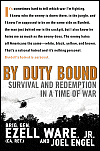
Joel Engel recently co-authored the book Duty Bound: Survival and Redemption in a Time of War, the story of Ezell Ware. Ware is the primary author. From the publisher (via barnesandnoble.com):
"Raised in the segregated South, Ezell Ware was determined to excel beyond the lines drawn by white power brokers. He became the top recruit in his Marine training class; having grown up without running water, electricity, or sufficient food, he wasn't daunted by military life. He eventually earned a chance to join the Army's helicopter pilot program, realizing his dream of flying. It was a role that would change his life, and the life of an unlikely partner in valor at the height of the Vietnam War." Downed by enemy fire while on a mission over thick jungles, Ware and his badly injured captain endured a three-week descent into hell, with one canteen and little defense against countless deadly forces. But when his captain revealed his membership in the Ku Klux Klan, their situation took a turn that surprised them both - and put Ezell on the road to becoming a general.
I've just done a quick tour around the Internet, and at this point the professional reviewers (Publisher's Weekly, Kirkus Reviews) are sneering at this book, but most customer reviews are proclaiming it inspiring. The panning in the 'official' reviews is not altogether surprising, since many professional critics appear to think it is their job to find fault instead of review (did I say that?). But one of the main problems appears to be that the 'pros' are quite obviously choking over Brig. Gen. Ezell Ware's assessment that it was right to go into Vietnam, and that certain aspects of the war went better than portrayed in press reports.

This book sounds a little too rough and gory for me, but I'd like to know whether to recommend it to some of our regular customers who generally go for military, history, or political reads. If you've read it, I'd appreciate a note in the comments section. Thanks.

By Duty Bound: Survival & Redemption in a Time of War

Friday, April 15, 2005

Good Book: Dear Mad'm, by Stella Walthal Patterson

This book was first published about fifty years ago and it just keeps right on quietly selling a copy here and another copy there and picking up fans in each generation.

Dear Mad'm relates the adventures and misadventures of a delightful lady who decided - at the age of 80, mind you - to go off by herself and manage a placer mine in the north California mountains for a year. Stella Walthal Patterson was one of those people possessed of a rare zest for life. When she figured she still had 'young legs' at her age, well, by golly, she was going to find some way to use them. And besides, she'd didn't know how to live in the mountains. Yet.

The woman had a good sense of humor as well as a sense of adventure. This is a spunky, funny read, straight out of the 1950s.

It's still in print, in a 1982 edition published by Naturegraph, ISBN 0879611316. The front jacket copy says, "The refreshing adventures of a woman who at the age of eighty found a new life in the wilds of the Siskiyou Mountains near Happy Camp, California."

Dear Mad'm
Dear Mad'm

Murdoc Online: Dear Pack 3311

Here's a great story about Cub Scouts and a Captain in the United States Marine Corps. Hats off to both the kids and the Marines. These folks have some class.

Hat tip: Expat Yank.

MazeWorks - Java Games and Puzzles

This looks to be a fun website for those of us who like brain teasers. It also features a daily chess problem, for those of you who play chess.

Hat tip: www.math.com. (Which is still under construction, but has some useful stuff already.)

'Don's' arrest sparks protest - JAMAICAOBSERVER.COM

This article is rather unpleasant, or at least it is about unpleasant happenings, but it does provide a useful contrast to politics in much of the rest of the world. I don't know about the rest of you, but I'm worried about Jamaica these days. I'm not sure it would stack up favorably side by side with Iraq just now, to be honest about it.

This is from the April 13, 2005, Jamaica Observer online. I notice that the reporter is listed semi-anonymously as "Observer Reporter". But if these guys are scared, who can blame them? There has been just a whole lot of violence down there lately, from what I've read.

(Of course, mass media always provides a balanced and accurate overall view of things, doesn't it?)

RESIDENTS of the tough Spanish Town community of Tawes Pen yesterday locked down sections of the old capital to protest against the detention of their area 'don', Andrew Hope, better known as "Bun man", the reputed leader of the One Order Gang, one of the two gangs said to be at the centre of the deadly intermittent violence plaguing that town...

Residents of Tawes Pen, home to some members of the One Order gang, claimed that they were justified in blocking the roads as the police wrongfully detained their "father" and abused them in the process.

"Him (Bun Man) a di father fi di whole a wi, a him sen wi pickney dem go a school so wi caan do without him roun' ya," shouted one female resident.

"Anyhow dem (police) try tek him weh again wi ago lock down di whole place or jus' mash it dung," another woman blurted.

Some of the residents claimed that they were boxed, kicked and verbally abused by members of the security forces.

But Inspector Robinson denied the claims. "Anytime you have situations of this nature there are always claims of abuse," he told the Observer. "I have been here all morning and I have not
witnessed any such incident."

The One Order gang, which is aligned to the Opposition Jamaica Labour Party, has been involved in bloody conflicts with members of the Klansman gang, which backs the ruling People's National Party...

Thursday, April 14, 2005

Technical difficulties

I tried to add some links to my template, and garbled the template. (Well, actually, I also managed somehow to delete about half the template. Don't ask me how.)

I finally admitted temporary defeat and started over with a pristine template. This means that I am having to start over on all sorts of little stuff.

So, naturally, Blogger and the Internet both seem to be having problems right now.

Please bear with me. I'll try to rebuild the links list, etc., sometime tomorrow or the next day if I can get everything to work long enough to get the job done.

Thanks.

UPDATE: Friday, 10:15 a.m. - OK, so I've almost recovered everything I'd lost. (For now, at least.) Now comes the fun part. Now I start trying to do the modifications that blew me out of the water yesterday. Please be patient. For the next few days I'll be experimenting, trying to improve the site. But since I'm a techno-rookie, I expect there will be some interesting mistakes along the way. If the links disappear again (or anything else for that matter), it's only because I'm learning. (Isn't that what we tell children who are attempting something unfamiliar and are positively botching the early proceedings? :)

Good Book: The Ordinary Princess, by M. M. Kaye

M.M. Kaye, known for sweeping historical novels like The Far Pavilions and Shadow of the Moon, and for her mystery/romantic suspense books (Death in Zanzibar, Death in Kenya, Death in Cypress, Death in Kashmir, Death in Berlin, etc., etc.), also, once upon a time, sat down under an apple tree in Kent and, fed up with fairy tales that featured only gorgeous princesses, wrote a small gem.

It's a shame, really, that The Ordinary Princess is generally marketed to young girls. Not that grade school girls aren't a natural audience for a book about a princess who is, as it happens, quite normal and ordinary (hooray!), but I'm afraid that such marketing might alienate another natural audience for this book. Don't laugh (OK, go ahead and laugh), but if you enjoy P.G. Wodehouse and are looking for a fresh dose of British wit and whimsy, mixed with a dose of razor-sharp perceptiveness when it comes to human shortcomings, you might check out this title. I don't want to oversell it here - just like its heroine it makes no pretense of being more than it is (nor, for that matter, is it quite the sustained over-the-top madness you tend to find with Wodehouse). But it's a nice, light, sometimes wickedly funny read all the same, in a very British way, and although it is quite different from the Jeeves and Wooster books, I can't help but recommend it to fans of that series. It's just too much fun, really.

Here's the part that explains where this story veers off from the usual run of princess stories:

She raised her twisty coral stick and waved it three times over the cradle of the seventh princess. "My child," said the Fairy Crustacea, "I am going to give you something that will probably bring you more happiness than all these fal-lals and fripperies put together. You shall be Ordinary!"

And nodding her head briskly the Fairy Crustacea turned away and hobbled rapidly out of the throne room, leaning on her twisty coral stick and leaving a faint smell of seaweed and a damp track on the polished floor behind her.

For quite a minute after she had gone there was a stunned silence in the red and gold throne room of the palace...

The Ordinary Princess, by M.M. Kaye, is available new in a reprint paperback edition from Penguin Group, ISBN 0142300853.

Addition: For more from Barnes & Noble, click on the book cover.

The Ordinary Princess

Wednesday, April 13, 2005

Expat Yank: For Fed-up Voters

The UK is suffering election run-up madness at the moment. Luckily, there are a few people who can translate political babble, among them Robert Tumminello of Expat Yank, who takes on the Greens in this post (use title link).

And lest you think he gives other parties a free pass, in a recent post he quite properly zeroed in on one addle-brained (one hopes he is addle-brained instead of crooked) Tory candidate who doctored a photo for his campaign material - a photo, mind you, that had run in its undoctored condition in a newspaper. (I keep hoping Tories will stop shooting their own feet, if even just for a little while. But, no...) See http://expatyank.blogspot.com/2005/04/altered-but-accurate.html for that bit of nonsense.

Elisabeth Sifton: Editing Saul Bellow

A woman who worked with Saul Bellow pays tribute to the late author.
When the Viking Press published Mr. Sammler's Planet in the fall of 1971, I happened to be the new kid on the Viking editorial block. I guess all of us knew, and I learned quickly, that the great man liked to read proofs in-house when he could, turning up to attend to this or that when he was in New York in the peri-publication period. Since he revised his texts heavily in the late stages (sometimes with up to four sets of proofs), he was around plenty....

Sense and Sensibility Bookstore - Books on Fashion History and Costuming

This is quite a collection of books. File under fashion, history, clothing, stage costumes. Hat tip to Pipsqueak at The Common Room (see previous post).

The Common Room: I'm making a regency dress

"Pipsqueak" at The Common Room has made Regency gowns for herself and three sisters, and is already working on a fifth, for a friend. She recommends the patterns at www.sensibility.com., especially if (as she says) you are a fan of books like Pride and Prejudice, Jane Eyre, and Emma.

Go, girl!

UPDATE: I guess it wasn't Pipsqueak, but someone writing under her account. See comments.

Go, Jenny-Any-Dot and friends!

Laura Hirschfeld Hollis: Protecting your family in a culture that's gone stark raving mad

This links to a book review of Home Invasion: Protecting Your Family in a Culture That's Gone Start Raving Mad, by Rebecca Hagelin.

John Leo: Baking up a controversy

Who would have thought that cookie sales could stir up this much trouble?

I'm not sure who came up with the idea for affirmative action bake sales - where prices are rigged according to the usual criteria used in affirmative action - but they've caught on among conserverative and moderate students wishing to make a point. As John Leo points out, the opposition forces are acting like this is of earth-shattering importance and are using any argument they can get their hands on to shut them down.

(One nice touch is that one university allowed a satirical feminist wage-gap bake sale, but not the affirmative action one...)

Tuesday, April 12, 2005

PBS - THE WEST - Junipero Serra

And for another take on the dauntless Father Serra, here's a write-up from "New Perspectives on The West" at PBS.

There are many other biographies at this site.

The Miracle of Padre Junipero, by Bret Harte

Many history books and most modern references seem to have this poem's title character as Father Junipero Serra (instead of Serro, as in the poem).

According to The Golden Book of California: From the Days of the Spanish Explorers to the Present, by Irwin Shapiro, Golden Press, New York, 1961, Father Serra was partially lame, ill, and "not a young man" when he was sent in 1769 to establish missions in Upper California. By 1773, he had established five missions. By the time he died in 1784, there were nine missions along El Camino Real, or the The King's Highway. Until shortly before his death, he had traveled from one to another, limping, leaning on a staff or riding a mule, his health getting worse and worse, but refusing to give up his travels until just weeks before his death. By then he had overseen a mission field in which more than 6,000 Indians had been baptised, and over 5,000 confirmed. He spent the last weeks of his life at the San Carlos Borromeo Mission at Monterey.

Here is Bret Harte's version of one of the Father Serra legends.

THIS IS the tale that the Chronicle
Tells of the wonderful miracle
Wrought by the pious Padre Serro,
The very reverend Junipero.

The heathen stood on his ancient mound,
Looking over the desert bound
Into the distant, hazy South,
Over the dusty and broad champaign,
Where, with many a gaping mouth
And fissure, cracked by the fervid drouth,
For seven months had the wasted plain
Known no moisture of dew or rain.
The wells were empty and choked with sand;
The rivers had perished from the land;
Only the sea-fogs to and fro
Slipped like ghosts of the streams below.
Deep in its bed lay the river’s bones,
Bleaching in pebbles and milk-white stones,
And tracked o’er the desert faint and far,
Its ribs shone bright on each sandy bar.

Thus they stood as the sun went down
Over the foot-hills bare and brown;
Thus they looked to the South, wherefrom
The pale-face medicine-man should come,
Not in anger or in strife,
But to bring—so ran the tale—
The welcome springs of eternal life,
The living waters that should not fail.

Said one, “He will come like Manitou,
Unseen, unheard, in the falling dew.”
Said another, “He will come full soon
Out of the round-faced watery moon.”
And another said, “He is here!” and lo,
Faltering, staggering, feeble and slow,
Out from the desert’s blinding heat
The Padre dropped at the heathen’s feet.

They stood and gazed for a little space
Down on his pallid and careworn face,
And a smile of scorn went round the band
As they touched alternate with foot and hand
This mortal waif, that the outer space
Of dim mysterious sky and sand
Flung with so little of Christian grace
Down on their barren, sterile strand.

Said one to him: “It seems thy God
Is a very pitiful kind of God:
He could not shield thine aching eyes
From the blowing desert sands that rise,
Nor turn aside from thy old gray head
The glittering blade that is brandishèd
By the sun He set in the heavens high;
He could not moisten thy lips when dry;
The desert fire is in thy brain;
Thy limbs are racked with the fever-pain.
If this be the grace He showeth thee
Who art His servant, what may we,
Strange to His ways and His commands,
Seek at His unforgiving hands?”

“Drink but this cup,” said the Padre, straight,
“And thou shalt know whose mercy bore
These aching limbs to your heathen door,
And purged my soul of its gross estate.
Drink in His name, and thou shalt see
The hidden depths of this mystery.
Drink!” and he held the cup. One blow
From the heathen dashed to the ground below
The sacred cup that the Padre bore,
And the thirsty soil drank the precious store
Of sacramental and holy wine,
That emblem and consecrated sign
And blessed symbol of blood divine.

Then, says the legend (and they who doubt
The same as heretics be accurst),
From the dry and feverish soil leaped out
A living fountain; a well-spring burst
Over the dusty and broad champaign,
Over the sandy and sterile plain,
Till the granite ribs and the milk-white stones
That lay in the valley—the scattered bones—
Moved in the river and lived again!

Such was the wonderful miracle
Wrought by the cup of wine that fell
From the hands of the pious Padre Serro,
The very reverend Junipero.