Thursday, August 10, 2006

Feeling creative, concise, and competitive?

Charis Connection is having a Flash Fiction Contest. (Otherwise known as a short-short story contest.) The deadline for submissions is August 19.

You do remember to look at the night sky sometimes, don't you?

This year's Perseid meteor shower is expected to peak this weekend, according to the info underneath tomorrow's Astronomy Picture of the Day.

Book note: Debunking 9/11 Myths, by Popular Mechanics

In March, 2005, Popular Mechanics ran an in-depth article on 9/11: Debunking The Myths. The response was so overwhelming that they dug in and expanded their research, the result of which is a just-released book (more info and excerpt available here). Senator John McCain wrote the foreword, which is available online here. Clicking on the book cover below will take you to Barnes & Noble.

Debunking 9/11 Myths: Why Conspiracy Theories Can't Stand Up to the Facts

Wednesday, August 09, 2006

American Trivia

In the United States, the municipality with the largest incorporated area is also one of the hardest to get to. Name the place, if you can.

Answer.

Hint: the total area inside the 'city limits' is 4,811.5 square miles, the land area is 2,874 square miles, but the population is less than 10,000. So, yes, to say it's the largest city strikes me as a bit of a stretch. (But let them have their fun, I say, as long as it doesn't tie in with some con game.)

More from the Census Bureau.
More from About.com, where Matt Rosenberg explains why this place "is a perfect example of an "overbounded" city...".

And now for something totally different

Sigh. Many moons ago I had a summer job in a city with a large Indian population and I lived near where bridal parties used to like to go to take pictures. I loved to go just hang around the park and watch the goings-on. I loved the saris. I didn't necessarily want to wear the saris, but I loved looking at them. The Anchoress is making me nostalgic...

And, yes, yes, I know. Some of the motel owners around here have wives who wear saris. And those are nice. But those are everyday saris. Not quite the same thing.

Book note: C.S. Lewis in a Time of War, by Justin Phillips

First off, let me say that I think the title and marketing of this book is somewhat misleading. Secondly, let me say that I can't think how I'd do much better. It is a wide-ranging book, and a good one, but hard to pigeonhole.

C.S. Lewis in a Time of War does have quite a bit about C.S. Lewis, particularly his broadcasting career, and it does keep coming back to him, but this is also - if not primarily - a history of the BBC, with an emphasis on its religious broadcasting. Which is not a bad thing. There is, for instance, an entire chapter on Dorothy Sayers and her battle to have The Man Born to Be King broadcast as she thought it ought to be broadcast. Sayers, in fact, shows up several places. There is quite a bit on how the founders of the BBC saw it largely as a medium to spread civilizing influences, particularly the Christian gospel. There is quite a bit on how the BBC coped with World War II, the hits it took, the moves it made to not only help insure its own survival but also to enhance national security. (Did you know, for instance, that it was decided to keep the news announcers few in number and have them state their names on air, so that the public would come to recognize each voice, so that enemy impostors - if any should manage to get on the air - would be instantly noticeable?) There is also some good, general recounting of life outside broadcasting during World War II. But the book by no means confines itself to the World War II years, either.

The author, Justin Phillips, was a journalist with the BBC for many years. He was also an elder at his church. According to the jacket copy, he'd completed the manuscript for this book when he died in 2000, but his daughter Laura Treneer oversaw the final editing and brought the book to publication.

Phillips makes a convincing argument that working with his editors at the BBC - learning to write for a radio audience with the help of good producers - turned C.S. Lewis into a better writer overall, and that the collaboration that went into the radio broadcasts strongly influenced Mere Christianity, and for the better. Certainly, that Lewis had ardent advocates of ecumenical Christianity at his back, trying to use his broadcasts to reinvent religious broadcasting, had to have made a difference.

At any rate, this book comes across as a labor of love, but not a puff piece. Phillips freely acknowledges that the BBC has made some serious missteps along the way, including in its relationships with both Lewis and Sayers. In that regard, this book also ranges into the "how to be a better manager" field, for anyone willing to take to heart the lessons of a bad example or two. (For example: Don't turn a prissy and territorial schoolmarm type assistant loose to correspond with anyone like Dorothy Sayers. You'll be hard pressed to pick up the pieces after the dust settles.)

Many books come across as something that someone else might have written had they only put their mind to it, but this one, I think, could not have been pulled off without Phillips, with his background, enthusiasm, and attention to detail. The chapters are well end-noted, for anyone wanting to dig deeper. For sources, he relied on not only written material, but archived audio, and interviews he conducted himself. It's a nice contribution overall to Lewis studies, but also gives a look at World War II from a fresh angle. On top of that, Phillips weaves in a bit of Christian apologetics of his own, building on what Lewis said in Mere Christianity and the broadcasts that preceded it.

On top of everything else, it shows how the BBC put itself on war footing for World War II, keeping national interests uppermost while fighting whatever looked like government encroachment upon its turf.

All in all, a nice behind-the-scenes look.

C. S. Lewis in a Time of War: The World War II Broadcasts That Riveted a Nation and Became the Classic Mere Christianity

One question, though. Does anyone know if that book is the same as the following? Or does it cover much the same ground in a different fashion? The former was published by HarperSanFrancisco earlier this year, and my copy says it's a first edition. I don't see any notice that it was previously published elsewhere. But the following, published a few years ago by Zondervan, certainly sounds like the same book?

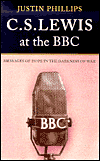
C. S. Lewis at the BBC: Messages of Hope in the Darkness of War

Clicking on a book cover will take you to Barnes & Noble.

A reader writes...

From a comment on a previous post:

...A friend just told me about a doctor in her town who had advised many women to abort their Down's children (including her, and her child ended up not having it) and then he had a grandchild with Down's. He wrote a public apology to all the women he'd counselled to have abortions!

Tuesday, August 08, 2006

Butterfly Central (for an afternoon)

Yesterday I set the sprinkler hose out back, to water the plum trees and the apple tree. The next thing I knew the yard was dancing with butterflies, more than one type, flying through the water or setting down on the ground to get a drink. Very, very cool.

It was especially nice because yesterday I came down with something, and was dragging when I set the sprinkler in place. It's amazing how much a little unexpected beauty and grace can bring into a person's day.

This morning we had a doozy of a thunderstorm, and then a lot of rain. And a power outage. The clouds also played at turning into mini-twisters, which wasn't particularly fun to watch. The weather has settled down some, but it's still a good day for non-electronic endeavors, at a guess. (She writes as the power dips and comes back, dips and comes back... Yikes.)

I am feeling some better today (she says with a yawn), but I think I'll spend most of my spare time dozing instead of blogging, thanks (she says with another yawn). Place nice until I come back, OK?

Saturday, August 05, 2006

Book note: Mama's Bank Account by Kathryn Forbes

This sounds like a book I'd probably like. And how nice to know that "I Remember Mama" is on DVD. I hadn't thought to look. (via Saturday Review of Books).

"No Tears for Fidel, Please"

My thanks to the Los Angles Times, for running No Tears for Fidel, Please by George Weigel, in their op-ed section.

hat tip: Carol Platt Liebau

Update: Bill Steigerwald of the Pittsburgh Tribune-Review also has a look at "What Fidel's Cuba really is like."

The President's summer reading list, and books on polio

History and government teacher Betsy Newmark starts with AP's coverage of President Bush's summer vacation reading choices, and goes from there.

One of the books on the President's list, by the way, is one I have on my want-to-see list: Polio: An American Story, by David M. Oshinsky. (By the way, the paperback edition is due to be released the end of this month, and can be pre-ordered now.) Clicking on the book cover will take you to Barnes & Noble.

Polio: An American Story

While looking for that book to link to, I chanced across this one. Have you read it? It sounds good in the write-ups. It's aimed at ages 12 and up. The author is Peg Kehret.

Small Steps: The Year I Got Polio

In China...

... according to Ethan McNern, writing in The Scotsman, Buddhism is big business for new breed of upwardly mobile monks.

Friday, August 04, 2006

Back when I was a kid...

Anna at A Rose By Any Other Name and Echo9er are hosting discussions of what life was like as a kid back in the 1930s-1960s. Echo9er has also issued an invitation to people born after 1970 to add comments and observations.

YouTube: how it started, where it's at, where it might be headed

See this Startup Journal, June 29, 2006, article by Kevin J. Delaney, staff reporter for The Wall Street Journal, for the story behind YouTube, one of the most-visited sites on the web.

Book market watch: Handicrafts for the Handicapped, c. 1916

Here's another title to add to your treasure hunting list: Handicrafts for the Handicapped, by Herbert Hall and Mertice Buck, published in 1916 by Moffatt, Yard, and Company. Since Headmistress at The Common Room discovered it, let her tell you about it.

I've just done a cursory search, and find a few copies of a 1928 edition also for sale, for not quite as much money, but still quite, quite nice, thanks.

This is not to mention that it sounds like an interesting and possibly useful book.

Thursday, August 03, 2006

Killing boys to "prevent" autism, and attacking women for having disabled children

Chuck Colson reports that British medical researchers want to screen out male embryos in families with a history of autism, simply to reduce the odds of a child being born with autism (simply because most people with autism are boys, and therefore having girls is 'safer'). Colson calls it Eugenics by Default.

Can't argue with him there.

He provides links at the bottom of his commentary for further reading - like Confessions of a "Genetic Outlaw" by Elizabeth R. Schiltz, a mother who has been openly called irresponsible by people who resent that she knew she was going to have a child with Down Syndrome, but didn't have an abortion. She is kinder to the folks arrayed against her and her family than I'd be. I'd suggest you read her article whether or not you read Colson's. (It was published, believe it or not, at BusinessWeek, in the Technology section. Hey, I'm not arguing. Sometimes it's the folks who are all caught up in the excitement of technological breakthroughs who need most to stop and think about the implications of what they're doing, after all.)

New and old ways of looking at the world through the lens of economics

Knowledge and the Wealth of Nations: A Story of Economic Discovery


Nick Schulz, editor of TCS Daily, has an article at OpinionJournal regarding the above book and what it is about.

If you like reading about history and/or economics, you might want to take a peek into one of the many editions of the following book, now in its seventh edition. I've only seen the earliest editions, but they were more interesting and readable than I had expected in a textbook, or with something with the title "The Worldly Philosophers."

No, let me revise that. I have just taken the time to take down a copy of the third edition and read in it a while. This reminded me. This is not a book to "peek into" if that means you will read just parts of chapters. This author sometimes sets some things up to take down - piece by piece if necessary - later in the chapter. If you don't take chapters as a whole, you will be miseducating yourself, very likely.

The Worldly Philosophers: The Lives, Times And Ideas Of The Great Economic Thinkers


I didn't know about the book The Worldly Philosophers until I saw it listed as suggested reading to go along with the well-done course Legacies of Great Economists by Professor Timothy Taylor, available through The Teaching Company. I know "Legacies of Great Economists" sounds like it might be a specialist course, but it isn't. It provides a fair amount of general history, and explains some of the evolution of ideas that have been used and misused by policy makers through the ages.

For the fine print, I am an affiliate of Barnes & Noble, so if you click through on a book cover and buy something on that trip I get a few pennies as a commission. But I have no affiliation with The Teaching Company. I just found that particular course more informative than I'd expected.

Book note: Sheiks & Adders by Michael Innes

Michael Innes (real name J.I.M. Stewart) is one of those authors with whom I have something approaching a love-hate relationship. Most of the mystery books of his that I've read have had serious shortcomings, to my view - mostly in the area of plot. He was not adverse to setting up a fictional crime that could not possibly come off without a series of unlikely things happening on cue, for instance. On top of that, he uses obscure (to me) references, and sprinkles his work with jokes or asides apparently designed for his fellow professors, which leaves me out of the loop. His books, in short, sometimes exasperate me. And yet I generally read almost any book of his that comes in front of me. They are occasionally oddball and sometimes quite funny (even for those of us who don't get his highbrow humor), and a few of them are adventurous, sometimes very much so. Some of them are quite good, overall. Even the ones that fall apart as mysteries generally have nice passages and observations, worth the reading.

Along the way, though, I had come to avoid most of what he wrote as an older man. Some of his later books seem a bit bitter. So, I'm pleased to note that the latest book of his to cross my path, Sheiks & Adders, c. 1982, a book written when he was quite old, isn't bitter at all, but comes across as written by an old man who has decided to be indulgent toward the younger generations. It harks back to his early days, brimming with highly unlikely circumstances and strange characters getting embroiled in ridiculous (but dangerous) situations. If you don't go into it expecting a great mystery novel (it is, in fact, very vague on the mystery side of things, the mystery apparently being an excuse to get our hero out of the house and amongst strange happenings and in contact with people who need a dose of his wisdom), but merely want a light diversion with a bit of social commentary, it'll do. The opening is worrisome in that it makes it appear the book will be thick with the finer points of the history of language, but I assure you that doesn't happen. And, a plus: the Boy Scouts are allowed to make a few appearances and are even allowed to help our hero Sir John Appleby.

The book is still in print.

Sheiks and Adders
Sheiks and Adders


In fact, now that I take a look, I see that many of his books (he was prolific, no question) are back in print, thanks to House of Stratus. If you aren't familiar with his work, may I suggest you start with one of his earliest books?

The Secret Vanguard
The Secret Vanguard


Hamlet, Revenge!
Hamlet, Revenge!

...Oh, sure. Just my luck. One of my favorites, Lament for a Maker, seems to be, at present, out of print again. (Or maybe it is just temporarily out of stock at Barnes & Noble?) I'm not the only one who likes this one. I've seen it held up as one of the best-written mystery novels of all time. I'm not sure I'd go that far, but if you only read one book by this author, this would likely be a good one to pick.

Lament for a Maker: A Sir John Appleby Mystery

P.S. J.I.M. Stewart wrote a memoir, Myself and Michael Innes, but I can't say I'd recommend it, if for no other reason than I liked the author less after I read it. He comes across better in his fiction, I'd say.

Note to self...

When one of your software providers urges you to do a free urgent download of an upgrade with "exciting" and "new" (but supposedly necessary) features, don't attempt it while your husband is busy elsewhere. You might need his help when the botched installation kicks other things out of its way. Like your anti-virus protection. Yinga.

Anyway, that's where I was much of yesterday. Fighting software battles. And staying offline until we had our ducks back in a row. Uffda.

Tuesday, August 01, 2006