Friday, November 11, 2005
Remarks at the Veterans Day Ceremony at the Vietnam Veterans Memorial
Yesterday's news, from Minnesota
For an example, here's Sunday, Oct. 13, 1918: Flu outbreak closes churches, schools, theaters, for those of us wanting to know a little more about the "Spanish Influenza" pandemic.
The Edmund Fitzgerald remembered
Thursday, November 10, 2005
GM's Corner : Bloggers Need YOUR Help... Not Tomorrow - TODAY!!!
Mackubin Thomas Owens on the Marine Corps on National Review Online
On November 10, 1775, 230 years ago, the Continental Congress authorized the formation of two battalions of Marines. Tradition says that the earliest recruiting of Marines took place at Tun Tavern in Philadelphia, owned by Robert Mullan, who later became a Continental Marine officer. The Marines' first operation was a raid on a British base in the Bahamas. As I like to say, the Marine Corps was formed in a bar and then immediately went on a Caribbean cruise.
The Marine Corps has the reputation of being one of the finest fighting organizations in history. In his wonderful book First to Fight, Lt. Gen. Victor H. "Brute" Krulak recounts a discussion he had early in his distinguished career with a senior Marine NCO. To Krulak's query about how the Marines had come by their reputation, the old Gunny replied, "Well, lieutenant, they started right out telling everybody how great they were. Pretty soon they got to believing it themselves. And they have been busy ever since proving they were right."
Read the rest of the article here.
For more information on the book he recommends (or to order), click on the book cover.

First to Fight (Bluejacket Books Series): An inside View of the U.S. Marine Corps
Barbara Pasquet James on France on National Review Online
Dog lover refuses to give up on pet
And if the picture that accompanies this article doesn't make you smile, I don't know what would. :-)
Wednesday, November 09, 2005
She'll never live it down
It turns out this was a day for house fire stories. Not too long after I posted, some neighbors noticed a roaring chimney fire at a house up the hill from us and called 911. The firefighters got there and knocked on the door. No answer. They thought maybe the back entrance would be easier to force, so they went around there and were about to bash in when they looked in the window and saw the lady of the house sitting in the living room, probably about five feet from them - watching television. The chimney, you understand, is doing a very good imitation of a blowtorch, the fire has spread to the attic and the rafters - and she's kicking back and watching TV.
It gets better (or worse, depending on your point of view). As we hear it (I haven't talked to the lady in question, but we're fairly sure of this since some firefighters let it out), B---- had noticed a fire in the chimney earlier. Sparks had rained on her carpet. She had put out those fires with a couple of cups of water - and then had gone back to her show.
She's old, but she's not that old.
Her family and friends will remind her of this for years, I'll just bet.
I hear the fire was kept contained to the roof and attic. I hope so. Even at that, this is a bad time of year to have holes in the house. It's cold. We're having rain and snow off and on, separately or mixed, at least as often as we're having clear skies. I assume there's water damage from the fire hoses. Ugh. At least she and her husband have family in town, if they need help or a place to sleep.
In the town about a dozen miles east of here, I understand that another family lost its house altogether from fire today. I heard that the Red Cross got called in to find them emergency shelter. I guess they don't have anybody near at hand.
It's that time of year. We get a lot of chimney fires around here in winter, especially early winter. People just don't seem to think to clean them between seasons. Or they toss any old flammable stuff in to burn, without thinking about the rules about what's safe to burn in fireplaces. (I have a special beef with folks who burn treated wood, and send nasty fumes out into the town for the rest of us to choke on. Shame on people like that. I like wood smoke, within limits. But toxic fumes I can do without, thanks.)
You-all who have chimneys, take proper care of them now. Please.
And, uh, if your chimney kicks a bunch of sparks out at you, turn off the TV and pay attention, OK?
(Or at least answer the door when the firefighters pound on it.)
I wish I knew what show is so good that it can keep you riveted even during a disaster on the premises...
Camp Katrina round-up
While Europe Thinks, We Shoot Back (On British soldiers being afraid to defend themselves because of fears of ending up in court.)
Good For Them (Some Iraqis aim for a tourist trade.)
England Nixes Mixed-Sex Training (Women are different from men, government discovers.)
Time to Regroup on the Whole Torture Thing (Some folks on the right are sending the wrong message.)
I've Got Your Rotation Right Here, Pal (In which AP makes a possible reduction in troops look like an increase in troops.)
More Good Work in Pakistan (A military field hospital treats its 1,000th patient.)
GM's Corner : One Year Old ~ And Still Growing
While you're there you can read GM's 'story behind the blog'.
WorldWatch - The End of Moderation? (The Ornery American)
At Least You Didn't Do This Today (Wittingshire blog)
At least the house didn't burn down. So we're allowed to laugh, right?
Tuesday, November 08, 2005
The American Enterprise: French Musings
One bit I want for my files:
...Yet what set of values can energize the French and other Europeans to reclaim their culture? It is said that you can’t fight something with nothing, and now that it is under fire, secular hedonism seems, in effect, to be fairly close to nothing. In this connection, a small but indicative detail emerging from this conference has remained in my mind. One of the presenters, a British sociologist who has done extensive polling on religion and religious identity across Europe, discovered that a significant number of the French (somewhere around 10 percent, as I recall) insist upon identifying themselves both as atheists and as Catholics. How to explain this? I doubt they are “Santayana Catholics,” who embrace the rituals and symbolism as a form of poetry, while rejecting the faith itself. The speaker himself said that he believes these Frenchmen were using “Catholic” as a passive cultural (or, in more Huntingtonian terms, civilizational) identity marker. In other words, it was a convenient (and not entirely socially unacceptable) way of saying “I am European, white, and not a Muslim.”
To say “Christian” apparently would imply positive belief in a way that they aren't willing to do. Thus, “Catholic,” to them, is not so demanding as a moniker. But somehow I think this is likely to be just a way station for them, and I greatly fear it's more on the way to being “white” than anything else. Such cultural use of religious markers tends to mangle and degrade the religion they batten upon. I’m reminded of the famous joke about the Irish terrorist who grabs an unsuspecting fellow, hauls him into an alley, and demands at knifepoint to know whether he is a Protestant or a Catholic. The man calmly replies, “Actually, I’m an atheist.” Impatient with such fine points, the mugger insists, “Are ye a Protestant atheist or a Catholic atheist?” The joke is, of course, no joke at all.
hat tip: Joseph Knippenberg's post Europe’s "regressive" future? at No Left Turns.
I-90 reopens after rockslide closure at Snoqualmie Pass ...
The Anchoress : An Email from Marianne in France
Another Anchoress post on the troubles in France, It's economic! It's social!, has several links to other news and blog posts.
Jimmy Carter versus Francisco Flores on liberation theology
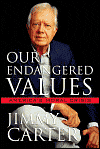
Jimmy Carter's 20th book is a tedious meditation about the appropriate uses of moral values in political life--as wisely and humbly exemplified by Himself--and of their misuses under the current Bush administration.
But tedious isn't quite the right word here, because it suggests mere boredom while Mr. Carter's prose manages to be irritating as well. Is there an English-language equivalent to the German Rechthaberei, which loosely translates as the state of thinking and behaving as if you're in the right and everyone else is in the wrong? Yet even such a term doesn't quite capture the sanctimony, the self-congratulation, the humorlessness, the convenient factual omissions and the passive-aggressive quirks that characterize our 39th president's aggressively passive world view. Mr. Carter is sui generis. He deserves his own word.
So, you will agree that he seems to seriously dislike the book, yes? Not to mention the author? Try to put that to the side for now, please...

Our Endangered Values: America's Moral Crisis
...because here comes the part that caught my eye, perhaps because Latin America is in the news right now, or perhaps because I recently read a dynamite speech about the amazing transformation of El Salvador. In any case, the following part of Stephen's review jumped out at me (emphasis added):
Everything about "Our Endangered Values" is wrong, beginning, obviously, with the title. The values Mr. Carter says are "ours" are certainly not mine and probably not yours and therefore, necessarily, not ours. In fact, it is not at all obvious that the things Mr. Carter speaks of even qualify as values, properly speaking, unless you believe that "economic justice" is a value, or you subscribe to Marxist liberation theology (Mr. Carter considers the Catholic priests who practiced this theology to be "heroes"), or you would like to pay your "personal respects" to Syria's dictator (never mind that he just had the prime minister of Lebanon assassinated), or you can think of nothing bad to say about Saddam Hussein except, perhaps, that he is "obnoxious."
How very odd, I thought, that I would read about long-discredited (or I thought it was long discredited) liberation theology in two places at nearly the same time, but coming from entirely different directions. This passage from a speech by former President of El Salvador Francisco Flores was still in my head:
El Salvador was destroyed by 13 years of unremitting violence. Every Salvadoran family had to mourn the loss of at least one of its members. One third of the population fled to neighboring countries. Its infrastructure was devastated, with no resources to reconstruct itself, and more than half of its population lived under the poverty line. At the end of the war in 1992, El Salvador seemed hopeless...
I say hopeless in a literal sense. At the beginning of the war, El Salvador was a deeply Catholic country. However, led by revolutionary priests beginning in the 1970s, important sectors of the Church embraced liberation theology. The Bible was read as a political program that justified armed insurgency. Christ’s teachings were used to justify terrorism.As they sought the protection of the Church in their need for spiritual comfort, our campesino families found that the pulpit had become one more source of violence. They were asked to hate, and told to act violently.
They did neither. These campesinos searched for Christ’s teachings elsewhere. I remember them walking through the narrow pathways of our mountains in those terrible days. The men wore long sleeved white shirts and black trousers, the women long skirts and their hair under white veils. If the guerrillas or the army stopped them, these humble people held a Bible up to the gun barrels that were pointed at them. They were courageous in their silence and though greatly vulnerable, they were immensely dignified. Never in my life have I been prouder to be a Salvadoran.
Well. I guess you can see why I found the contrast jarring.
I am inclined to be more impressed with Flores than Carter, for what it's worth.
Related previous post: Commentary: El Salvador's Secret: Freedom and Opportunity Cure Poverty
Books and Culture's Book of the Week: The Sinister Way
Despite its foreboding title and evident academic audience, von Glahn's treatment of Chinese religion offers a wealth of information and insight to general readers as well as to students of Chinese culture. To explain the rise and transformation of one prominent cult--that of Wutong, a precursor to the smiling face we see today--the author ranges widely throughout Chinese history. The end product is a general overview of popular Chinese religion from earliest times to the present.
After a succinct and critical review of recent theories of traditional Chinese religion, von Glahn traces the development of Chinese "vernacular" religion from the Shang Dynasty up to the 20th century. Such a survey complements the usual treatments, which neatly separate Confucian, Buddhist, Daoist, and "popular" beliefs and practices.
In particular, von Glahn traces the vicissitudes of what he terms "the sinister way." This menacing phrase refers to the "dark side" of Chinese religion. While some objects of worship, such as the Goddess of Mercy (Guanyin), represent nothing but benignity and kindness, others, such as Wutong, display a propensity for malice.
Full review (Christianity Today)
To order, or for more information from Barnes & Noble, click the book cover below.

The Sinister Way: The Divine and the Demonic in Chinese Religious Culture